
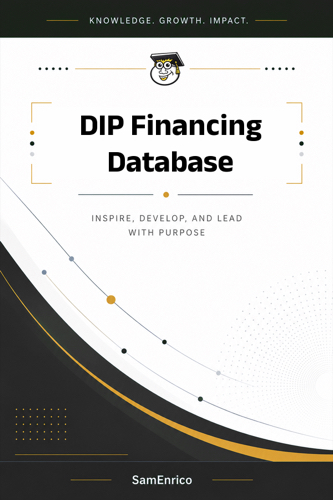
DIP Financing Database eBook
Documents debtor-in-possession loan structures and
Documents debtor-in-possession loan structures and priming liens.
Formats
Free sample
Chapter 1: The Breathing Spell--–- On a cold October morning in 1978, a single piece of legislation quietly rewrote the rules of American capitalism. The Bankruptcy Reform Act did not make headlines. It did not trigger protest marches or corporate lobbying campaigns. But within its 400-plus pages, buried beneath procedural language and jurisdictional definitions, lay a provision that would forever change the balance of power between distressed companies and the lenders who could save them—or bury them. That provision created what we now call debtor-in-possession financing, and it introduced a concept so radical that its full implications took decades to unfold: the breathing spell.Before the Bankruptcy Code of 1978, a company in financial distress had few options beyond liquidation.
The old equity receivership system, inherited from nineteenth-century railroad bankruptcies, placed the company under court-appointed receivers who answered first to secured creditors. There was no automatic stay as we know it today. There was no mechanism for a debtor to remain in control. And most critically, there was no statutory framework that allowed a struggling company to borrow money after filing for protection. If you filed for bankruptcy, your access to credit died instantly, and with it, any realistic chance of reorganization.The breathing spell changed all of that.
Embedded in Section 362 of the new Code, the automatic stay froze all collection actions, foreclosures, and lien enforcement the moment a petition was filed. For the first time, a debtor had room to breathe—hence the name that practitioners quickly adopted. But the drafters of the Code understood something that their predecessors had missed: breathing is useless without fuel. A company that cannot pay its suppliers, meet payroll, or keep the lights on will die regardless of how many lawsuits are stayed. The breathing spell needed a companion.
That companion was Section 364, the statutory heart of debtor-in-possession financing.This chapter establishes the foundational legal and historical context for every concept that follows in this book. Understanding why DIP financing exists—and why it takes the specific forms it does—requires a journey through nearly a century of bankruptcy law, from the Great Depression-era Chandler Act to the leveraged buyout excesses of the 1980s to the game-changing amendments of BAPCPA in 2005. More importantly, this chapter provides the statutory map that will guide you through every subsequent discussion of priming liens, adequate protection, intercreditor disputes, and enforcement remedies. By the time you finish this chapter, you will not only know what Section 364 says—you will understand why it says it, and how courts have interpreted its provisions in ways that continue to evolve today.The Pre-Code Era: Bankruptcy as Liquidation, Not Reorganization To appreciate the innovation of DIP financing, you must first understand the nightmare that preceded it. The Bankruptcy Act of 1898, which governed American insolvency for eighty years, was designed for an industrial economy of railroads, steel mills, and textile factories.
Its primary mechanism was liquidation: a trustee would take control of the debtor's assets, sell them off, and distribute the proceeds to creditors according to statutory priority. There was no expectation that a company would continue operating after filing. The very concept of "reorganization" was an afterthought, bolted onto the 1898 Act through a series of patchwork amendments, most notably Section 77B in 1934 and the Chandler Act in 1938.The Chandler Act represented the first serious attempt to create a reorganization culture in American bankruptcy. It introduced Chapter X for large public companies and Chapter XI for smaller businesses, along with Chapter XII for real property arrangements. But despite these innovations, the Chandler Act retained a fundamental assumption that would prove crippling: the debtor could not borrow new money after filing without court approval, and even with approval, any post-petition lender could only obtain a junior lien subordinate to all pre-petition secured claims.
In practical terms, this meant that no rational lender would extend credit to a Chapter X debtor. Why would a bank lend money when its collateral position was automatically inferior to every pre-existing lienholder?The result was a system that systematically starved reorganization efforts. Debtors that filed for protection under Chapter X or Chapter XI found themselves unable to finance operations, pay critical vendors, or maintain inventory. The few companies that successfully reorganized did so only because they had enough cash on hand at the time of filing to survive the entire process—a luxury that most distressed companies did not enjoy. For everyone else, the act of filing for bankruptcy was effectively a death sentence.
The breathing spell was not yet law, but even if it had been, it would have been irrelevant. You cannot breathe if someone is holding a pillow over your face.This historical failure set the stage for the most important bankruptcy reform in American history. By the mid-1970s, it was clear to every serious observer that the Chandler Act had outlived its usefulness. The Commission on the Bankruptcy Laws of the United States, appointed by Congress in 1970, spent three years studying the system and issued a report in 1973 that was scathing in its assessment. The existing law, the Commission wrote, was "antiquated, overly complex, and insufficiently responsive to the needs of debtors and creditors." Among its many recommendations was a simple but revolutionary idea: a debtor in bankruptcy should be able to borrow money on a secured basis, and that security interest should be capable of priming—that is, jumping ahead of—existing liens under certain carefully defined circumstances.Congress took the Commission's recommendation seriously.
After five more years of hearings, drafting, and lobbying, the Bankruptcy Reform Act of 1978 emerged. Title 11 of the United States Code was rewritten from scratch. Section 362 created the automatic stay—the breathing spell in its purest form. And Section 364 created the statutory framework for DIP financing that remains in place today, with only modest amendments over the subsequent four decades.Section 364: The Four Tiers of Post-Petition Financing Section 364 is not a long statute. In its entirety, it runs fewer than 500 words.
But those words create a hierarchy of borrowing authority that every distressed finance professional must internalize. The statute establishes four distinct tiers of post-petition financing, each with increasing levels of security and correspondingly higher burdens of proof for the debtor seeking approval.Tier One: Ordinary Course Borrowing Under Section 364(a) and (b)The simplest form of DIP financing requires no court approval at all. Under Section 364(a), a debtor may obtain unsecured credit in the ordinary course of business as an administrative expense. This means that if a debtor needs to purchase inventory from a supplier on net-30 terms, or obtain routine trade credit, it can do so without filing a motion or seeking a court order. The debt incurred will be treated as an administrative expense under Section 503(b)(1), which means it must be paid in full before any general unsecured claims receive a distribution.Section 364(b) adds a modest variation: credit obtained outside the ordinary course of business may also be approved on an unsecured administrative expense basis, but this requires court approval.
In practice, Section 364(b) is rarely used because lenders almost always demand security. The real action begins at Tier Two.Tier Two: Administrative Expense Priority Under Section 364(c)(1)The first escalation comes in Section 364(c)(1).…
This is the end of the free sample. Get the eBook to keep going. Buy now
About this book
Details
- Author
- Solum Matthew
- Publisher
- SamEnrico
- Language
- English
- Genre
- Non-Fiction, Capital & Valuation Register
- Released
- 2026-06-10
- Pages (approx.)
- 138
- Available as
- eBook, Audiobook

Read better in the ZLOADR app
Your eBooks on your phone or tablet. Sign in with your SamEnrico account and start reading.
More by Solum Matthew
 IBS Peppermint Oil GuideSolum Matthew$11.99
 The Night Eating Syndrome SolutionSolum Matthew$11.99
 Compulsive Spending for AccountantsSolum Matthew$11.99
 The Dragon's Hoard: Saint George and the Forgotten PactSolum Matthew$11.99
 Temporary Sales AssociateSolum Matthew$11.99
 How to Produce AnkletsSolum Matthew$11.99
 Occupation List Decoder for StudentsSolum Matthew$12.99
 Ultimate Handbook Guide to El Paso : (United States) Travel GuideSolum Matthew$11.99
You may also like
 Distressed LBO StructureCrowl Raymond$11.99
 Exit Financing GuidePrimavera Lesli$11.99
 Debt Service Coverage RatiosLeone Queen$11.99
 Catch Up Provision DBDerr Samual$11.99
 Leveraged ESOP GuideErickson Archie$11.99
 Debt Buyback DatabaseStrand Penney$11.99
 Deal By Deal ModelMontana Glenn$11.99
 Buy and Build HandbookScoggins Elissa$11.99
 Leverage Covenant DatabaseFiore Lea$11.99
 Rollover Option DatabaseGreenberg Weldon$11.99
 TVPI Database GuideQuintanilla Hilde$11.99
 RVPI Residual Value DBBegay Bella$11.99