
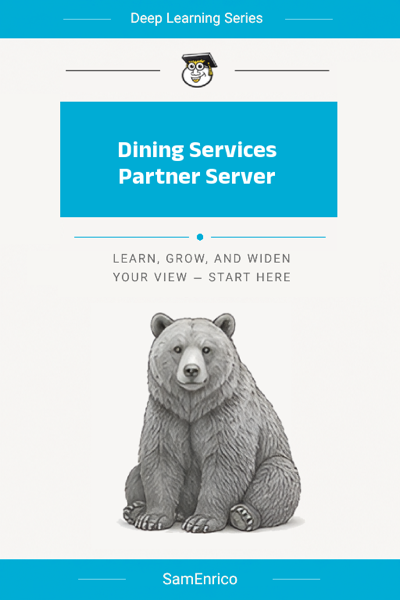
Non-FictionInformativeEducational
Dining Services Partner Server eBook
A Coursebook on Dining Services Partner Server
A Coursebook on Dining Services Partner Server
Formats
Free sample
Chapter 1: Beyond the Tray--–- Most servers enter the dining room carrying two things: a tray of food and a quiet belief that they have no real power. They believe the chef controls the food, the manager controls the floor, the host controls the seating, and the guest controls the tip. Their job, in this view, is simply to execute – to carry, to pour, to nod, to run. This chapter exists to destroy that belief permanently.The thesis of this entire book rests on a single, uncomfortable truth: the server has more influence over a restaurant’s financial success than the chef does. Not equal influence.
More. A brilliant meal ruined by indifferent service becomes a one-star review. A mediocre meal rescued by exceptional service becomes a loyal regular. The difference between those two outcomes is not the food. It is the person standing between the kitchen and the table – you.This chapter dismantles the outdated “order-taker” model and introduces the Partner Philosophy.
You will learn why viewing yourself as a strategic partner – not a middleman – changes every decision you make. You will learn how to read a guest’s emotional state in thirty seconds and adapt accordingly. You will learn the mathematics of loyalty and why a five percent increase in guest retention can boost profits by twenty-five to ninety-five percent. And you will confront the central tension of modern hospitality: the Partner’s Dilemma, or how to sell without sacrificing trust.By the end of this chapter, you will never carry a tray the same way again.The Order-Taker’s Funeral Let us begin with an autopsy. The order-taker model emerged in the mid-twentieth century when restaurants operated like factories.
The kitchen produced; the dining room consumed; servers functioned as conveyor belts. Management measured success by table turns per hour, not guest satisfaction per visit. Training consisted of memorizing menu codes and learning to balance three plates on one arm. Emotional intelligence was not a job requirement. It was not even discussed.That model is dying.
Not because restaurants have become kinder, but because customers have become smarter. Diners today arrive with food allergies, dietary restrictions, Yelp memories, and zero tolerance for indifference. They have eaten in Tokyo, Paris, and Brooklyn. They know the difference between a genuine welcome and a scripted greeting. They can smell apathy from across the room.The order-taker survives by hiding behind systems: “I just work here.” “The kitchen is backed up.” “That is not my section.” These phrases are not excuses.
They are confessions of powerlessness. And powerlessness, in hospitality, is a self-fulfilling prophecy. When you believe you cannot affect the outcome, you stop trying. When you stop trying, guests leave unhappy. When guests leave unhappy, tips shrink.
When tips shrink, you believe even more strongly that you have no power.This book proposes a different loop.The Partner Philosophy Defined A partner server is someone who treats every shift as a co-production. You are not carrying out someone else’s vision. You are co-creating the guest’s experience alongside the chef, the host, the bartender, and the busser. This means four specific shifts in mindset.First, partners own problems instead of passing them. When a guest receives the wrong dish, the partner does not say “I will get the manager.” The partner says “I will fix this right now,” and then fixes it within the limits of their authority – or escalates with a solution already in hand.
The difference is linguistic but transformative. “I will get the manager” hands off responsibility. “I will fix this” claims it.Second, partners think in systems, not tasks. The order-taker asks “What do I need to do next?” The partner asks “How does everything fit together? Where are the bottlenecks?
What can I do two minutes from now to prevent a five-minute delay later?” This forward-looking orientation distinguishes competent servers from exceptional ones. It is the difference between reacting and orchestrating.Third, partners measure success by guest retention, not just check average. An order-taker celebrates a 200table.Apartnercelebratesa200 table. A partner celebrates a 200table.Apartnercelebratesa200 table that books a reservation for next month. The partner knows that the lifetime value of a regular customer far exceeds any single meal’s revenue.
This knowledge changes behavior at the margins: partners do not rush the check, do not hover, do not upsell aggressively. They play the long game.Fourth, partners align with the kitchen instead of resenting it. The order-taker views BOH as an obstacle – slow, forgetful, careless. The partner views BOH as a collaborator. They learn the line cooks’ names.
They bring them water on hot shifts. They communicate dietary restrictions clearly and thank the team after a rush. This alignment pays dividends when mistakes happen. A partner who has built goodwill receives faster remakes, fewer arguments, and better information.The Thirty-Second Scan Emotional intelligence is not a soft skill. It is a hard skill that happens to involve emotions.
And like any hard skill, it can be practiced, measured, and improved.The thirty-second scan is the partner’s first tool. Within thirty seconds of approaching a table – ideally while the guests are still removing their coats or settling into chairs – you must identify four things: the party’s primary emotional state, their urgency level, their social dynamic, and their hospitality preference.Emotional states fall into five common categories. Celebratory guests laugh, touch each other’s arms, order champagne, and take photos. They want energy, enthusiasm, and permission to be loud. Stressed guests check watches, make phone calls, apologize to each other, and order quickly.
They want speed, brevity, and zero small talk. Romantic guests sit close, speak quietly, maintain eye contact, and ignore phones. They want privacy, slow pacing, and deferential attention – approachable but not intrusive. Business guests discuss contracts, open laptops, use surnames, and sit across from each other. They want efficiency, accuracy, and a quiet word about the check before it arrives.
Grieving guests – present after funerals or losses – speak in low tones, order less food, and sometimes cry. They want gentleness, space, and no forced cheerfulness.Urgency level is visible in posture and props. Guests who need to eat and leave within forty-five minutes have flat menus, closed body language, and phones face-up on the table. Guests who plan to linger have open menus, leaned-back postures, and drinks ordered before food. When urgency and emotional state conflict – a stressed celebratory guest, for example – urgency wins.
Speed first, warmth second.Social dynamics reveal who holds decision-making power. At a four-top, the person who orders first, asks questions, and waves down the server is usually the host. At a two-top, the person who faces the room rather than the wall often holds higher status. At any table, the person who pays is not always the person who decides. Partners identify the decision-maker within the first minute and direct menu descriptions, recommendations, and check delivery accordingly.Hospitality preference is the ghost/friend distinction introduced here and explored fully in Chapter 5.
Ghost guests want minimal interaction – water, order, food, check, goodbye. Friend guests ask about your day, share personal stories, and invite conversation. The partner adapts instantly. Ghosts receive professional distance; friends receive warmth. The…
This is the end of the free sample. Get the eBook to keep going. Buy now
About this book
Details
- Author
- Timm Rasheeda
- Publisher
- SamEnrico
- Language
- English
- Genre
- Non-Fiction, Informative, Educational
- Released
- 2026-05-08
- Pages (approx.)
- 131
- Available as
- eBook, Audiobook

Read better in the ZLOADR app
Your eBooks on your phone or tablet. Sign in with your SamEnrico account and start reading.
More by Timm Rasheeda
 NuvaRing Removal EffectsTimm Rasheeda$11.99
 Networking for the Temporarily UnemployedTimm Rasheeda$11.99
 Gut Brain Axis and ObesityTimm Rasheeda$11.99
 Forgiveness of Others GuideTimm Rasheeda$11.99
 The Leshy's Labyrinth: Guardian of the Forbidden ForestTimm Rasheeda$11.99
 How to Produce BasketsTimm Rasheeda$11.99
 Chinese Student Progress TrackingTimm Rasheeda$12.99
 How to Start a Bolognas Business (Beginners Guide)Timm Rasheeda$11.99
You may also like
 Hong Kong Handover 1997Dunn Johnnie$11.99
 Zumba For Postnatal Recovery CourseNeal Christian$11.99
 Zumba for BeginnersLadner Nikia$11.99
 YouTube Comment Mining GuideHumes Pandora$12.99
 Worry Box MeditationCarlin Rudy$11.99
 Workplace Stress MeditationNguyen Lynn$11.99
 Workplace Stress and Sleep RepairHawley Ivory$11.99
 Workplace Perfectionism CureDelaney Jeffry$11.99
 Workplace Injustice Anger GuideWallen Isabelle$11.99
 Work Addiction and Burnout LinkGreenwood Ester$11.99
 Women in Yoga and WellnessBeattie Galina$11.99
 Women in Stand Up ComedyChun Evangeline$11.99