
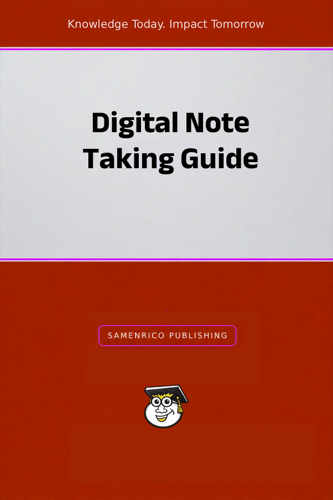
Digital Note Taking Guide eBook
Use apps like Notion, OneNote, or Evernote for sea
Use apps like Notion, OneNote, or Evernote for searchable study materials.
Formats
Free sample
Chapter 1: The 47-Minute Loss--–- The fluorescent lights of the university library hummed their usual funeral dirge at 2:00 AM. Sarah, a third-year pre-med student, had been staring at her laptop screen for forty-seven minutes. Not studying. Not writing. Searching.
She knew the quote existed. Professor Martinez had said it during Week 3: something about dopamine receptors and addiction pathways. She had written it down. She was certain. The problem was that she had written it down somewhere inside one of twelve notebooks, three different note-taking apps, forty-two loose PDFs, and a growing collection of screenshots that lived in a folder simply labeled "School Stuff."She tried the blue notebook first.
No. The green one? No. The app she had used for the first two weeks of the semester before switching to a different one? She couldn't even remember which app that had been.
She scrolled through her camera roll, squinting at photos of whiteboards she had taken in September. She opened Evernote, then Notion, then One Note, then back to Evernote. She searched for "dopamine" and got thirty-seven results, none of which were the quote she needed. She searched for "addiction." Nothing. She searched for "Martinez said." Twenty-three results, all from Week 10 onward.Forty-seven minutes.
That was not hyperbole. Sarah had looked at the clock when she started and looked again when she finally gave up. Forty-seven minutes of her life, gone. Not just wasted—consumed. That was time she could have spent reviewing for the exam.
Time she could have slept. Time she could have done literally anything else. Instead, she had re-learned a painful truth that most students discover eventually: taking notes is not the same as having notes. You can write down every word a professor says, but if you cannot find those words when you need them, you might as well have been staring out the window.This book exists because of Sarah. And because of the thousands of students just like her who have internalized a terrible lie about how learning works.The Lie You Have Been Told The lie is this: if you take good notes during class, you will succeed.
The corollary to this lie is that "good notes" means complete, linear, chronological transcriptions of everything the professor said, written neatly, preferably color-coded, and organized into meticulously labeled folders.This is nonsense.Let me say that again with full conviction: the traditional approach to note-taking is fundamentally, demonstrably wrong for the way human brains actually retrieve information. The proof is sitting in your own experience. Think back to the last time you lost a note. Perhaps it was a brilliant idea you had in the shower, scribbled on a post-it that vanished into the void. Perhaps it was a PDF your professor emailed that you saved to your desktop (or your Downloads folder, or your i Cloud Drive, or your Google Drive—you have six places you save things, don't you?).
Perhaps it was a quote from a textbook that you highlighted, but now you cannot remember which chapter, which book, or even which class.The feeling that follows—that low-grade panic mixed with self-recrimination—is not a character flaw. It is not a sign that you are disorganized or lazy or not cut out for academic work. It is a sign that you have been using a system designed for physical paper in a digital world, and those two things do not play well together.Here is what I mean by that.Location-Based Memory vs. Semantic Memory Your brain has two fundamentally different ways of remembering where information lives. The first is called location-based memory.
This is the ancient, primal system that helped your ancestors remember where the berry bushes were, which cave entrance led to shelter, and which path avoided the predator's territory. Location-based memory is powerful and automatic. You do not have to try to remember where your bed is. You just know. If someone asks you where you left your keys, you mentally walk through your apartment.
You see the counter, the couch, the hook by the door. You are using location.The second system is semantic memory. This is the newer, more abstract system that stores facts, concepts, and meanings independent of where you learned them. You know that Paris is the capital of France. You do not need to remember the specific textbook page or lecture where you learned that.
The fact has detached from its origin. Semantic memory is what allows you to use information flexibly, to apply concepts to new situations, and to synthesize ideas across different domains.Here is the problem. Physical notebooks and paper files are designed for location-based memory. You put your chemistry notes in the blue notebook, and you remember that the Krebs cycle is on page 47, about halfway down, near the coffee stain. That works—until you have twelve notebooks.
Until you take notes on loose paper. Until you switch to a digital app but keep printing things out. Until your location-based memory simply cannot hold all the locations anymore.Digital search, on the other hand, is designed for semantic memory. When you type a word into a search bar, the computer does not care where the note is stored. It does not care about notebooks, page numbers, or folder hierarchies.
It scans the content of every single note and returns only the ones that contain that word. This is not just faster. It is fundamentally different. It is a different way of relating to your information.And most students are not using it.Most students are still organizing their digital notes as if they were paper. They create folders.
They subdivide folders into subfolders. They color-code. They spend hours building elaborate hierarchies that they will never use because searching is faster—if they have set up their notes to be searchable in the first place.The Hidden Cost of the Lost Note Sarah lost forty-seven minutes. That is the visible cost. But there is a hidden cost that is far more damaging, and it is this: every time you fail to find a note, you lose not just time but also trust in your own system.
You begin to doubt whether taking notes is even worth it. You start saving things in multiple places "just in case," which creates more clutter and makes the problem worse. You develop workarounds that are themselves inefficient, like re-taking notes on material you already covered because you cannot find your original notes.This phenomenon has a name in cognitive psychology: the retrieval-induced forgetting loop. When you cannot find information, you are forced to re-learn it. Re-learning takes longer than finding would have taken.
But because you spent that time re-learning, you have less time to review new material. That new material is therefore less likely to stick. And so the cycle continues, each semester harder than the last, not because the material is harder (though it often is) but because your foundation is built on sand.I have worked with students who had perfect GPAs in high school but crashed in college. Not because they were less intelligent. Not because they did not study.
But because they were drowning in their own notes. They had never been taught how to build a digital system…
This is the end of the free sample. Get the eBook to keep going. Buy now
About this book
Details
- Author
- Wingfield Ara
- Publisher
- SamEnrico
- Language
- English
- Genre
- Non-Fiction, Self-Help, Digital Tools
- Released
- 2026-06-10
- Pages (approx.)
- 142
- Available as
- eBook, Audiobook

Read better in the ZLOADR app
Your eBooks on your phone or tablet. Sign in with your SamEnrico account and start reading.
More by Wingfield Ara
 Twelve Step Prayer and MeditationWingfield Ara$11.99
 Oppenheimer’s Los Alamos AssemblersWingfield Ara$11.99
 Esports Betting CompulsionWingfield Ara$11.99
 Cuban Camp To Miami LifeWingfield Ara$11.99
 The Study Space SanctuaryWingfield Ara$11.99
 Rumination Cessation GuideWingfield Ara$11.99
 Disappointment In GrandchildrenWingfield Ara$11.99
 Advanced Sleep Phase Syndrome HelpWingfield Ara$11.99
 Boxer Uprising: China's Last Imperial RebellionWingfield Ara$11.99
 Whispers of the Forbidden LibraryWingfield Ara$11.99
 The Composer’s Redemption: How a Fallen Star Reclaimed His SymphonyWingfield Ara$11.99
 Understanding Arroyo–Garcia–cimadevilla SyndromeWingfield Ara$17.99
You may also like
 Slack Collaboration GuideHendricks Erlinda$11.99
 Digital Calendar Mastery CoursePaxton Jesica$11.99
 The Team Digital WhiteboardPinto Lang$11.99
 Social Media Site BlockersWhaley Cherly$11.99
 Remote Tool Stack CommunicationHigginbotham Ila$11.99
 Digital Calendar Time BlockingMcelroy Yolonda$11.99
 Virtual Whiteboard ToolsGoldsmith Dung$11.99
 Family Calendar Sync GuideEldridge Lanie$11.99
 Digital Palace AppsPritchett Jalisa$11.99
 Digital Dream JournalingLindsay Arnette$11.99
 Workplace Stress App ToolkitTejada Dina$11.99
 Sex Addiction And Porn Filters Technology GuideClifford Talisha$11.99