
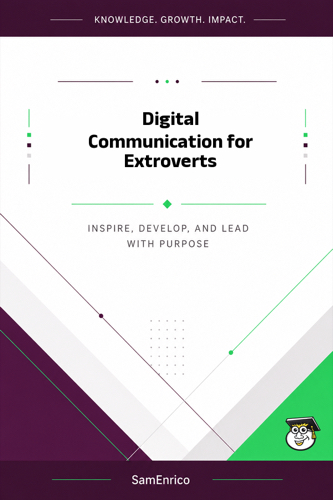
Digital Communication for Extroverts eBook
Adapts social energy to remote settings.
Adapts social energy to remote settings.
Formats
Free sample
Chapter 1: The Social Battery--–- It was 10:47 on a Tuesday morning, and Sarah had just finished her third Zoom call of the day. She was exhausted. Not the kind of tired that comes from solving hard problems or working long hours. The kind of tired that comes from sitting perfectly still while your brain screams for something it cannot find. She had presented slides, nodded at rectangles, and laughed at jokes that landed in silence.
When she closed her laptop, her home office felt like a tomb. She wanted to call someone. Anyone. But her calendar showed back-to-back meetings until 4 p.m. She was surrounded by people all day and had never felt more alone.Sarah is not an introvert pretending to be an extrovert.
She is not shy. She does not have social anxiety. In the old world—the world of conference rooms, hallway collisions, and impromptu lunch outings—Sarah was the person everyone wanted on their team. She brought the energy. She asked the questions others were afraid to ask.
She made the quiet people feel seen. But remote work has turned her superpower into a liability, and she cannot figure out why.This chapter is for Sarah. And for every extrovert who has ever ended a day of video calls feeling like they ran a marathon and lost.We are going to name the invisible problem that most remote work advice ignores. We are going to give you a language for what you are feeling. And we are going to set the foundation for everything that follows in this book—not by telling you to become quieter or smaller, but by teaching you to understand the unique way your brain consumes and expends social energy.The Myth of Zoom Fatigue By now, almost everyone has heard of "Zoom fatigue." The term entered our collective vocabulary sometime in 2020, and it has been used to describe everything from eye strain to existential dread.
But here is the problem: most explanations of Zoom fatigue are wrong for extroverts.The conventional wisdom says that video calls exhaust us because we are forced to stare at our own faces, process too many non-verbal cues at once, and maintain unnatural eye contact. Researchers have pointed to "mirror anxiety" (the discomfort of watching yourself perform), "cognitive load" (the extra effort required to interpret digital body language), and "locked-in posture" (the fact that we cannot pace or move freely during video calls). All of these are real. All of them affect everyone.But they miss the central problem for extroverts.For an introvert, a day of Zoom calls is exhausting because it is too much social interaction. Their battery drains from the constant demand to perform, react, and engage.
For an extrovert, a day of Zoom calls is exhausting for the opposite reason. It is not too much interaction. It is not enough. Your battery is not drained by the effort of performing. Your battery is drained by the absence of authentic connection.Let me say that again because it is the most important sentence in this chapter.You are not tired because you worked too hard.
You are tired because your brain is starved of the social fuel it runs on.This is not a metaphor. It is a biological reality. And understanding it is the first step toward fixing everything.Social Energy Expenditure Theory Every human being has what psychologists call a "social energy budget." You wake up with a certain amount of energy to spend on interaction. Every conversation, every meeting, every casual hello withdraws a little from that budget. When the budget runs out, you feel depleted.
You need solitude to recharge.Here is the critical difference: introverts and extroverts have opposite accounting systems.For introverts, most social interactions are withdrawals. A meeting costs energy. A networking event is expensive. Even a friendly chat with a colleague takes something out of the tank. Introverts recharge by being alone.
Solitude is a deposit.For extroverts, most social interactions are deposits. A good meeting gives you energy. A lively conversation fills your tank. Even small talk with a stranger can leave you feeling more alive. Extroverts recharge by being with other people.
Solitude is a withdrawal.This is not a preference. It is not a choice. It is a neurological difference rooted in how your brain processes dopamine and responds to external stimulation. Extroverts have a higher baseline arousal level, which means they need more external stimulation to reach an optimal state. Introverts have a lower baseline arousal level, which means they need less.Now here is where remote work breaks the extrovert brain.In a physical office, you are constantly making small deposits.
The nod from a colleague as you pass in the hallway. The laugh you share at the coffee machine. The five minutes of joking before a meeting starts. The spontaneous brainstorming session that turns into a solution. These moments are not distractions.
They are the ambient trickle charger that keeps your social battery full.Remote work removes all of that. You sit alone. You stare at a screen. You join calls that are structured, timed, and often silent between talking turns. The ambient deposits are gone.
And in their place, you are left with something far more draining: the performance.Performance vs. Connection Here is the distinction that will change how you think about every video call you will ever take.Performing is what you do when you are trying to be seen, heard, and approved of. You are aware of the camera. You are monitoring your own face. You are waiting for reactions that never come.
You are trying to be interesting, competent, and likable all at once. Performing takes energy. A lot of it.Connecting is what you do when you are genuinely present with another person. You are not trying to impress. You are not monitoring yourself.
You are curious about the other person. You are responding in real time to real cues. Connecting gives energy. It fills your tank.Here is the cruel irony of remote work: most video calls force extroverts into a state of pure performance while offering almost none of the rewards of connection.Think about the last Zoom call you were on. Were you truly connecting with anyone?
Or were you taking turns talking while staring at a grid of faces that rarely showed genuine emotion? Did anyone laugh the way they would in a room? Did anyone interrupt with excitement? Did anyone finish someone else's sentence? Probably not.
Because the medium does not allow it. The slight delay makes interrupting feel awkward. The small screen makes body language hard to read. The awareness of being recorded makes spontaneity feel risky.So you perform. You sit up straight.
You modulate your voice. You remember to nod. You wait for your turn to speak. And at the end of the call, you feel hollow. Not because you talked too much.
Because you never really connected at all.This is the silent crisis for extroverts in remote work. And most people do not even have the language to describe it. They just know they feel terrible at the end of the day and cannot…
This is the end of the free sample. Get the eBook to keep going. Buy now
About this book
Details
- Author
- Mcclain Porsche
- Publisher
- SamEnrico
- Language
- English
- Genre
- Non-Fiction, Self-Help, Extrovert
- Released
- 2026-06-08
- Pages (approx.)
- 141
- Available as
- eBook, Audiobook

Read better in the ZLOADR app
Your eBooks on your phone or tablet. Sign in with your SamEnrico account and start reading.
More by Mcclain Porsche
 Pickleball Hypnosis GuideMcclain Porsche$11.99
 Desert Night StargazingMcclain Porsche$11.99
 Moonlit Beach VisualizationMcclain Porsche$11.99
 The Writer Focus GuideMcclain Porsche$11.99
 Self Talk for ParentingMcclain Porsche$11.99
 Boxer's Self Hypnosis GuideMcclain Porsche$11.99
 The Senior Hope GuideMcclain Porsche$11.99
 The Last Oracle of Delphi: Secrets of the Ancient PriestessesMcclain Porsche$11.99
 The Shadow of the White Queen: The Assassination That Sparked a Cartel WarMcclain Porsche$11.99
 How to Produce Pizza PansMcclain Porsche$11.99
 How to Produce Diaper Rash TreatmentMcclain Porsche$11.99
 A Collector's Handbook to the Wolseley 60 Series IiiMcclain Porsche$11.99
You may also like
 Hong Kong Handover 1997Dunn Johnnie$11.99
 Zumba For Postnatal Recovery CourseNeal Christian$11.99
 Zumba for BeginnersLadner Nikia$11.99
 YouTube Comment Mining GuideHumes Pandora$12.99
 Worry Box MeditationCarlin Rudy$11.99
 Workplace Stress MeditationNguyen Lynn$11.99
 Workplace Stress and Sleep RepairHawley Ivory$11.99
 Workplace Perfectionism CureDelaney Jeffry$11.99
 Workplace Injustice Anger GuideWallen Isabelle$11.99
 Work Addiction and Burnout LinkGreenwood Ester$11.99
 Women in Yoga and WellnessBeattie Galina$11.99
 Women in Stand Up ComedyChun Evangeline$11.99