
Non-FictionSelf-HelpDigital Wellness
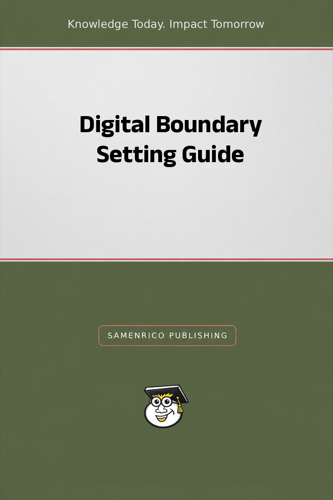
Digital Boundary Setting Guide eBook
Manage work emails after hours, social media deman
Manage work emails after hours, social media demands, and texting expectations.
Formats
Free sample
Chapter 1: The Digital Trespass--The average smartphone user checks their phone once every four minutes of their waking life. That is not a typo. Every four minutes, without thinking, without deciding, without any conscious awareness of having made a choice, you reach for a slab of glass and aluminum and stare at it. Over a sixteen-hour waking day, that is two hundred and forty checks. Over a week, nearly seventeen hundred.
Over a year, almost ninety thousand. And here is the part that should terrify you: you cannot remember ninety-nine percent of them.You cannot remember picking up your phone at a red light. You cannot remember answering that email while your child was telling you about their day. You cannot remember the moment you scrolled past forty-seven Instagram stories while sitting on the edge of your bed at 11:47 PM, exhausted but unable to stop. These moments have vanished from your memory not because you have a bad memory, but because you were never really present for them in the first place.
You were on autopilot. And autopilot leaves no trace.This chapter is about waking up from that autopilot. It is about understanding, for the first time with real clarity, why you feel so exhausted despite doing nothing, why you feel so connected yet so alone, and why a device designed to make your life easier has somehow made you its servant. The problem is not that you are weak or undisciplined or addicted in some clinical sense. The problem is much more subtle and much more insidious.
The problem is that the natural boundaries between you and the rest of the world have been silently demolished, and you never noticed until the walls were gone.The Boundary You Didn't Know You Lost Let us go back in time for a moment. Not centuries, just decades. Imagine yourself in the year 1995. You are sitting at your kitchen table, reading a book. The phone rings.
It is attached to the wall by a cord, so you cannot bring it with you. You have a choice: stand up, walk to the phone, and answer it, or let it ring and return the call later. That is the entire interaction. There is no anxiety about missing something important because voicemail exists. There is no guilt about not answering because you were clearly doing something else.
There is no expectation of instant response because instant response was technologically impossible.Now come back to the present. Your phone is on your body right now. You can feel it in your pocket, on your thigh, in your hand. It has followed you into the bathroom, into your bedroom, into the dinner table, into the delivery room, into the funeral home. There is no room in your life that this device does not enter.
There is no moment of solitude it cannot puncture. There is no boundary it cannot cross because, somewhere along the way, you stopped building boundaries and started building a life inside the device itself.This is what I call the Boundary Paradox. Technology has removed the natural friction between wanting something and getting it. In the past, a request could not reach you unless someone drove to your house, mailed a letter, or called your landline during the narrow window when you happened to be home. Every request required effort on the part of the requester.
That effort acted as a filter. Only truly important things survived the filter. Now, everyone’s request enters your pocket instantly, at zero cost to them, at enormous cost to you. We have more access to each other than any humans in history, and yet we have less protection from each other than any humans in history.The result is a strange new form of exhaustion. You are not physically tired.
You have slept enough. You have not run a marathon. But you feel drained, hollowed out, as if something has been slowly siphoning your energy while you weren't looking. That something is your attention. And it has been stolen from you thousands of times today alone.The Moment It Crosses the Line Let me introduce you to a concept that will appear throughout this book.
I call it the Digital Trespass.Imagine you are sitting in your living room. The door is closed. You are reading, or talking to your partner, or simply staring out the window, thinking about nothing in particular. Now imagine that a stranger walks through your front door without knocking, stands in the middle of your living room, and says nothing. They just stand there, waiting.
How would that feel? Violating, certainly. Unsettling. Maybe even frightening. You would not tolerate it for a second.
You would demand to know who they were and why they were in your home.Now imagine that same scenario, except instead of a physical stranger, it is a notification. A buzz. A ding. A red badge on an app icon. That notification has just crossed the threshold of your attention without your permission.
It has entered your mental living room, interrupted your train of thought, and demanded that you look at it. And you have been trained to tolerate this thousands of times per day. You have been trained to accept that your mental living room is public property, open to anyone with your email address or phone number or Instagram handle.A Digital Trespass is the moment a notification, email, text message, or direct message crosses your mental property line without your explicit invitation. It feels violating because it is violating. But because the violation is a tiny vibration in your pocket rather than a stranger in your kitchen, you have learned to ignore the feeling.
You have learned to say "it's just a text" or "it's just work" or "it's just my mom checking in." But each one of those "just" moments is a small trespass. And when you add them up over a day, a week, a year, you end up with a life that never fully belongs to you.The goal of this chapter, and this book, is to re-sensitize you to that feeling. I want you to notice the Digital Trespass again. I want you to feel that little spike of violation every time a notification interrupts you without permission. Not because I want you to be angry or anxious, but because you cannot build a fence around your attention until you can feel the boundary being crossed.
You cannot protect a line you cannot see.The Quiet Thief of Your Intelligence Here is where the trespass stops being metaphorical and becomes measurable. A study conducted at the University of California, Irvine, found that after a single interruption, it takes an average of twenty-three minutes to return to the original task with the same level of focus. Twenty-three minutes. That is not a typo. If you check your phone for thirty seconds to answer a text, you have just lost nearly half an hour of productive focus.Let me show you how this adds up.
Imagine you check your phone twenty times a day. That is a conservative estimate for most people. Actually, let me correct that. That is a conservative estimate…
This is the end of the free sample. Get the eBook to keep going. Buy now
About this book
Details
- Author
- Thrash Wilmer
- Publisher
- SamEnrico
- Language
- English
- Genre
- Non-Fiction, Self-Help, Digital Wellness
- Released
- 2026-06-06
- Pages (approx.)
- 133
- Available as
- eBook, Audiobook

Read better in the ZLOADR app
Your eBooks on your phone or tablet. Sign in with your SamEnrico account and start reading.
More by Thrash Wilmer
 Insulin Resistance Medication GuideThrash Wilmer$11.99
 Remote Employee Monitoring EthicsThrash Wilmer$11.99
 Teresa's Vision of Hell Meditation GuideThrash Wilmer$11.99
 Mortgage Stress Solutions GuideThrash Wilmer$11.99
 The Silent Protocol: The Untold Siege of the 1975 Stockholm Bank HeistThrash Wilmer$11.99
 The Lost Geometry of the Renaissance: How a Forgotten Mathematician Shaped the WorldThrash Wilmer$11.99
 Kanban for HashiCorp StartupsThrash Wilmer$12.99
 AI Art Redbubble Success StoriesThrash Wilmer$12.99
 Understanding EosophobiaThrash Wilmer$17.99
 How to Start a Automobile Association Road Patrols Business (Beginners Guide)Thrash Wilmer$11.99
 Health & Safety CoordinatorThrash Wilmer$11.99
You may also like
 Hong Kong Handover 1997Dunn Johnnie$11.99
 Zumba For Postnatal Recovery CourseNeal Christian$11.99
 Zumba for BeginnersLadner Nikia$11.99
 YouTube Comment Mining GuideHumes Pandora$12.99
 Worry Box MeditationCarlin Rudy$11.99
 Workplace Stress MeditationNguyen Lynn$11.99
 Workplace Stress and Sleep RepairHawley Ivory$11.99
 Workplace Perfectionism CureDelaney Jeffry$11.99
 Workplace Injustice Anger GuideWallen Isabelle$11.99
 Work Addiction and Burnout LinkGreenwood Ester$11.99
 Women in Yoga and WellnessBeattie Galina$11.99
 Women in Stand Up ComedyChun Evangeline$11.99