
Non-FictionHealth & WellnessAnatomy
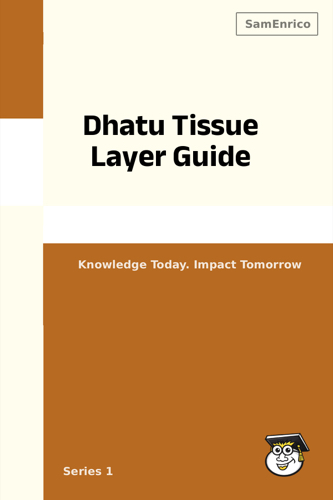
Dhatu Tissue Layer Guide eBook
Explains the seven tissue layers and their nourish
by Heaton Kasie
Explains the seven tissue layers and their nourishment.
Formats
Free sample
Chapter 1: Beyond the Scalpel--–- Imagine for a moment that you are holding a glass of water. You can see it, feel its weight, touch its cool surface. Now imagine that same glass of water after you have drunk it. Where does it go? It becomes part of your blood, your lymph, the moisture on your skin, the fluid inside your joints, the very substance that cushions your brain.
In less than an hour, that water has ceased to be a separate thing and has joined the living river of your body. This simple act of drinking is not just hydration. It is the beginning of a journey through seven invisible landscapes—seven tissue layers that Ayurveda has mapped for over three thousand years. These layers, called the Sapta Dhatu, are not anatomical structures you can dissect with a scalpel. They are metabolic processes you can nourish, imbalance, and heal.
This chapter is your first step into that living river.Most people go their entire lives believing that their body is a collection of separate parts: bones here, muscles there, blood circulating in tubes. This mechanical view has given us remarkable surgical tools and life-saving emergency medicine, but it has also blinded us to something essential. The body is not a machine that breaks down and needs repair. It is a continuous transformation of food, water, air, and experience into living tissue. Every meal you eat, every breath you take, every emotion you feel is being translated into the substance of your seven tissue layers.
Understanding these layers is not an academic exercise. It is the difference between randomly taking supplements and intelligently rebuilding your body from the inside out.The Sanskrit word Dhātu comes from the root dha, which means "to hold, to support, or to nourish." A Dhātu is not merely a tissue in the Western sense—a collection of similar cells performing a function. It is a living, intelligent process of holding the body together while simultaneously nourishing every other part. There are seven Dhātus, and they exist in a precise sequence: Rasa (plasma and lymph), Rakta (blood), Mamsa (muscle), Meda (fat), Asthi (bone), Majja (marrow and nerves), and Śukra (reproductive and creative essence). This sequence is not arbitrary.
It is the metabolic supply chain of your life, and understanding it will change everything about how you approach your health.The Mechanical Lie: Why Your Body Is Not a Machine Let us begin with a hard truth. The way you have been taught to see your body is wrong. Not partially wrong, not metaphorically wrong, but fundamentally and practically wrong. You have been taught that your bones are a frame, your muscles are cables, your blood is a transport fluid, and your organs are pumps and filters. This is the mechanical model, and it has dominated medicine for four hundred years.
It works beautifully for trauma. If you break your arm, a surgeon can set the bone, screw in a metal plate, and restore function. If you have a blocked coronary artery, a cardiologist can snake a stent through your blood vessel and prop it open. These are miracles of mechanical thinking, and we owe them profound gratitude.But the mechanical model fails catastrophically when it comes to chronic illness, metabolic disease, and the slow erosion of vitality. Why?
Because a machine is assembled from parts that do not change. A screw does not become a gear. A gear does not become a belt. Your body, in contrast, is constantly turning one substance into another. The oatmeal you ate for breakfast is now, hours later, glucose in your blood, amino acids in your muscles, and fatty acids in your fat cells.
In a few weeks, some of that oatmeal may become part of your bone matrix. In a few months, it may become part of your nerve sheaths. Your body is not an assembly of parts. It is a river of transformation.Here is the practical consequence of this error. When you go to a doctor with fatigue, brain fog, joint pain, and poor immunity, you will likely be sent to multiple specialists.
A rheumatologist for the joints. A neurologist for the brain fog. An immunologist for the infections. Each specialist will look at their piece of the machine. None of them will look at the metabolic supply chain that connects all of these symptoms.
In the Dhātu model, these seemingly unrelated symptoms are not separate problems. They are the same problem appearing at different points along the seven-tissue cascade. Fatigue and poor immunity point to weak Rasa (plasma). Brain fog and nervous symptoms point to weak Majja (nerve tissue). Joint pain points to weak Asthi (bone).
But the root cause may be upstream—perhaps in Agni, the digestive fire that transforms food into tissue in the first place. You will learn about Agni in Chapter 2. For now, simply understand that the mechanical model breaks the body into pieces. The Dhātu model sees the whole river.The Five Elements: The Alphabet of Your Tissues Before you can understand the seven Dhātus, you must understand their building blocks. Ayurveda teaches that all matter, including your body, is composed of five great elements, called the Panchamahabhuta.
Do not mistake these for the chemical elements of the periodic table. They are not oxygen, carbon, or hydrogen. They are qualities of experience—the fundamental ways that matter manifests. Every tissue in your body contains all five elements, but each tissue has a dominant elemental signature.Earth (Prithvi) is the quality of solidity, stability, weight, and structure. Earth gives your tissues their form.
Without earth, your bones would be jelly, your muscles would have no attachment points, and your cells would have no membranes. Earth is the element of holding—the very meaning of the word Dhātu.Water (Apas) is the quality of fluidity, cohesion, and liquidity. Water allows your tissues to flow, to hydrate, to transport nutrients, and to maintain their shape without being rigid. Your blood, lymph, saliva, and cellular cytoplasm are all manifestations of the water element.Fire (Agni) is the quality of transformation, heat, light, and metabolism. Fire digests your food, converts nutrients into tissue, generates your body temperature, and powers every enzymatic reaction in your body.
Without fire, you would not be able to turn a bowl of rice into your own plasma.Air (Vayu) is the quality of movement, expansion, and vibration. Air moves your blood through your vessels, your nerve impulses along your axons, your breath in and out of your lungs, and your thoughts through your mind. Air is the element of communication between tissues.Ether (Akasha) is the quality of space, emptiness, and potential. Ether is the most subtle element. It is the space within your cells, the space between your joints, the space within your blood vessels, and the space that allows the other four elements to exist and move.
Without ether, there is no container for anything.You do not need to memorize the elemental composition of each tissue today. But you do need to remember one thing: when a tissue is imbalanced, you are not dealing with a deficiency of a chemical. You are…
This is the end of the free sample. Get the eBook to keep going. Buy now
About this book
Details
- Author
- Heaton Kasie
- Publisher
- SamEnrico
- Language
- English
- Genre
- Non-Fiction, Health & Wellness, Anatomy
- Released
- 2026-06-08
- Pages (approx.)
- 159
- Available as
- eBook, Audiobook

Read better in the ZLOADR app
Your eBooks on your phone or tablet. Sign in with your SamEnrico account and start reading.
More by Heaton Kasie
 Shopping Addiction TherapyHeaton Kasie$11.99
 Self Talk for Creatives GuideHeaton Kasie$11.99
 Binge Eating and Perfectionism LinkHeaton Kasie$11.99
 Open Body Language GuideHeaton Kasie$11.99
 High Blood Pressure CausesHeaton Kasie$11.99
 Panic Relapse PreventionHeaton Kasie$11.99
 Canyon Descent ProtocolsHeaton Kasie$11.99
 The Lion’s Ingenuity: Benjamin Banneker’s Astronomical WondersHeaton Kasie$11.99
 The Vanished Vermeer: A Dutch Master’s Midnight EscapeHeaton Kasie$11.99
 A Collector's Handbook to the Ford FalconHeaton Kasie$11.99
 Service Providers Guide to General Cleaning ServicesHeaton Kasie$11.99
 How to Become a Major-assembly InspectorHeaton Kasie$11.99
You may also like
 Hong Kong Handover 1997Dunn Johnnie$11.99
 Zumba For Postnatal Recovery CourseNeal Christian$11.99
 Zumba for BeginnersLadner Nikia$11.99
 YouTube Comment Mining GuideHumes Pandora$12.99
 Worry Box MeditationCarlin Rudy$11.99
 Workplace Stress MeditationNguyen Lynn$11.99
 Workplace Stress and Sleep RepairHawley Ivory$11.99
 Workplace Perfectionism CureDelaney Jeffry$11.99
 Workplace Injustice Anger GuideWallen Isabelle$11.99
 Work Addiction and Burnout LinkGreenwood Ester$11.99
 Women in Yoga and WellnessBeattie Galina$11.99
 Women in Stand Up ComedyChun Evangeline$11.99