
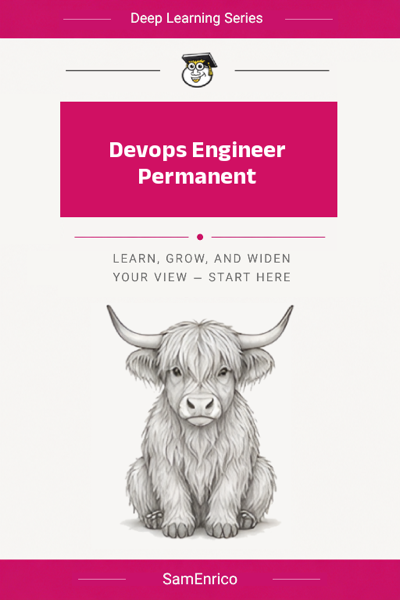
Non-FictionInformativeEducational
Devops Engineer Permanent eBook
A Coursebook on Devops Engineer Permanent
by Carl Madison
A Coursebook on Devops Engineer Permanent
Formats
Free sample
Chapter 1: The Fourth Pager--–- The alert came in at 2:17 AM on a Tuesday. Maya Chen, senior site reliability engineer at Fin Serve Global, had been asleep for exactly ninety-two minutes when her work phone vibrated across the nightstand. She didn't need to look at the screen. She knew the pattern: the frantic buzz of a Pager Duty notification for a critical severity incident. Her third this week.She fumbled for the phone, squinted at the blinding white screen, and read the message: "Production database migration failed.
Checkout service offline. Incident ID: INC-4471." Below it, a Slack message from James, the lead developer who had pushed the migration at 9:00 PM before going home. His message was timestamped 2:15 AM: "Works on my laptop. Must be a prod environment issue. Someone from Ops should roll back."Maya sat up, rubbed her eyes, and thought the same thought she had thought at least a hundred times in the past year: Why is it always my problem when their code breaks?She opened her laptop, connected to the VPN, and began the slow, painful process of untangling the mess.
The migration script was designed to add three new columns to the transactions table—a table with forty-seven million rows. In development, where the table had twelve rows, the migration ran in 0.2 seconds. In staging, where the table had ten thousand rows, it ran in three seconds. In production, with forty-seven million rows and an active transaction load of two hundred writes per second, the migration created a lock that brought the entire checkout system to a halt.It took Maya four hours to roll back the migration, restart the database replicas, and verify that the checkout service was functional again. She finished at 6:45 AM.
James would wake up at 8:00, read the incident report, and say something like, "Why didn't the monitoring catch this earlier?" He would not apologize. He would not stay up the next night to help. He would, however, push another migration later that week.This was not an unusual night. This was not a crisis. This was Tuesday.The Wall You Didn't Know You Were Building If you are reading this book, you already know something is wrong with how software gets built and operated.
You may be a developer who has just been told you are now "on call" for the services you wrote, and you feel a mix of resentment and fear. You may be an operations engineer who has spent the past year cleaning up after developers who treat production like a science experiment. You may be a manager watching your team burn out while your competitors ship features every hour. You may be new to the industry, wondering why everyone seems so angry all the time.The problem you are experiencing has a name. It is called the "wall of confusion," and it has existed for longer than most people reading this book have been alive.To understand the wall, you need to understand a piece of history that is rarely taught in computer science programs.
In the 1980s and 1990s, software development followed a model called "waterfall." Requirements were written by business analysts, handed to developers, who handed code to testers, who handed tested software to operations, who deployed it to production. Each handoff was a wall. Each wall had a gatekeeper. And each gatekeeper had a different definition of "done."The developer said: "Done means the code compiles and passes my unit tests."The tester said: "Done means no critical bugs found in the staging environment."The operations engineer said: "Done means the server hasn't crashed for thirty consecutive days."These definitions were not malicious. They were the natural result of specialization.
Developers specialized in speed—how quickly could they add features? Operations specialized in stability—how reliably did the system stay up? These are both noble goals, but they are fundamentally in tension. Speed asks: "What happens if we change this?" Stability asks: "What happens if we don't?"For decades, organizations accepted this tension as an unavoidable fact of life. You hired smart developers to move fast.
You hired careful operations engineers to keep things running. And you hired project managers to mediate the inevitable conflict when the two groups disagreed.Then, in 2001, a group of seventeen software developers met at a ski resort in Utah and wrote the Agile Manifesto. They were frustrated with the waterfall model, which treated software like manufacturing—something you design once and build exactly to spec. Software, they argued, is discovery. You don't know what the user needs until they start using the software.
Therefore, you must release small pieces frequently, get feedback, and adapt.Agile solved many problems. It shortened feedback loops between developers and users. It replaced annual releases with weekly or daily releases. It made developers happier because they saw their code in production faster.But Agile created a new problem. It accelerated the development side of the wall while doing nothing to accelerate the operations side.
Developers who used to release software once per quarter now released it once per week. Operations engineers, who were already stretched thin, suddenly had to deploy four times as often. The wall didn't disappear. It just got taller, because the throwing speed increased.This is the world Maya and James inhabit. James, the developer, is measured by his team lead on how many story points he completes per sprint.
He is rewarded for velocity—for closing tickets, merging pull requests, shipping features. He has no incentive to worry about the database migration that will run at 2 AM because he will not be the one woken up. He is not a bad person. He is responding rationally to the incentives his organization has created.Maya, the operations engineer, is measured on uptime and mean time to recovery (MTTR). She is rewarded when the system stays up.
She has every incentive to resist changes, because every change carries risk. She is not a Luddite or a blocker. She is responding rationally to the incentives her organization has created.The result is not a failure of individuals. It is a failure of structure. And that structure is what this book will teach you to dismantle.The Four Business Metrics That Will Get You Promoted (Or Fired)Before we go any further, you need to understand something that most Dev Ops books bury in Chapter 8 or 9.
Dev Ops is not about tools. It is not about culture as a warm, fuzzy concept. It is about four business metrics that determine whether your company survives or dies. If you can speak the language of these metrics, you will never have to convince a skeptical manager to adopt Dev Ops practices again. You will simply show them the numbers.The first metric is lead time.
This is the clock time from when a developer starts working on a feature to when that feature is available to users. Not when the code is written. Not when the tests pass. When a user can actually use it. The worst organizations in the world have lead times measured in months.
The best organizations—Amazon, Netflix, Etsy, Google—have lead times measured in minutes. Every day of lead time is a day your…
This is the end of the free sample. Get the eBook to keep going. Buy now
About this book
Details
- Author
- Carl Madison
- Publisher
- SamEnrico
- Language
- English
- Genre
- Non-Fiction, Informative, Educational
- Released
- 2026-06-03
- Pages (approx.)
- 153
- Available as
- eBook, Audiobook

Read better in the ZLOADR app
Your eBooks on your phone or tablet. Sign in with your SamEnrico account and start reading.
More by Carl Madison
 Mindful Waiting in Line GuideCarl Madison$11.99
 Diversity Hiring BenchmarksCarl Madison$11.99
 The Complicated Grief at WorkCarl Madison$11.99
 The Remote Status Update GuideCarl Madison$11.99
 David Wilkerson Cross and SwitchbladeCarl Madison$11.99
 Hannibal's Ghosts: The Shadow of Carthage in the Punic WarsCarl Madison$11.99
 How to Become a Shear Operator IiCarl Madison$11.99
 Relief from Royalty MethodCarl Madison$12.99
 Organic Tea Export GuideCarl Madison$12.99
 Understanding Succinate Coenzyme Q Reductase Deficiency OfCarl Madison$17.99
You may also like
 Hong Kong Handover 1997Dunn Johnnie$11.99
 Zumba For Postnatal Recovery CourseNeal Christian$11.99
 Zumba for BeginnersLadner Nikia$11.99
 YouTube Comment Mining GuideHumes Pandora$12.99
 Worry Box MeditationCarlin Rudy$11.99
 Workplace Stress MeditationNguyen Lynn$11.99
 Workplace Stress and Sleep RepairHawley Ivory$11.99
 Workplace Perfectionism CureDelaney Jeffry$11.99
 Workplace Injustice Anger GuideWallen Isabelle$11.99
 Work Addiction and Burnout LinkGreenwood Ester$11.99
 Women in Yoga and WellnessBeattie Galina$11.99
 Women in Stand Up ComedyChun Evangeline$11.99