
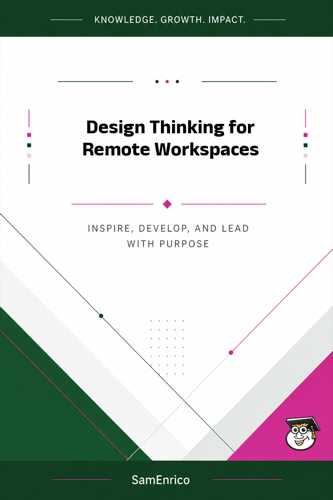
Design Thinking for Remote Workspaces eBook
Create virtual environments that support distribut
by Gallant Jone
Create virtual environments that support distributed design collaboration.
Formats
Free sample
Chapter 1: Kill the Zoom Grid--The twelve faces stared back at her like a wall of judgment. Some were pixelated, frozen mid-blink. Two were clearly checking email. One had the slack-jawed look of someone who had forgotten they were on camera. Maya, a design lead with fourteen years of experience, had just asked a simple question: "What do we think about the new user flow?" Silence.
Then a crackle. Then someone said, "Sorry, you broke up there," though she hadn't. Then someone else typed in chat: "I think it's good." That was it. Three hours of prep. Twelve people on the call.
Four whiteboards of sticky notes. And the output of this "collaboration" was a single, tepid sentence in a Slack thread that would be forgotten by morning.Maya closed her laptop and stared at her ceiling. She thought: We were better than this in person. Weren't we?Here is the truth that Maya was beginning to suspect, and that this chapter will prove: the problem was never remote work. The problem was the Zoom grid.
The grid is not a neutral tool. It is a confession of failure—a digital admission that says, "We have no shared space, so here are twelve separate spaces stitched together." When you put twelve faces on a screen, you are asking your team to do something impossible: maintain eye contact with eleven people simultaneously while also looking at a whiteboard, while also reading chat, while also remembering you are on mute. That is not collaboration. That is cognitive hazing.This chapter dismantles the Zoom grid and replaces it with something better. You will learn why the traditional design studio failed before remote work even existed.
You will understand the concept of Spatial Fluidity—the ability for design work to move seamlessly across digital contexts. You will confront the Hybrid Paradox, the persistent inequality where in-room participants dominate remote ones. And you will reframe "Zoom fatigue" not as an inevitable cost of remote work, but as a symptom of poorly designed digital spaces.By the end of this chapter, you will never look at a grid of faces the same way again. More importantly, you will have the first layer of the Spatial Operating System (SOS) —Zones—and a clear path to building a virtual studio that outperforms any physical office you have ever worked in.The Myth of the Physical Studio Before we can build something new, we must admit something uncomfortable: the traditional design studio was never that good. It just benefited from centuries of inertia.Walk into almost any design studio built between 1980 and 2019, and you will see the same things.
Open floor plans. Whiteboards on every wall. Sticky notes in primary colors. A kitchenette with terrible coffee. Maybe a ping-pong table if the company had venture capital and wanted to seem fun.
These spaces were not designed. They were inherited. They came from an architectural tradition that valued proximity over psychology—the belief that putting people near each other would automatically make them collaborate.It did not.What the physical studio actually produced was noise, interruption, and the constant low-grade anxiety of being watched. Research from the University of California, Irvine, found that office workers are interrupted every eleven minutes. It takes twenty-three minutes to return to full focus after each interruption.
Do the math. A typical eight-hour day contains roughly forty-three interruptions and nearly sixteen hours of recovery time—which is impossible, because there are only eight hours. Something has to give. What gives is deep work.The physical studio also produced something else: inequality. The people closest to the powerful got heard.
The people in the corner offices got to see everything while being seen by no one. The extroverts dominated the whiteboard while the introverts sat silently, generating ideas that would never be spoken. The physical studio was not a meritocracy. It was a stage, and the stage had terrible lighting for anyone not standing in the center.And yet, we romanticize it. We remember the late-night breakthroughs, the pizza-fueled whiteboard sessions, the moment when someone drew a squiggly line and someone else said "yes, and" and the whole room leaned forward.
Those moments happened. They were real. But they happened despite the physical studio, not because of it. They happened because of psychological safety, shared purpose, and enough caffeine. Those things can exist anywhere.So the goal of this book is not to replicate the physical studio.
The goal is to invent a new medium that amplifies what actually worked—empathy, ideation, iteration—while discarding what did not. The goal is to build a virtual studio that is better than any physical space you have ever occupied.What Is a Virtual Environment, Really?Most people hear "virtual environment" and think of a video call. That is like hearing "home" and thinking of a door. A video call is just an entry point. A virtual environment is the entire constructed space that exists beyond that entry point—its rules, its boundaries, its affordances, its psychology.Let me define this precisely.
A virtual environment for design collaboration is a digital space with four properties:Shared awareness. Everyone in the space knows who else is present, what they are doing, and where their attention is directed.Persistence. The space retains information between sessions. A sticky note placed today is still there tomorrow.Contextuality. The space changes based on what you are doing.
A brainstorming session looks different from a critique session, which looks different from a deep work session.Intentionality. The space was designed for a purpose. It did not emerge by accident.A Zoom call has none of these properties. Awareness is fragmented across the grid. Persistence is zero—the call ends, the whiteboard vanishes.
Contextuality is absent—every session looks the same. Intentionality is often missing—most calls are scheduled by default, not designed by choice.A true virtual environment, by contrast, feels like a place. Not a video call. A place. You enter it.
You move through it. You leave things there. You return to find them unchanged. You bump into people. You overhear conversations.
You choose to enter a quiet room when you need focus. You choose to enter a busy room when you need energy.This is not science fiction. These environments exist today using tools you already have or can learn in an afternoon: Miro, Mural, Figma, Notion, Slack (used intentionally), and spatial platforms like Gather or Overtone. The difference between a team that feels exhausted and a team that feels energized is not the tools. It is whether they have built an environment or just scheduled another call.Spatial Fluidity: The Core Concept Let me introduce the most important concept in this book: Spatial Fluidity.Spatial fluidity is the ability for design work to move seamlessly across different digital contexts without losing momentum, context, or shared awareness.
In a physical studio, spatial fluidity is low. To move from a whiteboard brainstorming session to a prototyping session, you have to walk to a different room, open a different application on a different computer, and hope someone remembers to take a photo of the whiteboard before it gets erased.In a virtual environment with high spatial…
This is the end of the free sample. Get the eBook to keep going. Buy now
About this book
Details
- Author
- Gallant Jone
- Publisher
- SamEnrico
- Language
- English
- Genre
- Non-Fiction, Self-Help
- Released
- 2026-06-09
- Pages (approx.)
- 153
- Available as
- eBook, Audiobook

Read better in the ZLOADR app
Your eBooks on your phone or tablet. Sign in with your SamEnrico account and start reading.
More by Gallant Jone
 Teresas Way of PerfectionGallant Jone$11.99
 DBT for GrandparentsGallant Jone$11.99
 Retirement Identity ShiftGallant Jone$11.99
 Mindfulness Based Smoking CessationGallant Jone$11.99
 Fasting For Weight LossGallant Jone$11.99
 Empathy Circle GuideGallant Jone$11.99
 NVC for Leaders GuideGallant Jone$11.99
 Elevating Grace: The Divine Artistry of Black Ballet PioneersGallant Jone$11.99
 The Battle of Nakatsukuni: Yamato's Rise to Dominance (3rd Century BC)Gallant Jone$11.99
 Service Providers Guide to OphthalmologyGallant Jone$11.99
 How to Produce Toothbrush SanitizersGallant Jone$11.99
 How to Produce Industrial Computer and AccessoriesGallant Jone$11.99
You may also like
 Hong Kong Handover 1997Dunn Johnnie$11.99
 Zumba For Postnatal Recovery CourseNeal Christian$11.99
 Zumba for BeginnersLadner Nikia$11.99
 YouTube Comment Mining GuideHumes Pandora$12.99
 Worry Box MeditationCarlin Rudy$11.99
 Workplace Stress MeditationNguyen Lynn$11.99
 Workplace Stress and Sleep RepairHawley Ivory$11.99
 Workplace Perfectionism CureDelaney Jeffry$11.99
 Workplace Injustice Anger GuideWallen Isabelle$11.99
 Work Addiction and Burnout LinkGreenwood Ester$11.99
 Women in Yoga and WellnessBeattie Galina$11.99
 Women in Stand Up ComedyChun Evangeline$11.99