
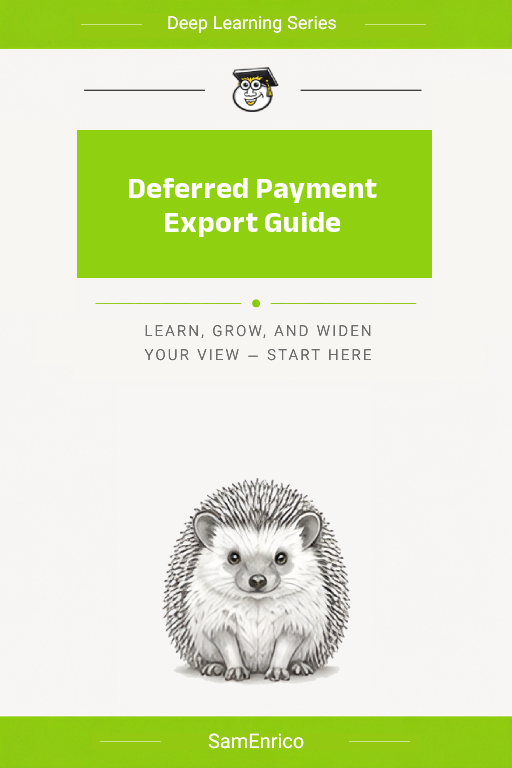
Deferred Payment Export Guide Audiobook
Structure deferred payment terms up to 180 days fo
by Wesley Sean
Structure deferred payment terms up to 180 days for capital goods exports. Use bank guarantee to secure future receipt for African manufactured goods.
Formats
Free sample
Chapter 1: The $10 Million Handshake---- In a humid conference room in Lagos, a Nigerian manufacturer of industrial packaging machinery watched a deal worth $2.3 million walk out the door. The buyer—a growing Ethiopian agri-processing company—loved the equipment, approved the price, and even praised the after-sales support. But when the Nigerian exporter explained that payment was due upon shipment, the Ethiopian buyer paused. "We can pay in 180 days," the buyer said. "We cannot pay today.
The dollars are not available."The Nigerian exporter said no.Three weeks later, the Ethiopian buyer signed the same contract with a Turkish competitor who offered 180-day deferred payment terms. The Nigerian manufacturer lost not only $2.3 million in revenue but also a long-term relationship, a foothold in the Ethiopian market, and the chance to build a reference case for future East African sales.This story is not unique. It happens every day across Africa. A manufacturer in Nairobi loses a deal to a Chinese supplier. A South African mining equipment fabricator watches a Zambian buyer choose an Indian competitor.
A Ghanaian agricultural machinery producer wonders why their proforma invoices go silent after the first enthusiastic email.The answer is almost always the same: payment terms.The Invisible Barrier That Costs African Exporters Billions The problem is so pervasive that most exporters have stopped seeing it. They blame the buyer, the economy, or bad luck. But the real culprit is a structural gap in African trade finance—a gap that foreign competitors have learned to exploit systematically.Let us name this gap clearly: the liquidity gap.Here is what the liquidity gap looks like in practice. An African buyer—say, a food processing company in Accra that needs new milling equipment—has a profitable business, a solid reputation, and every intention of paying for the machinery they purchase. Their bank account in Ghanaian cedis is healthy.
Their credit history with local suppliers is excellent. They have warehouse space ready, operators trained, and a clear plan to generate revenue from the new equipment once installed.But they cannot pay you in US dollars or euros today.Why not? Because their country's central bank rations foreign currency. Because the banking system has a backlog of dollar requests that stretches four months deep. Because the parallel market rate is 30% higher than the official rate, and using it would violate their corporate governance.
Because they need to apply for a Form M in Nigeria or an import license in Ethiopia that takes sixty…
This is the end of the free sample. Get the Audiobook to keep going. Buy now
About this book
Details
- Author
- Wesley Sean
- Publisher
- SamEnrico
- Language
- English
- Genre
- Non-Fiction, Business Brief, Deferred Payment
- Released
- 2026-06-01
- Pages (approx.)
- 150
- Available as
- eBook, Audiobook

Listen in the VoxFlicks app
Audiobooks and audio dramas wherever you go. Sign in with your SamEnrico account and press play.
More by Wesley Sean
 Pet Loss For FarmersWesley Sean$11.99
 Reverse Mortgage Cash Flow GuideWesley Sean$11.99
 Radiofrequency Skin Tightening HandbookWesley Sean$11.99
 Fireplace and Wood Smoke GuideWesley Sean$11.99
 Trigger Anticipation PlanningWesley Sean$11.99
 CBT For IBS WorkbookWesley Sean$11.99
 Advanced Materials CapitalWesley Sean$11.99
 Meeting Time Blocking RulesWesley Sean$11.99
 Anger In FriendshipWesley Sean$11.99
 The Unseen Empire: How a Single Store Changed the WorldWesley Sean$11.99
 Echoes of the Red Dawn: The Untold Cyber War That Reshaped ElectionsWesley Sean$11.99
 The Silent Revolution: How Rachel Carson Unlocked the Secrets of the SeaWesley Sean$11.99