
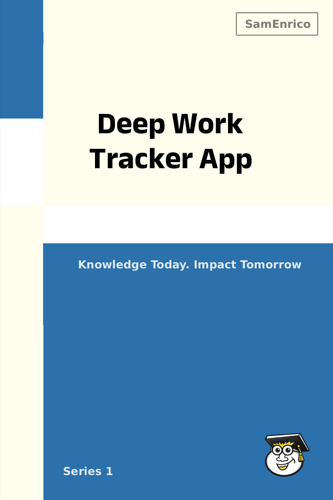
Deep Work Tracker App eBook
Teaches using digital tools to log and analyze foc
by Staley Hedy
Teaches using digital tools to log and analyze focus sessions.
Formats
Free sample
Chapter 1: The Measurement Paradox--–- Anna had read every productivity book on her shelf. Deep Work sat on her nightstand, dog-eared and highlighted. Make Time was open on her desk, its “Highlight” strategy already failing her for the third time that week. She understood the theory of focused attention. She could recite Cal Newport’s arguments about shallow versus deep work from memory.
She had even deleted Instagram from her phone twice—once with dramatic ceremony, once with quiet resignation.And yet, at 3:47 PM on a Tuesday, Anna found herself staring at a blank document, her email inbox open in another tab, her phone buzzing with Slack notifications she had promised herself she would ignore, and her brain simultaneously planning dinner, replaying a minor argument from the morning, and wondering if anyone had liked the photo she posted yesterday before she deleted the app again.She was not lazy. She was not undisciplined. She was not lacking in ambition or intelligence.She was missing one thing: feedback.This is a book about measurement. Not the obsessive, guilt-ridden measurement of a perfectionist, but the quiet, clarifying measurement of a scientist. It is a book about using digital tools—specifically, a deep work tracker app—not as a leash or a whip, but as a mirror.
Because here is the truth that no productivity guru tells you with enough emphasis: you cannot improve what you do not measure.The Knowledge-Feedback Gap Let us begin with a confession. The author of this book has written entire chapters while convinced they were in a state of profound focus, only to check their timer and discover they had spent forty-five minutes reorganizing their desktop folders and calling it “research.” The author has also emerged from ninety-minute sessions that felt scattered and distracted, only to review the data and realize they had produced more high-quality output in that messy hour than in three “perfect” days.Our feelings about our focus are unreliable narrators.This is the Knowledge-Feedback Gap. It is the chasm between understanding what deep work is (knowledge) and knowing whether you are actually doing it (feedback). Every popular book in the productivity space—from Newport’s Deep Work to Jake Knapp and John Zeratsky’s Make Time—excels at the first part. They tell you what deep work looks like, why it matters, and how to structure your day around it.
They give you philosophy and tactics. They give you inspiration.What they do not give you is a dashboard.Imagine trying to lose weight without a scale. Imagine trying to improve your running speed without a stopwatch. Imagine trying to save money without ever checking your bank balance. You could read every nutrition book ever written.
You could hire a personal trainer. You could create the most beautiful budget spreadsheet in existence. But without measurement, you are guessing. And guessing, over time, turns into frustration. Frustration turns into abandonment.
Abandonment turns into the quiet conviction that you are simply not the kind of person who can focus.That conviction is a lie. But it is a very comfortable lie, because it absolves you of trying again.The deep work tracker is the scale. It is the stopwatch. It is the bank balance for your attention. It does not judge you.
It does not shame you. It simply reports the truth, and the truth—even when it is uncomfortable—is the only foundation upon which improvement can be built.A Brief History of What You Have Been Told To understand why tracking is the missing piece, we must first understand what the most successful productivity books have given you—and what they have inadvertently withheld.Cal Newport’s Deep Work (2016) gave you the why. Newport argued, with rigorous evidence and compelling case studies, that the ability to focus without distraction on cognitively demanding tasks is becoming increasingly rare and increasingly valuable. He introduced the distinction between deep work (hard, focused, valuable) and shallow work (logistical, distracting, easily outsourced). He provided rules: work deeply, embrace boredom, quit social media, drain the shallows.
These are powerful ideas. They changed how millions of people think about their work.But Deep Work does not give you a system for measuring your progress. It tells you to quit social media, but it does not show you how to calculate the opportunity cost of the hours you spend scrolling. It tells you to work deeply, but it does not provide a protocol for logging the quality of each session. It is a book of philosophy dressed as strategy.
The philosophy is excellent. The strategy is incomplete.Jake Knapp and John Zeratsky’s Make Time (2018) gave you the how, at least at the daily level. Their framework—Highlight, Laser, Energize, Reflect—is brilliant in its simplicity. Choose one high-priority activity each day (the Highlight). Protect your focus from distractions (the Laser).
Invest in your physical energy (Energize). Look back at what worked and what didn’t (Reflect). This is a tactical system that has helped countless readers reclaim hours of lost attention.But Make Time treats measurement as an afterthought. The Reflect step is qualitative: you think about your day and make a mental note. There is no data.
There are no charts. There is no way to know, six weeks later, whether your Highlight strategy is actually improving your output or just making you feel busier. The system is designed for the short term, for the daily battle. It does not equip you for the long war of building sustainable focus habits.James Clear’s Atomic Habits (2018) gave you the mechanics of habit formation, including the famous “Don’t break the chain” method popularized by comedian Jerry Seinfeld. Clear argues, correctly, that small, consistent actions compound into remarkable results.
He provides a framework for designing environments that make good habits easier and bad habits harder.But the “chain” method fails for deep work because deep work is variable. You can floss every day without fail. You cannot perform deep work every day without fail. Some days you are tired. Some days you are sick.
Some days your child is home from school, or your deadline has moved, or your brain simply refuses to cooperate. The chain method turns these normal fluctuations into failures. It punishes you for being human. And so you break the chain, feel guilty, and stop tracking entirely.These three books—pillars of the modern productivity canon—have given you the what, the why, and the daily how. They have not given you the feedback loop.
They have not given you a way to see your own patterns, to distinguish signal from noise, to know whether you are actually improving or merely rearranging deck chairs on the Titanic of your attention.This book is the missing fourth volume.The Focus Loop: Log, Analyze, Adjust, Improve The central operating system of this book is called the Focus Loop. You will see these four words again and again, in every chapter, because they are the engine that transforms tracking from a chore into a superpower.Log. This is the act of capture. You record when you start a deep work session, when you end it, and what you accomplished. You note the…
This is the end of the free sample. Get the eBook to keep going. Buy now
About this book
Details
- Author
- Staley Hedy
- Publisher
- SamEnrico
- Language
- English
- Genre
- Non-Fiction, Business Brief, Productivity Tech
- Released
- 2026-06-05
- Pages (approx.)
- 129
- Available as
- eBook, Audiobook

Read better in the ZLOADR app
Your eBooks on your phone or tablet. Sign in with your SamEnrico account and start reading.
More by Staley Hedy
 Scripting for Anger ManagementStaley Hedy$11.99
 Patti Smith Just Kids MemoirStaley Hedy$11.99
 Love Language MismatchStaley Hedy$11.99
 Meeting Silent Mute DefaultStaley Hedy$11.99
 Deep Work for WritersStaley Hedy$11.99
 Congressional Floor Speeches DecodedStaley Hedy$11.99
 Job Loss and Marriage GuideStaley Hedy$11.99
 The London Heist: The Armored Car Killer Who Stalked the NHSStaley Hedy$11.99
 The Iron Bridges of Coalbrookdale: How England Forged the Industrial AgeStaley Hedy$11.99
 Exploring Japanese Art: Ukiyo-e, Ink & LacquerStaley Hedy$11.99
 Aubergine: Eggplant HarvestingStaley Hedy$11.99
 How to Produce Poker Chip Carriers and TraysStaley Hedy$11.99