
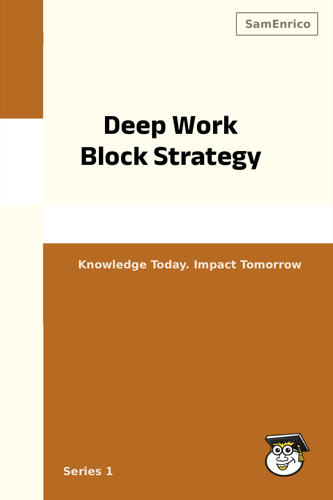
Deep Work Block Strategy eBook
Reserve 90 minute uninterrupted sessions for your
Reserve 90 minute uninterrupted sessions for your most important cognitive tasks.
Formats
Free sample
Chapter 1: The Great Fragmentation--The modern workplace is not designed for thinking. It is designed for interruption.Walk into any open-plan office, coffee shop, or even your own home office, and you will witness the same spectacle: human beings attempting to perform complex cognitive work while their attention is pulled in a dozen directions simultaneously. A Slack notification chirps. An email badge turns red. A colleague taps your shoulder.
Your phone buzzes with a news alert about something that absolutely cannot wait. By the time you look up from the last interruption, you have forgotten what you were doing. So you check email again, just to reset. The cycle repeats.This is not a productivity problem. It is a cognitive crisis.You are currently losing between four and six hours of cognitive capacity every single day, and you do not even notice it happening.
The loss is not due to laziness, lack of willpower, or poor time management. It is due to a phenomenon that most knowledge workers have never heard of, yet it governs the quality of every single thing they produce.The name for this phenomenon is attention residue.The Science of a Fragmented Mind In 2009, researchers Sophie Leroy and Theresa Glomb published a groundbreaking study that would forever change how we understand task switching. Their discovery was deceptively simple: when you leave Task A unfinished to work on Task B, a portion of your cognitive resources remain stuck on Task A. You are not fully present for Task B. Your brain is still processing the unfinished work, the lingering uncertainty, the dangling obligation.Leroy called this attention residue.The magnitude of the effect is staggering.
When you switch tasks with an unfinished task lingering in your mental RAM, your performance on the new task drops by up to forty percent. That is not a typo. Forty percent. Imagine showing up to work and being told that for the rest of the day, you would be operating at sixty percent of your intellectual capacity. You would be outraged.
You would demand an explanation. Yet that is exactly what happens every time you glance at your email while writing a report, answer a Slack message while analyzing data, or check your phone while reading a document.Your IQ does not actually drop. Your available cognitive bandwidth does. And the difference is invisible to you in the moment.Here is what makes attention residue so insidious: you feel productive when you switch tasks quickly. The dopamine hit of clearing a small obligation provides a sense of progress.
You answer an email. You close a ticket. You respond to a message. Each micro-interaction triggers a small reward circuit in your brain, convincing you that you are getting things done.But you are not getting things done. You are getting things started, interrupted, restarted, and abandoned.
The research on task completion is merciless: the average knowledge worker switches tasks every three minutes and five seconds. At that rate, you never hold a single thought long enough to achieve anything resembling depth. You are skimming the surface of your own intelligence.The Casino That Steals Your IQConsider the design of the modern workplace as an attention-switching casino. The slot machines are your notifications. The chips are your moments of focus.
The house always wins.Every notification badge, every unread email count, every blinking cursor in a Slack channel is engineered to do one thing: pull your attention away from whatever you are doing and redirect it to something else. The engineers who built these systems call this "engagement." They measure it in daily active users and time spent in app. They do not measure what you lose when you switch.And what you lose is your ability to think.Deep thinking requires uninterrupted time. It requires the kind of sustained concentration where you hold a problem in your mind, turn it over, examine it from multiple angles, and gradually build a solution. This is not a luxury.
It is the fundamental unit of knowledge work. A surgeon cannot operate in thirty-second increments. A pilot cannot land a plane between text messages. A lawyer cannot construct a legal argument while checking email every two minutes.Yet knowledge workers are expected to do exactly that. Write a report, but stop to answer Slack.
Analyze a spreadsheet, but pause for a quick Zoom. Design a strategy, but first respond to these twelve emails. The implicit message is that your deep thinking is less valuable than anyone else's shallow interruption.The result is a workforce that is busier than ever and less productive than ever. We measure productivity in hours logged, emails sent, and meetings attended. We never measure it in problems solved, insights generated, or value created.
The metrics of busyness have replaced the metrics of achievement.The Goldilocks Zone of Cognitive Work If attention residue is the disease, what is the cure?The answer is not to work longer hours. The answer is not to install yet another productivity app or attend another time management seminar. The answer is to fundamentally restructure how you work around a single unit of cognitive labor: the uninterrupted block.But how long should that block be?The productivity world is filled with competing answers. The Pomodoro Technique advocates for twenty-five minute sprints. Some productivity gurus suggest fifty-two minutes of work followed by seventeen minutes of rest.
Others recommend ninety-minute sessions based on something called ultradian rhythms. And a certain breed of hustle-culture enthusiast will tell you to work for eight, ten, or twelve hours straight.Who is right?Let us examine the evidence systematically.The Pomodoro Technique was developed in the late 1980s by Francesco Cirillo, who used a tomato-shaped kitchen timer to break his work into twenty-five minute intervals. For simple, repetitive tasks like studying flashcards or answering routine emails, Pomodoro works well. The short intervals prevent burnout and provide frequent breaks.But for complex cognitive work, twenty-five minutes is a joke.Consider what happens in a twenty-five minute deep work session. The first five minutes are spent loading the problem into your mental RAM.
You review where you left off, reorient yourself to the context, and begin to engage with the material. The next five minutes are spent overcoming resistance. Your brain does not want to do hard things, so it generates reasons to check email, make coffee, or reorganize your desk. Around the ten-minute mark, you finally achieve a state of shallow focus. You are working, but you are not yet in flow.By minute twenty, you are just entering the kind of concentrated state where real breakthroughs happen.
Your mind is fully engaged. The problem has unfolded before you. You see connections that were invisible five minutes ago. You are generating insights.And then the timer goes off.You are forced to stop. You take a five-minute break.
You check your phone, stretch your legs, or refill your water. When you return for the next Pomodoro, you spend another ten minutes reloading the context. The cycle repeats. You never actually achieve sustained deep work. You are jogging in place while believing you are running a marathon.At the other extreme, eight-hour work sessions are equally misguided.
The human brain is not designed for sustained concentration over an entire workday. Cognitive fatigue accumulates. Decision quality degrades. Creativity…
This is the end of the free sample. Get the eBook to keep going. Buy now
About this book
Details
- Author
- Velez Takisha
- Publisher
- SamEnrico
- Language
- English
- Genre
- Non-Fiction, Self-Help, Deep Work
- Released
- 2026-06-07
- Pages (approx.)
- 136
- Available as
- eBook, Audiobook

Read better in the ZLOADR app
Your eBooks on your phone or tablet. Sign in with your SamEnrico account and start reading.
More by Velez Takisha
 The Perimenopause Partner Communication GuideVelez Takisha$11.99The Perimenopause Partner Communication GuideVelez Takisha$11.99
 Priming Influence TechniquesVelez Takisha$11.99
 Facebook Parenting PressureVelez Takisha$11.99
 Self Talk for PostpartumVelez Takisha$11.99
 The Architect of the Djinn: How a Mortal Built a Tower to the SkyVelez Takisha$11.99
 Understanding Jumping Frenchmen of MaineVelez Takisha$17.99
 ESG Investment Flows GuideVelez Takisha$12.99
 Post Layoff Grief ProtocolVelez Takisha$12.99
 Model RocketsVelez Takisha$11.99
 How to Become a Coating-mixer TenderVelez Takisha$11.99
You may also like
 Hong Kong Handover 1997Dunn Johnnie$11.99
 Zumba For Postnatal Recovery CourseNeal Christian$11.99
 Zumba for BeginnersLadner Nikia$11.99
 YouTube Comment Mining GuideHumes Pandora$12.99
 Worry Box MeditationCarlin Rudy$11.99
 Workplace Stress MeditationNguyen Lynn$11.99
 Workplace Stress and Sleep RepairHawley Ivory$11.99
 Workplace Perfectionism CureDelaney Jeffry$11.99
 Workplace Injustice Anger GuideWallen Isabelle$11.99
 Work Addiction and Burnout LinkGreenwood Ester$11.99
 Women in Yoga and WellnessBeattie Galina$11.99
 Women in Stand Up ComedyChun Evangeline$11.99