
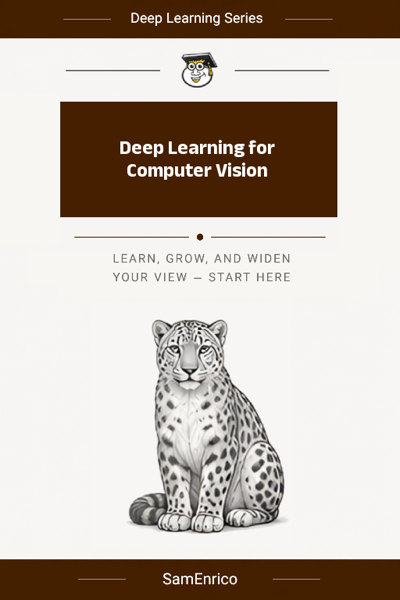
Deep Learning for Computer Vision eBook
A Coursebook on Deep Learning for Computer Vision
A Coursebook on Deep Learning for Computer Vision
Formats
Free sample
Chapter 1: The Tensor Awakening--–- You are about to teach a machine to see. Not to memorize, not to calculate faster than a human, but to genuinely interpret the visual world—to look at a photograph of a busy intersection and identify every pedestrian, every traffic light, every parked car, and every lane marking. This is not magic. It is not science fiction. It is applied mathematics, executed at a scale that would have been impossible just fifteen years ago.If you have ever wondered how your smartphone recognizes your face, how a self-driving car distinguishes a plastic bag from a dog, or how a medical AI spots a tumor that a radiologist might miss, you have wondered about deep learning for computer vision. This book will take you from the absolute foundations—the humble tensor—to the bleeding edge: vision transformers, diffusion models, and multimodal systems that can read images and write captions. But we will not just study these systems. We will build them. By the end of this book, you will have constructed a complete Traffic Scene Understanding System: a dashcam AI that detects pedestrians, recognizes traffic signs, segments lane markings, estimates depth, and runs efficiently enough to deploy on an edge device.Before we write a single line of code, before we define our first neural network, we need to understand a fundamental truth: computer vision did not begin with deep learning. It began with desperate cleverness—engineers hand-crafting features like SIFT and HOG, writing thousands of lines of rules that worked reasonably well in controlled conditions and failed catastrophically in the real world. The revolution came when researchers realized that instead of telling the machine what to look for, they could let the machine learn what to look for. That shift—from feature engineering to feature learning—is the single most important idea in modern artificial intelligence.This chapter establishes the historical, mathematical, and practical groundwork for everything that follows. We will contrast the old paradigm with the new, introduce the fundamental data structure of all computer vision (the tensor), examine the three forces that made deep learning possible (data, compute, and algorithms), and launch the unified project that will span all twelve chapters. Most importantly, we will write our first piece of code: loading a dashcam image from disk, converting it to a Py Torch tensor, and confirming that we have successfully bridged the gap between a photograph and a mathematical object that a neural network can process.By the end of this chapter, you will have written working code, understood why deep learning won, and taken the first concrete step toward building an AI that sees.The Old Way: Desperation by Hand Before 2012, computer vision was an exercise in creative exhaustion. If you wanted a machine to detect a pedestrian, you did not train a model. You designed a feature. You wrote code to detect edges, compute gradients, build histograms of oriented gradients (HOG), and then feed those hand-crafted features into a relatively shallow classifier like a support vector machine (SVM). It worked—sometimes. A well-tuned HOG+SVM pedestrian detector could achieve respectable accuracy on a sunny day with clear lighting and pedestrians standing upright. But tilt the camera, change the lighting, add an umbrella, or simply encounter a pedestrian wearing dark clothing, and the system would fail without warning.The fundamental problem was brittleness. Hand-crafted features are designed by humans, and humans are terrible at anticipating every variation the real world can produce. A corner detector that works perfectly on natural images may fail catastrophically on medical X-rays. An edge detector designed for highway lane markings will mistake shadows for cracks on a residential street. Engineers would spend months tuning parameters, adding special cases, and chasing failures—only to discover that fixing one problem created two more.The most famous hand-crafted features of the pre-deep-learning era include SIFT (Scale-Invariant Feature Transform), which could detect and describe local image features even under changes in scale and rotation, and HOG (Histogram of Oriented Gradients), which counted occurrences of gradient orientation in localized portions of an image. Both were triumphs of human ingenuity. Both were also fundamentally limited. A SIFT descriptor captures texture but not context. A HOG descriptor captures shape but not color. Neither can learn to ignore irrelevant variation while preserving what matters for a specific task.Deep learning did not solve this problem by inventing better features. It solved the problem by eliminating the need for hand-crafted features entirely. Instead of telling the machine what to look for, you give it raw pixels and a task, and it learns what to look for. The features emerge from the data, shaped by the task. Edge detectors appear spontaneously in the first layer of a trained convolutional network. Texture detectors appear in the second layer. Object parts appear in the third. The network builds its own hierarchy of visual understanding, perfectly tuned to the problem it was trained to solve.This is not magic. It is optimization. But it feels like magic the first time you watch a network learn to see.The New Paradigm: Learning Everything The shift from hand-crafted features to learned features rests on a simple but profound insight: the same optimization algorithm—gradient descent—can learn feature extractors and classifiers simultaneously. You do not design a Sobel edge detector; the network learns a set of kernels that happen to resemble Sobel operators because edge detection is useful for the task. You do not design a color histogram; the network learns to attend to color channels because color distinguishes classes.This end-to-end learning paradigm has several critical advantages. First, it removes the bottleneck of human engineering. Whatever features are most useful for the task—no matter how unintuitive or non-linear—the network can potentially learn them. Second, learned features adapt to the specific distribution of your data. A feature that works well for urban driving may be useless for medical imaging, and the network will learn different features accordingly. Third, end-to-end learning can discover representations that no human would ever design. Some of the most effective convolutional kernels in modern networks look like random noise to the human eye but encode subtle statistical regularities that matter deeply for classification.The cost of this flexibility is data. Lots of data. While a hand-crafted HOG detector might work reasonably well with a few hundred labeled examples, a deep neural network typically requires hundreds of thousands or millions of labeled examples to learn features that generalize. This brings us to the first of three forces that made deep learning possible.The Three Forces Behind the Revolution Deep learning for computer vision did not emerge from a single theoretical breakthrough. It emerged when three separate forces converged: massive datasets, massive compute, and algorithmic maturity. Understanding each force is essential for understanding why this field moves so quickly and where it is likely to go next.Force One: Large-Scale Labeled Datasets In 2006, if you wanted to train a deep neural network on natural images, you had two options: the CIFAR-10 dataset (60,000 tiny 32×32 images) or the MNIST dataset (70,000 grayscale digits). Both were useful for research. Neither resembled the complexity of real-world visual recognition. A network trained on CIFAR-10 might achieve 80% accuracy on that benchmark and then perform no better than random on a photograph from your phone.The turning…
This is the end of the free sample. Get the eBook to keep going. Buy now
About this book
Details
- Author
- Cameron Omega
- Publisher
- SamEnrico
- Language
- English
- Genre
- Non-Fiction, Informative, Educational
- Released
- 2026-05-04
- Pages (approx.)
- 157
- Available as
- eBook, Audiobook

Read better in the ZLOADR app
Your eBooks on your phone or tablet. Sign in with your SamEnrico account and start reading.
More by Cameron Omega
 Research Proposal Mixed Methods DesignCameron Omega$11.99
 MRI Claustrophobia MockCameron Omega$11.99
 Joshua Tree Lost CasesCameron Omega$11.99
 The Medicare and Self Esteem GuideCameron Omega$11.99
 Sector for VeteransCameron Omega$11.99
 Cross Elasticity ApplicationsCameron Omega$11.99
 Wrestling Weight Cut HypnosisCameron Omega$11.99
 Deepening Script TechniquesCameron Omega$11.99
 Anansi Weaves the World: The Spider’s Cosmic TrickeryCameron Omega$11.99
 Tracy Chapman: Fast Car, Far HorizonsCameron Omega$11.99
 The Sword and the Scroll: Charlemagne's Carolingian GambitCameron Omega$11.99
 How to Become a Buckle-wire InserterCameron Omega$11.99