
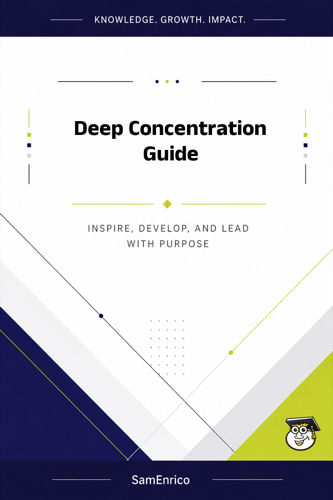
Deep Concentration Guide eBook
Eliminate distractions and focus deeply for flow s
Eliminate distractions and focus deeply for flow states using this workbook.
Formats
Free sample
Chapter 1: The Rarest Skill...--–- The email arrives at 9:17 AM. You are twenty minutes into a complex report that requires your full attention. The notification banner slides down from the top of your screen. You glance at it. It is not urgent.
It is not even important. It is a newsletter you do not remember subscribing to. But the damage is already done. Your attention has fractured. It will take you an average of twenty-three minutes to return to the same level of focus you had before that notification appeared.
Twenty-three minutes. For a single glance at a single email you did not need to read.This is the hidden cost of distraction. It is not the five seconds you spend reading the email. It is not the thirty seconds you spend deciding whether to respond. It is the twenty-three minutes of fractured attention that follows—the mental residue that lingers, the cognitive friction that slows every subsequent thought.
Multiply that by the dozens of interruptions you experience each day, and you are not losing minutes. You are losing hours. You are losing days. You are losing the ability to do your best work.This chapter is about the foundation of deep concentration. It is about understanding what deep work truly is, why it is becoming so rare, and why it is becoming more valuable with each passing year.
The insights in this chapter draw from decades of research on productivity, attention, and cognitive performance. They are not theories. They are not opinions. They are the accumulated wisdom of psychologists, neuroscientists, and performance experts who have studied how the most effective people in the world do their best work.Before you can eliminate distractions and master flow states, you need to understand what you are building. You need a foundation.
This chapter is that foundation.The Two Kinds of Work Let us start with a distinction that will appear throughout this workbook. It comes from Cal Newport, a computer science professor at Georgetown University and the author of the foundational book Deep Work. Newport argues that all work falls into one of two categories.The first category is deep work. Newport defines deep work as "professional activities performed in a state of distraction-free concentration that push your cognitive capabilities to their limit. These efforts create new value, improve your skill, and are hard to replicate."Think of deep work as the kind of concentration that produces your best output.
It is writing a report that requires synthesizing multiple sources. It is learning a new programming language. It is brainstorming a creative strategy. It is analyzing complex data to find patterns no one else has seen. Deep work feels difficult because it is difficult.
It requires sustained mental effort. It resists interruption. It cannot be done while you are also checking email, scrolling social media, or half-listening to a podcast.The second category is shallow work. Newport defines shallow work as "noncognitively demanding, logistical-style tasks, often performed while distracted. These efforts tend not to create much new value in the world and are easy to replicate."Shallow work is checking email.
It is rearranging files in a folder. It is attending a meeting that could have been an email. It is filling out forms, scheduling appointments, and responding to messages that do not require deep thought. Shallow work feels productive because it creates a sense of motion. You are doing things.
You are checking boxes. You are clearing your inbox. But shallow work rarely moves the needle on what truly matters.Here is the problem: shallow work has a way of crowding out deep work. It is easier. It provides more immediate feedback.
It does not require the same cognitive effort. And because our devices are designed to reward shallow work—a notification is easier to respond to than a complex problem—we find ourselves spending more and more time on tasks that do not truly matter.Newport argues that those who focus on deep work, "and then make it the core of their working life, will thrive." The reasoning is straightforward: as shallow work becomes easier to automate or outsource, deep work becomes more valuable. The ability to concentrate deeply is the ability to produce work that cannot be replicated by artificial intelligence or by someone in a lower-cost labor market.The Deep Work Hypothesis Newport's central argument can be summarized as what he calls the Deep Work Hypothesis: "The ability to perform deep work is becoming increasingly rare at exactly the same time it is becoming increasingly valuable in our economy. As a consequence, the few who cultivate this skill, and then make it the core of their working life, will thrive."This hypothesis rests on two observations about the modern economy.First, the economy increasingly rewards those who can quickly master hard things. New technologies emerge constantly.
Industries transform overnight. The skills that were valuable five years ago may be obsolete today. The ability to learn complex skills rapidly is a massive competitive advantage. And deep work is precisely the skill that enables rapid learning. You cannot master a difficult subject in thirty-minute increments between email checks.
You need sustained, uninterrupted concentration.Second, the economy rewards those who can produce at an elite level, in terms of both quality and speed. Shallow work produces shallow results. It produces work that is adequate, average, easily replicated. Deep work produces work that stands out, that creates new value, that cannot be easily copied. In a world of endless noise and distraction, deep work is the signal.These two observations are not speculative.
They are supported by research across multiple fields. A study of workplace productivity found that the top 10 percent of performers produced more than 50 percent of the total output in their organizations. These top performers did not work more hours. They did not have higher IQs. They had a greater ability to concentrate deeply on complex tasks without interruption.Why Deep Work Is So Rare If deep work is so valuable, why do so few people practice it?
The answer is not that people are lazy or undisciplined. The answer is that deep work faces powerful obstacles that shallow work does not.The Metric Black Hole. Many knowledge work tasks are difficult to measure. How do you quantify the quality of a strategic plan? The creativity of a design?
The insight of a research paper? Because these outputs are hard to measure, workers and organizations often default to measuring what is easy—hours logged, emails sent, tasks checked off. This favors shallow work, which is easy to count, over deep work, which is hard to quantify but produces more value.The Principle of Least Resistance. In the absence of clear goals and metrics, people tend toward the path of least resistance. Shallow work is easier than deep work.
It requires less mental effort. It provides more immediate feedback. It feels like progress even when it is not. So shallow work wins, even when it produces less value. This is not a character flaw.
It is a feature of how the human brain is wired. We are drawn to what is easy and immediate, even when we know that…
This is the end of the free sample. Get the eBook to keep going. Buy now
About this book
Details
- Author
- Danielson Terese
- Publisher
- SamEnrico
- Language
- English
- Genre
- Non-Fiction, Self-Help, Deep Work
- Released
- 2026-06-08
- Pages (approx.)
- 113
- Available as
- eBook, Audiobook

Read better in the ZLOADR app
Your eBooks on your phone or tablet. Sign in with your SamEnrico account and start reading.
More by Danielson Terese
 Fear of Failure in CaregivingDanielson Terese$11.99
 Disappointment Anger RestructuringDanielson Terese$11.99
 Financial Insomnia SolutionsDanielson Terese$11.99
 Assertiveness for Nice GuysDanielson Terese$11.99
 HGH and Longevity ResearchDanielson Terese$11.99
 Vaping EVALI GuideDanielson Terese$11.99
 Delegation for PerfectionistsDanielson Terese$11.99
 The Poisoned Tea: Japan's Deadly Corporate ConspiracyDanielson Terese$11.99
 The Last Song of Cleopatra: A Funeral in ExileDanielson Terese$11.99
 How to Produce Pry BarsDanielson Terese$11.99
 How to Produce Electronic Components and SuppliesDanielson Terese$11.99
 Mailchimp Test Email GuideDanielson Terese$12.99
You may also like
 Hong Kong Handover 1997Dunn Johnnie$11.99
 Zumba For Postnatal Recovery CourseNeal Christian$11.99
 Zumba for BeginnersLadner Nikia$11.99
 YouTube Comment Mining GuideHumes Pandora$12.99
 Worry Box MeditationCarlin Rudy$11.99
 Workplace Stress MeditationNguyen Lynn$11.99
 Workplace Stress and Sleep RepairHawley Ivory$11.99
 Workplace Perfectionism CureDelaney Jeffry$11.99
 Workplace Injustice Anger GuideWallen Isabelle$11.99
 Work Addiction and Burnout LinkGreenwood Ester$11.99
 Women in Yoga and WellnessBeattie Galina$11.99
 Women in Stand Up ComedyChun Evangeline$11.99