
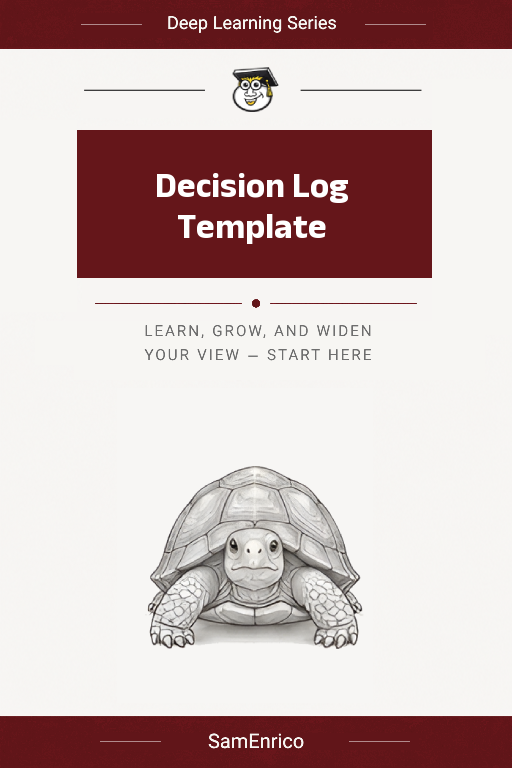
Non-FictionFirst 30 DaysDecision Tracking
Decision Log Template eBook
Track key decisions made, alternatives considered,
Track key decisions made, alternatives considered, and outcomes on one strategic accountability page.
Formats
Free sample
Chapter 1: The $100M Rationale--–- The CEO had every reason to say no. The offer was low. The timing was wrong. The acquirer was a known culture killer. He explained all of this to his board in a forty-five-minute presentation, complete with slides, financial models, and a passionate defense of his team's roadmap.
The board nodded. The offer was rejected. The CEO went back to work.Eighteen months later, the company was worth forty million dollars. It had been valued at two hundred million at the time of the offer. The board ousted the CEO for negligence.
In the lawsuit that followed, a lawyer asked a devastatingly simple question: "Can you show us the document where you considered the alternatives and documented your rationale?"The CEO had nothing. Not because he was lazy. Not because he was hiding something. Because he was human. He had trusted his memory.
He had assumed that the reasoning so clear in his head would remain clear forever. He had believed that a good decision, explained well in a meeting, would protect itself.He was wrong. The absence of a single page—a rationale written at the time, stored somewhere searchable, immune to the rewriting of history—cost him his company, his reputation, and years of litigation. The money was gone. But the document that could have saved it all would have taken five minutes to write.This book is that document.
For every decision you haven't made yet. For every rationale you assume you'll remember. For every choice that seems obvious today but will be invisible tomorrow.The Invisible Cost of a Bad Decision Organizations do not collapse from obviously terrible decisions. There are no boardrooms where someone says, "Let's do the thing that will definitely bankrupt us," and everyone agrees. Catastrophic failure is almost never the result of a single, clearly stupid choice made by a lone fool.The real killer is the accumulation of moderately poor decisions made in isolation.
A hiring choice that seemed fine at the time but quietly lowered the team's average competence. A product feature prioritization that shifted six weeks of engineering time toward a low-impact initiative. A pricing adjustment that felt minor but slowly eroded margins. A partnership agreement signed without explicitly logging the assumptions about the partner's delivery timeline.Each of these decisions, by itself, is survivable. But they compound.
They create what this chapter calls decision debt—the hidden liability of undocumented choices that will eventually need to be revisited, explained, defended, or reversed, often at the worst possible moment and with the least possible information.Decision debt works exactly like technical debt. You can ignore it for a while. It doesn't crash the system immediately. But every undocumented decision increases the risk that someone—maybe you, maybe your successor—will have to reverse-engineer the logic behind a choice that seemed obvious at the time but makes no sense in hindsight. And unlike technical debt, decision debt cannot be refactored.
It can only be reconstructed through painful, inaccurate, blame-seeking post-mortems.Consider the following, drawn from a composite of real cases across technology, finance, and healthcare:A manufacturing company decides to consolidate suppliers to reduce costs. The decision is made in a two-hour meeting. The rationale—lower unit prices, simplified logistics, fewer vendor management headaches—is shared verbally. No one writes down the assumptions: that the remaining supplier can scale, that quality will remain consistent, that geopolitical risks are negligible. Six months later, the sole supplier has a factory fire.
Production halts for eleven weeks. The cost of the consolidation, including lost revenue and expedited shipping from emergency backup suppliers, exceeds the savings by a factor of ten. When the board asks why no one considered the single-point-of-failure risk, the team scrambles to find evidence that they did consider it. There is no evidence. The meeting minutes say only "Supplier consolidation approved."The decision was not obviously wrong.
Under different circumstances—a more reliable supplier, a different geopolitical environment—it might have worked brilliantly. But because the rationale and assumptions were never logged, the decision looks in retrospect like negligence. The team that made the call is blamed not for bad judgment but for bad memory. They cannot prove they thought about the risks because they never wrote down that they thought about the risks.This is the invisible cost. Not the bad decision itself.
The inability to defend a good decision that turned out badly.System Noise: The Bias You Didn't Know You Had Most leaders are familiar with cognitive bias. They know about confirmation bias (seeking evidence that supports what they already believe). They know about anchoring (being influenced by the first number they hear). They know about loss aversion (fearing losses more than valuing equivalent gains). These biases are well-documented, widely taught, and the subject of entire books, including Daniel Kahneman's masterwork Thinking, Fast and Slow.But there is a second, less famous, potentially more expensive source of error in organizational decision-making.
Kahneman calls it noise.Noise is inconsistency. It is what happens when two equally qualified, equally well-intentioned professionals facing the same set of facts make different judgments. A judge gives one defendant five years and another defendant ten years for the same crime. A hiring committee selects one candidate in the morning and rejects an identical candidate in the afternoon. A credit analyst approves a loan that another analyst at the same bank, using the same data, would reject.Bias is a predictable error in a specific direction.
Noise is random scatter. And noise, Kahneman's research shows, often costs organizations more than bias because it is invisible, unmeasured, and rarely discussed.Here is a simple experiment you can run in your own organization. Gather five senior leaders. Give them the same one-page description of a strategic decision—say, whether to enter a new market. Ask each of them to write down their recommended course of action and their confidence level.
Do not let them talk to each other first.In almost every organization that runs this exercise, the results are shocking. The same facts, interpreted by equally experienced people, produce wildly different recommendations. One leader says "enter aggressively" with 90% confidence. Another says "wait six months" with 70% confidence. A third says "enter but with a smaller investment" with 60% confidence.
These are not differences in expertise. They are noise.Noise exists because human judgment is not a reliable instrument. Our brains are not computers. They are affected by mood, fatigue, the order in which information is presented, the last conversation we had, and a thousand other irrelevant factors. The same person, facing the same decision on Tuesday morning versus Thursday afternoon, might reach a different conclusion.The decision log is the single most effective tool for reducing noise.
Not because it eliminates judgment—judgment is still essential—but because it makes judgment visible. When every strategic decision is logged with its rationale, alternatives, assumptions, and confidence levels, inconsistencies become obvious. The leader who approved a high-risk project on Tuesday and rejected an identical project on Thursday cannot hide behind "different circumstances." The log exposes the inconsistency. And exposure is the first step toward calibration.The Difference Between a Good Decision and a Lucky Outcome Before we…
This is the end of the free sample. Get the eBook to keep going. Buy now
About this book
Details
- Author
- Goulet Kenton
- Publisher
- SamEnrico
- Language
- English
- Genre
- Non-Fiction, First 30 Days, Decision Tracking
- Released
- 2026-06-01
- Pages (approx.)
- 145
- Available as
- eBook, Audiobook

Read better in the ZLOADR app
Your eBooks on your phone or tablet. Sign in with your SamEnrico account and start reading.
More by Goulet Kenton
 Shein Haul Comparison GuideGoulet Kenton$11.99
 Meeting Pre Read PenaltyGoulet Kenton$11.99
 Harry Belafonte Calypso KingGoulet Kenton$11.99
 Healthcare Worker Migration TrendsGoulet Kenton$11.99
 Investor Ready FinancialsGoulet Kenton$11.99
 Hybrid Work Scheduling GuideGoulet Kenton$11.99
 Scripting for ProductivityGoulet Kenton$11.99
 Time Blocking for PilotsGoulet Kenton$11.99
 The Golden Boot of Argentina: The Untold Story of Guillermo Stábile's 1930 World Cup TriumphGoulet Kenton$11.99
 How to Produce Poncho LinersGoulet Kenton$11.99
 Briggs Turnip Rape: Forage HarvestingGoulet Kenton$11.99
 How to Produce Door ClosersGoulet Kenton$11.99
You may also like
 Hong Kong Handover 1997Dunn Johnnie$11.99
 Zumba For Postnatal Recovery CourseNeal Christian$11.99
 Zumba for BeginnersLadner Nikia$11.99
 YouTube Comment Mining GuideHumes Pandora$12.99
 Worry Box MeditationCarlin Rudy$11.99
 Workplace Stress MeditationNguyen Lynn$11.99
 Workplace Stress and Sleep RepairHawley Ivory$11.99
 Workplace Perfectionism CureDelaney Jeffry$11.99
 Workplace Injustice Anger GuideWallen Isabelle$11.99
 Work Addiction and Burnout LinkGreenwood Ester$11.99
 Women in Yoga and WellnessBeattie Galina$11.99
 Women in Stand Up ComedyChun Evangeline$11.99