
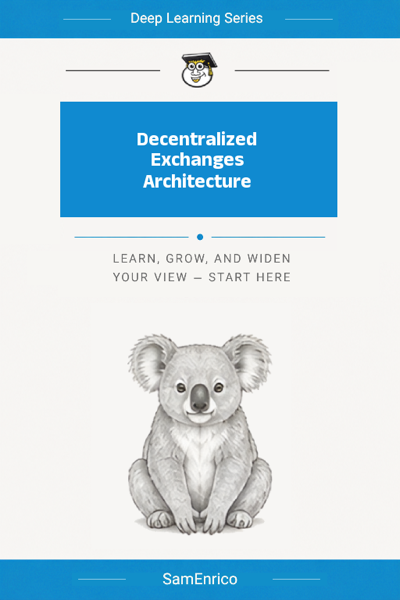
Decentralized Exchanges Architecture
A Coursebook on Decentralized Exchanges Architectu
A Coursebook on Decentralized Exchanges Architecture
Formats
About this book
Free sample
Chapter 1: The Day the Money Vanished--–- On February 24, 2014, Mark Karpelès, the CEO of Mt. Gox, stood before a room of journalists in Tokyo and delivered a confession that would forever change how the world thought about digital asset exchanges. "We have lost approximately 850,000 bitcoins," he said, his voice barely above a whisper. At the time, that represented over $450 million in customer funds. The audience sat in stunned silence.
Not because theft was unprecedented—hacks had happened before—but because of the profound implications: a single company, trusted by nearly 70% of all bitcoin traders worldwide, had simply lost its users' money. No bank insurance. No government bailout. No recourse. The funds were gone.This chapter establishes why decentralized exchanges exist, not as academic experiments or crypto-ideological fantasies, but as necessary infrastructure born from repeated, catastrophic failures of centralized control.
We will dissect the architecture of traditional centralized exchanges (CEXs), understand their inherent vulnerabilities, and trace the intellectual and technological journey that led to the creation of trust-minimized trading protocols. By the end, you will understand why DEXs are not merely alternatives to CEXs but fundamental re-architectures of how value can be exchanged between strangers on the internet.The Architecture of Trust: How Centralized Exchanges Really Work Before we can appreciate what makes a decentralized exchange different, we must first understand the machine it seeks to replace. A centralized cryptocurrency exchange operates on a deceptively simple premise: users deposit their funds into the exchange's wallets, and the exchange maintains an internal ledger of who owns what. This is not fundamentally different from how a bank operates. When you deposit dollars into your bank account, the bank does not stuff physical bills into a box labeled with your name.
Rather, it updates a database entry showing your balance. The bank then uses your deposit to lend to others, invest in securities, or simply hold as reserves. You trust that when you return to withdraw, the bank will honor your claim.A CEX works almost identically. When you create an account on Binance, Coinbase, or Kraken, you receive a deposit address. You send…
This is the end of the free sample. Get the eBook to keep going. Buy now
Contents
- Chapter 1
- Chapter 2
- Chapter 3
- Chapter 4
- Chapter 5
- Chapter 6
- Chapter 7
- Chapter 8
- Chapter 9
- Chapter 10
- Chapter 11
- Chapter 12
Details
- Author
- Mattison Ayanna
- Publisher
- SamEnrico
- Language
- English
- Genre
- Non-Fiction, Informative, Educational
- Released
- 2026-06-02
- Pages (approx.)
- 144
- Available as
- eBook, Audiobook

Read better in the ZLOADR app
Your eBooks on your phone or tablet. Sign in with your SamEnrico account and start reading.
More by Mattison Ayanna
 Loot Box Gambling Connection GuideMattison Ayanna$11.99
 Story View Anxiety GuideMattison Ayanna$11.99
 The Weight Childhood TeasingMattison Ayanna$11.99
 The Group Affirmation CircleMattison Ayanna$11.99
 Career Comparison on Social MediaMattison Ayanna$11.99
 Hepatitis Vaccination SeriesMattison Ayanna$11.99
 Pilot Stress ResilienceMattison Ayanna$11.99
 Entrepreneur Grit GuideMattison Ayanna$11.99
 Nurse Imposter SyndromeMattison Ayanna$11.99
 The Last Song of the Whale: How a Forgotten Tribe Saved an OceanMattison Ayanna$11.99
 The Alchemist of Malacca: Unraveling the Secrets of the Atom in the Age of SpiceMattison Ayanna$11.99
 Lucid: The Secret Sleep Experiments of the Soviet UnionMattison Ayanna$11.99