
Non-FictionInformativeEducational
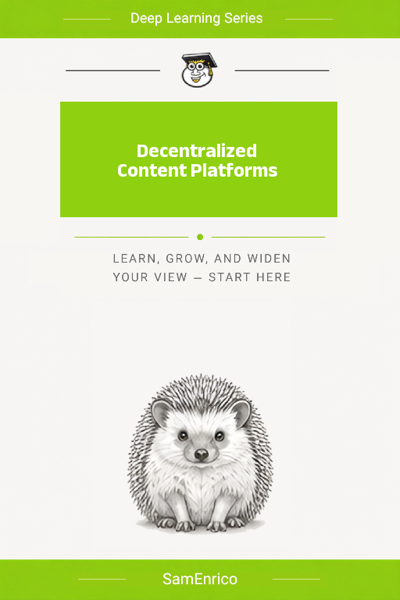
Decentralized Content Platforms eBook
A Coursebook on Decentralized Content Platforms
by Jarvis Daryl
A Coursebook on Decentralized Content Platforms
Formats
Free sample
Chapter 1: The Great Unraveling...--–- On October 17, 2021, a You Tuber named Claire sat in her Los Angeles apartment staring at a blank screen where her income used to be. She had 2.3 million subscribers. Her videos about sustainable living had been viewed over 400 million times. She had a production team of seven people, a mortgage, and a three-year-old daughter. That morning, she opened You Tube Studio to check her analytics and found a single line of red text: "This account has been terminated for violating our Community Guidelines." No specific video cited.
No appeal button that worked. No human being to call. In the twelve hours that followed, Claire lost everything her nine-year career had built. Her entire back catalog of 800 videos—gone. Her email list, which she had been building through You Tube's "private" messaging system—gone.
Her Patreon link, which You Tube had allowed her to pin to every video—orphaned. She posted on Twitter, "If anyone has my videos saved, please DM me. I didn't back them up." The tweet got 40,000 retweets. But only three people had saved any of her work. She had trusted the platform.
The platform had not trusted her back.This is not a story about a rogue algorithm or a bad moderator. This is a story about the architecture of the internet itself. Claire did not lose her channel because she broke a rule. She lost her channel because she never owned it in the first place. You Tube did not take something that belonged to her.
It revoked access to something that belonged to it. And in that distinction lies the central crisis of our digital age: the web we built together has been taken from us, one terms-of-service update at a time.The Three Internets To understand how we arrived at a world where a creator with millions of fans can be erased overnight, we need to travel backward. The internet has lived through three distinct architectural eras, and each one has redefined the relationship between people, content, and power.Web 1.0: The Read-Only Era (1990–2004)The first internet was a library. Static HTML pages sat on personal servers. You visited a website, read its content, and left.
If you wanted to publish something, you needed to know how to write HTML, rent server space, and manage your own domain. The barrier to entry was high, but the reward was absolute ownership. When you published a page on your own server running on your own domain, no one could take it from you without seizing the physical machine. Geocities and Angelfire offered free hosting, but even there, you could download your files and move them elsewhere. The web was decentralized by necessity, not by philosophy.
There simply wasn't a better way to build it yet.The limitations of Web 1.0 were real. Most people could not create content; they could only consume it. Interaction was limited to email links and rudimentary guestbooks. E-commerce required custom payment integrations. Social networks did not exist.
But for all its clunkiness, Web 1.0 had a property that we have since lost: users owned their own infrastructure. If you wanted to delete your website, you deleted the files yourself. No platform could do it for you.Web 2.0: The Read-Write Era (2005–2024)Then came the platforms. Blogger, Word Press, My Space, Facebook, Twitter, You Tube, Substack, Tik Tok. The promise was irresistible: stop wrestling with servers and HTML.
Let us handle the technology. You just create. And create we did. User-generated content exploded from zero to billions of pieces per day. The web became read-write—anyone could publish anything instantly, for free, with no technical skills.But there was a catch hidden inside every terms-of-service agreement.
The platforms were not altruistic utilities. They were businesses built on a specific economic model: provide free tools, capture user attention, sell that attention to advertisers, and keep the vast majority of the revenue. This model required platforms to own the relationships between creators and their audiences. If a You Tuber could easily migrate her subscribers to a competing platform, You Tube's bargaining power would collapse. So platforms engineered "stickiness"—not through better products, but through deliberate friction.
You cannot export your subscriber list. Your videos live on their servers. Your analytics are their proprietary data. Your channel is a row in their database.Chris Dixon, the venture capitalist and author of Read Write Own, calls this the "Faustian bargain" of Web 2.0. Users received free, powerful tools in exchange for surrendering ownership of their digital lives.
Alex Tapscott, in Web3: Charting the Internet's Next Economic Frontier, describes the result as "the Great Centralization"—the consolidation of the internet's economic value into five companies: Google (You Tube), Meta (Facebook, Instagram), Amazon (Twitch, Kindle), Apple (the App Store), and Microsoft (Linked In, Git Hub). Between them, these five firms capture more than 80 percent of all digital advertising revenue and control the distribution channels for nearly all digital content.This was not an accident. Network effects—the phenomenon where a platform becomes more valuable as more people use it—create natural monopolies. The first social network to reach critical mass becomes almost impossible to displace. Facebook had 1 billion users; no competitor could offer a better experience because the experience was the other users.
This lock-in allowed platforms to raise their "rent" over time. You Tube started with a 45 percent revenue share for creators. Today, after accounting for all fees and taxes, most creators keep less than 30 percent of the ad revenue their content generates. Amazon Kindle takes up to 65 percent of ebook sales. Substack takes 10 percent of subscription revenue, plus payment processing fees that can add another 5–8 percent.The platforms became digital landlords, and creators became sharecroppers.
And like all landlords, they wrote the rules. Which brings us to the second hidden cost of Web 2.0.The Algorithm as Landlord Claire did not wake up on October 17 expecting to be homeless. She had done everything You Tube asked. She posted three times per week. She followed the monetization policies.
She avoided copyrighted music. She flagged her own videos when she thought they might be borderline. And still, the platform evicted her.The specific reason for her termination, which she eventually learned after two weeks of emailing every Google employee she could find, was a single video about composting. In the video, she had said, "Some commercial compost facilities use chemicals that I personally wouldn't want near my vegetable garden." A viewer flagged this as "medical misinformation about chemical safety." An automated system reviewed the flag, found the phrase "chemicals" and "unsafe" in proximity, and terminated the channel. No human reviewed the decision until Claire's lawyer got involved.
By then, the damage was done. She had lost two weeks of income, her entire back catalog, and her trust in the platform.This is algorithmic censorship—not censorship in the First Amendment sense, but in the economic sense. Platforms are not government actors. They can ban anyone for any reason or no reason at all. The problem is not that platforms moderate content.
The problem is that they moderate through opaque, unaccountable, and frequently broken automated systems that creators cannot appeal. And because platforms control the only path to most audiences…
This is the end of the free sample. Get the eBook to keep going. Buy now
About this book
Details
- Author
- Jarvis Daryl
- Publisher
- SamEnrico
- Language
- English
- Genre
- Non-Fiction, Informative, Educational
- Released
- 2026-06-02
- Pages (approx.)
- 152
- Available as
- eBook, Audiobook

Read better in the ZLOADR app
Your eBooks on your phone or tablet. Sign in with your SamEnrico account and start reading.
More by Jarvis Daryl
 The Pneumonia Vaccine GuideJarvis Daryl$11.99
 The Teen Identity WorkbookJarvis Daryl$11.99
 Financial Stress And Substance Use GuideJarvis Daryl$11.99
 The Learning Disability Shame GuideJarvis Daryl$11.99
 Like Addiction Recovery WorkbookJarvis Daryl$11.99
 Online Gambling Self Exclusion GuideJarvis Daryl$11.99
 Heroin to HarvardJarvis Daryl$11.99
 Athlete Resilience GuideJarvis Daryl$11.99
 Imposter Syndrome In SalesJarvis Daryl$11.99
 Hostile Bid: The Unseen War for Yahoo!Jarvis Daryl$11.99
 The Hollow Hill's Last Guardian: A Tuatha Dé Danann's OathJarvis Daryl$11.99
 The Babylonian Star Gazers: How Ancient Mesopotamia Mapped the PlanetsJarvis Daryl$11.99
You may also like
 Hong Kong Handover 1997Dunn Johnnie$11.99
 Zumba For Postnatal Recovery CourseNeal Christian$11.99
 Zumba for BeginnersLadner Nikia$11.99
 YouTube Comment Mining GuideHumes Pandora$12.99
 Worry Box MeditationCarlin Rudy$11.99
 Workplace Stress MeditationNguyen Lynn$11.99
 Workplace Stress and Sleep RepairHawley Ivory$11.99
 Workplace Perfectionism CureDelaney Jeffry$11.99
 Workplace Injustice Anger GuideWallen Isabelle$11.99
 Work Addiction and Burnout LinkGreenwood Ester$11.99
 Women in Yoga and WellnessBeattie Galina$11.99
 Women in Stand Up ComedyChun Evangeline$11.99