
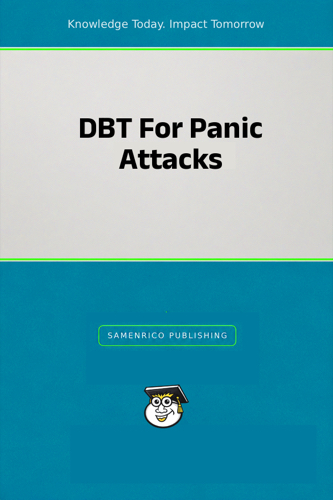
DBT For Panic Attacks eBook
Use TIPP and temperature change to stop panic epis
Use TIPP and temperature change to stop panic episodes quickly.
Formats
Free sample
Chapter 1: The Body Betrayal--–- The first time it happened, I was stopped at a red light. Not running a marathon, not giving a speech, not in a war zone. Just sitting in my car, listening to a podcast about medieval history, waiting for the light to turn green. My heart began to pound like a fist against a door. My vision tunneled inward, as if someone was slowly closing a curtain from the edges.
My hands—my perfectly healthy, twenty-six-year-old hands—went numb. And then came the thought, the one that changes everything: I am dying.–- I did what any rational person would do. I pulled into a pharmacy parking lot, stumbled inside, and asked the pharmacist to take my blood pressure. She looked at me—sweating, pale, pupils dilated—and said, "You need to sit down." My blood pressure was elevated, but not dangerously. My pulse was 140, but regular.
She asked if I had taken any drugs. No. Had I been running? No. Was I under stress?
The normal amount. She handed me a cup of water and said, "I think you might have had a panic attack."–- A panic attack. The words felt like an insult. I wasn't the kind of person who had panic attacks. I was calm.
I was logical. I had a graduate degree. I had read books about stoicism. I had meditated—actual meditation, not the app version—for three months straight in 2019. Panic attacks were for people who drank too much coffee or had unresolved childhood trauma or watched too much news.
Not me.–- But there I was, sitting on a folding chair in a CVS, holding a tiny paper cup, afraid to drive home because what if it happened again? What if I passed out behind the wheel? What if the numbness spread to my chest? What if the pharmacist was wrong and I was actually having a heart attack and she had just sent me back out to die?–- That was the beginning of my education. And the first thing I learned—the thing that changed everything—was that I had been lied to.
Not maliciously. Not by any single person. But by an entire culture that believes you can think your way out of fear.The Myth of Reasoning with a Panic Attack–- Here is the lie: when you feel panic rising, you should remind yourself that you are safe. You should take a deep breath. You should tell yourself that this is just anxiety, that it will pass, that there is no real danger.
This advice appears everywhere—in magazine articles, on mental health hotlines, in the calm, reasonable voices of therapists who have never woken up at 3 a.m. convinced that their heart is about to stop.–- This advice does not work. Worse, it can make the panic worse. And the reason is not psychological weakness or lack of willpower. It is neurobiology.–- To understand why you cannot talk yourself down from a panic attack, you need to understand what a panic attack actually is.
Most people use the words "anxiety" and "panic" interchangeably, but they are not the same thing. Anxiety is cognitive. It lives in words and scenarios. Anxiety says, What if I fail the presentation? What if she doesn't call me back?
What if I get sick on the plane? Anxiety has a narrative structure. It has a beginning, a middle, and an anxious end. You can argue with anxiety. You can say, "That's unlikely," or "I've handled worse," or "I have a plan."–- Panic is not anxiety.
Panic is a physiological hijack. It does not have a story. It has a siren. It is the difference between worrying about a fire and being inside a burning building. When panic arrives, your prefrontal cortex—the part of your brain that handles logic, reasoning, and self-awareness—is not merely distracted.
It is overridden. Shut down. Taken offline by an older, faster, more powerful part of your brain called the amygdala.The Amygdala: Your Brain's Smoke Detector–- The amygdala is often called the brain's fear center, but that is a simplification. A better metaphor is a smoke detector. Its job is not to understand fire.
Its job is to detect a threat and sound the alarm immediately, without waiting for confirmation. Evolution designed the amygdala to be fast, not accurate. A smoke detector that waits to confirm that smoke is actually fire before sounding the alarm is a smoke detector that burns down the house.–- The amygdala sits deep in the brain, in the medial temporal lobe, and it has direct connections to your brainstem and your autonomic nervous system. It does not need to consult the prefrontal cortex. In fact, it can send a distress signal to your body—your heart, your lungs, your adrenal glands—before your conscious brain even registers what is happening.
This is why you sometimes jump back from a curb before you consciously see the bus. That was your amygdala.–- Under normal conditions, the amygdala and the prefrontal cortex communicate. The amygdala says, "Something might be wrong," and the prefrontal cortex says, "Let me check. No, that's just a shadow. False alarm.
Calm down." This is the feedback loop that allows you to walk through a dark house without calling the police every time you see a coat hanging on a door.–- But during a panic attack, that feedback loop breaks. The amygdala becomes hyperactive—for reasons that are still not fully understood, but likely involve a combination of genetic vulnerability, stress, sleep deprivation, and previous conditioning—and it sends a full alarm signal to your body without any input from the prefrontal cortex. Worse, it actively suppresses the prefrontal cortex. Your logic center is not just ignored; it is gagged.–- This is why, during a panic attack, you cannot remember that you have survived panic attacks before. You cannot access the memory of the last time you felt this way and did not die.
You cannot use positive affirmations. You cannot talk yourself down. Your prefrontal cortex is not available to you. It is like trying to use a laptop that has been unplugged and has a dead battery. The hardware is still there, but the power is gone.The Body's Response: A False Alarm of Epic Proportions–- So the amygdala sounds the alarm.
What happens next? Your sympathetic nervous system—the "gas pedal" of your autonomic nervous system—activates within milliseconds. Your adrenal glands release epinephrine (adrenaline) and norepinephrine. Your heart rate accelerates. Your blood pressure rises.
Your breathing becomes fast and shallow. Your pupils dilate to take in more light. Blood is shunted away from your skin and digestive system and toward your large muscle groups. Your palms sweat. Your mouth goes dry.
Your hearing sharpens. You are now a perfect fighting or fleeing machine.–- There is only one problem: there is nothing to fight and nowhere to flee. You are on a stationary subway car. You are in a meeting. You are lying in bed.
Your body has prepared you for a lion attack, but the lion does not exist. And now you have ten…
This is the end of the free sample. Get the eBook to keep going. Buy now
About this book
Details
- Author
- Valentine Shalon
- Publisher
- SamEnrico
- Language
- English
- Genre
- Non-Fiction, Self-Help, Panic
- Released
- 2026-06-08
- Pages (approx.)
- 155
- Available as
- eBook, Audiobook

Read better in the ZLOADR app
Your eBooks on your phone or tablet. Sign in with your SamEnrico account and start reading.
More by Valentine Shalon
 Delegation for LawyersValentine Shalon$11.99
 Manly P Hall Wisdom GuideValentine Shalon$11.99
 Breath Awareness For EntrepreneursValentine Shalon$11.99
 Pelvic Floor for GymnastsValentine Shalon$11.99
 Eisenhower Matrix for Project ManagersValentine Shalon$11.99
 Overcoming Parental Criticism LegacyValentine Shalon$11.99
 Pomodoro For Email ManagementValentine Shalon$11.99
 The Iron Forges of Meroë: Forge of the Nile’s MightValentine Shalon$11.99
 The Fall of Angkor: Fire and Blood in the Khmer EmpireValentine Shalon$11.99
 How to Produce a String TrimmerValentine Shalon$11.99
 Mastering The Art of Kuk Sool WonValentine Shalon$11.99
 How to Produce HammocksValentine Shalon$11.99
You may also like
 Mindful Breathing For Panic GuideEastman Leandra$11.99
 Breath Awareness for PanicAbney Dede$11.99
 Breath for Panic DisorderKearns Annice$11.99
 Walking Meditation For Panic DisorderAlley Delmy$11.99
 TM for Panic DisorderStamper Mechelle$11.99
 Student Panic Attack ManagementWiseman Catharine$11.99
 Panic Disorder Night PracticePridgen Kory$11.99
 Meditation For Panic BeginnersWoo Taisha$11.99
 The Money Panic Attack GuideBurdette Vella$11.99
 The Breath Anchor for PanicLadner Eneida$11.99
 Panic Attack Emergency GuideDelgado Curtis$11.99
 MBSR for Panic DisorderBrumfield Florencia$11.99