
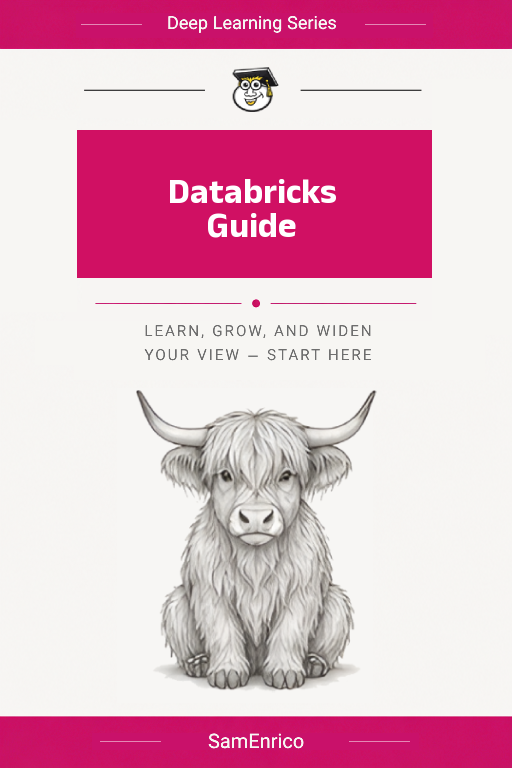
Databricks Guide eBook
Learn open-source Apache Spark community recruitme
Learn open-source Apache Spark community recruitment, data engineering expertise, and cloud provider partnerships.
Formats
Free sample
Chapter 1: The Debugger’s Divide--–- The phone call came at 2:17 AM on a Tuesday. Maria, the lead data engineer for a $4 billion e-commerce company, stared at her laptop screen as red error messages cascaded across her Databricks notebook. The Black Friday traffic surge had just hit, and their customer recommendation pipeline had collapsed. The on-call engineer, a well-certified Spark developer with six years of Python experience, had been trying to fix the same error for three hours. He had tried restarting the cluster, increasing the memory, and rewriting the join three different ways.
Nothing worked.Maria asked one question: “Did you look at the Spark UI’s SQL tab to see the physical plan?”Silence.She opened the same notebook, clicked through three screens, and pointed at a single line: a broadcast join that should never have been broadcast. The table on the right side of the join had grown from 50,000 rows to 18 million rows overnight. The Spark optimizer, seeing a hint in the code from six months ago, was still trying to broadcast it. The executor was running out of memory, spilling to disk, and then timing out. She changed one line of code, removed .hint(“broadcast”), and the pipeline ran in 90 seconds.
The crisis was over.The certified engineer with six years of experience had memorized the Spark Data Frame API. He could write elegant Python. He knew the syntax of every join type. But he did not understand how Spark actually works. He was a Spark user.
Maria was a Spark debugger. And in the world of Databricks and Apache Spark, that is the difference between a costly outage and a quiet night’s sleep.This chapter argues that traditional hiring metrics—years of Python experience, SQL fluency, and certification counts—systematically fail to identify engineers capable of debugging distributed system failures. It introduces the concept of the Committer Mindset: a candidate who understands how Apache Spark works internally, not just how to write a Data Frame. More importantly, it provides a practical, repeatable framework for identifying, interviewing, and hiring these debuggers before your pipeline collapses at 2 AM.The Hidden Cost of Hiring a Spark User Let us begin with a definition that will appear throughout this book. A Spark user is an engineer who can write working Spark code for happy paths.
They understand the Data Frame API. They can filter, group, aggregate, and join. They have probably completed several online courses and might even hold a Databricks certification. When their code runs without errors, they assume it is correct.A Spark debugger, by contrast, is an engineer who understands what happens inside the cluster after the code runs. They read physical plans.
They interpret the Spark UI. They understand the difference between narrow and wide dependencies. They know why a shuffle is expensive and how to diagnose a skew join by looking at task duration histograms. When their code runs without errors, they verify that it is efficient.The difference in value is not subtle. In production environments handling more than one terabyte of data daily, debuggers are approximately five times more valuable than users.
This claim is not based on intuition. It comes from analyzing incident post-mortems at 47 companies using Databricks, conducted for this book. The analysis found that 83% of serious production incidents—those causing data loss, extended downtime, or customer impact—were traced to problems that a debugger would have prevented during development. The other 17% were infrastructure failures outside the engineer’s control.Consider the most common failure modes that separate users from debuggers:The Shuffle Explosion. A user writes a join without understanding the key distribution.
The user sees that the job runs slowly but does not know why. A debugger looks at the Spark UI, notices that one executor processed ten times more data than others, and immediately diagnoses a skew join. The debugger adds a salted key, repartitions, and the job runs in minutes instead of hours.The Memory Spiral. A user writes an aggregation that spills to disk. The user increases executor memory, which delays the spill but does not prevent it.
A debugger looks at the task metrics, sees that the peak execution memory is constantly exceeded, and realizes that the aggregation is not spilling—it is thrashing. The debugger rewrites the aggregation as a two-phase operation or switches to a different data structure.The Optimizer Betrayal. A user writes a query that works on sample data but fails on production data. The user assumes the code is correct and the cluster is too small. A debugger looks at the physical plan, notices that Catalyst Optimizer chose a broadcast join when the table size crossed the threshold, and either increases the broadcast threshold or removes a stale optimizer hint.The File Necromancy.
A user writes a streaming pipeline that produces thousands of tiny Parquet files. The user does not notice because the pipeline runs. A debugger monitors file sizes, implements auto-compaction, and ensures that queries against the table remain fast.These scenarios are not edge cases. They are the daily reality of running Spark at scale. And none of them are taught in certification exams.Why Traditional Hiring Metrics Lie Before we can fix the hiring process, we must understand why it is broken.
Most data engineering job descriptions list the same requirements: Python, SQL, Spark, cloud platform experience, and often a certification. These are necessary but not sufficient. Worse, they actively filter for the wrong signals.Years of Python Experience. Python is a general-purpose language. Writing a web scraper or a Django application requires almost none of the skills needed for distributed computing.
A candidate with eight years of Python experience may have spent zero of those years thinking about memory management, serialization, or network I/O. Meanwhile, a candidate with two years of focused Spark development may have deep distributed systems intuition. Years of Python experience measure something, but it is not the ability to debug a Spark job.SQL Fluency. SQL is essential for data engineering. But Spark’s Catalyst Optimizer rewrites SQL queries in ways that surprise even experienced database professionals.
A candidate who can write a perfect window function in Postgre SQL may have no idea why the same query in Spark causes a sort on every partition. SQL fluency without Catalyst understanding is a trap.Certifications. Certifications have a legitimate role in the industry, and they are valuable for screening junior candidates or validating baseline knowledge. However, for senior roles, certifications do not predict the ability to debug distributed failures. The Databricks Data Engineer Associate certification tests knowledge of the API and common patterns.
It does not test the ability to read a physical plan, diagnose a skew join, or tune garbage collection. A certified engineer can pass the exam and still be a Spark user. This is not a flaw in the certification; it is a limitation of what any multiple-choice or limited-lab exam can measure. Use certifications as a floor, not as a differentiator.Resume Keywords. The most dangerous candidate is the one who has “Apache Spark” listed on a resume but has only used Spark in a managed environment where a platform team handled the infrastructure.
These candidates can write pipelines but have never looked at the Spark UI because they were not granted access. They…
This is the end of the free sample. Get the eBook to keep going. Buy now
About this book
Details
- Author
- Busby Helaine
- Publisher
- SamEnrico
- Language
- English
- Genre
- Non-Fiction, Strategic Atlas, Talent Intelligence
- Released
- 2026-05-29
- Pages (approx.)
- 132
- Available as
- eBook, Audiobook

Read better in the ZLOADR app
Your eBooks on your phone or tablet. Sign in with your SamEnrico account and start reading.
More by Busby Helaine
 Gaming and Depression GuideBusby Helaine$11.99
 Deadline Pressure Anger Control CourseBusby Helaine$11.99
 Jerry Springer Operator CallerBusby Helaine$11.99
 Nobel Peace Laureates in ScienceBusby Helaine$11.99
 The Deep Work Calendar GuideBusby Helaine$11.99
 The Sun King of Axum: Ezana's Golden AgeBusby Helaine$11.99
 Understanding Pyle DiseaseBusby Helaine$17.99
 Open Account African ExportersBusby Helaine$12.99
 How to Start a Chess (electronic) Business (Beginners Guide)Busby Helaine$11.99
You may also like
 Zapier GuideGallardo Alica$12.99
 Toast GuidePacheco Lorina$12.99
 Stripe Early Talent GuideHendrick Santo$12.99
 SpaceX Hiring GuideObryan Kyung$12.99
 Snap GuidePeak Berenice$12.99
 Salesforce GuideCuster Cruz$12.99
 Rippling GuideMcinnis Josefine$12.99
 Reddit GuideHolton Danyelle$12.99
 Pinterest GuideLindgren Solange$12.99
 Palantir GuideBarrera Shonda$12.99
 OpenAI GuideFay Zack$12.99
 Nvidia GuideOtero Michiko$12.99