
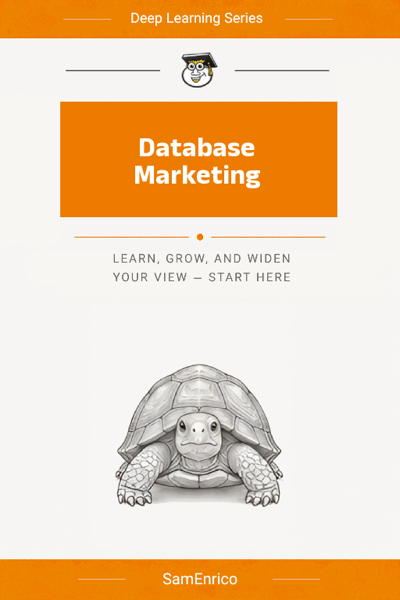
Non-FictionInformativeEducational
Database Marketing eBook
A Coursebook on Database Marketing
A Coursebook on Database Marketing
Formats
Free sample
Chapter 1: The $47 Trillion Blind Spot--Every year, companies around the world spend over $600 billion on advertising. They pour money into Google ads, Facebook campaigns, television spots, billboards, and sponsored content. They track click-through rates, impression counts, and cost-per-acquisition with religious fervor. And yet, the vast majority of these same companies cannot answer a single question that matters more than all of their marketing metrics combined: What is the total value of the customers you already own?Ask a CFO the value of their inventory. They will tell you to the penny.
Ask them the value of their factory, their intellectual property, or their real estate. They will produce spreadsheets, appraisals, and depreciation schedules. But ask them the value of their customer base—the only reason any of those other assets exist—and you will be met with a blank stare. That blank stare costs the global economy an estimated $47 trillion annually. It is the single largest source of wasted opportunity in the history of commerce.This book exists because that blank stare is optional.
It is curable. And the cure is called database marketing.The Invention You Already Know Let us begin with a story about a technology so ancient, so fundamental, that we have forgotten it was ever invented.Before computers. Before spreadsheets. Before loyalty cards and cookies and customer data platforms. There was a grocer.
He worked six days a week behind a wooden counter in a neighborhood that knew his name. When a customer walked through the door, he did not ask, "How can I help you?" He already knew. He knew that Mrs. Henderson preferred the darker roast. He knew that the Murphy family bought two loaves of bread every Tuesday and a dozen eggs every Friday.
He knew that the young couple expecting their first child had started buying diapers—not because they told him, but because he noticed the pattern.This grocer was not a genius. He was not a technologist. He was simply paying attention. He was doing, at a microscopic scale, what database marketing does at a global scale: remembering who his customers were, what they wanted, and when they wanted it. He was building, in his mind, what we now call a Single Customer View.The only difference between that grocer and your company is scale.
He served two hundred families. You serve two million. He remembered everything because his brain was sufficient for the task. You remember nothing because your spreadsheets, your CRM, your email platform, and your point-of-sale system are all having a silent argument about who owns the truth. The grocer had no silos.
You have twelve.Database marketing is not a new invention. It is the digital scaling of an ancient, trusted model: know your customer, remember what you know, and use that knowledge to serve them better. Everything else in this book is just technique.The Definition That Changes Everything Before we go any further, we need to be precise about what database marketing is—and what it is not.Database marketing is the use of individual customer data stored in a unified, persistent database to customize marketing communications, offers, and experiences over the lifetime of the customer relationship.Let us break that definition into its four essential components.First: individual customer data. Not aggregates. Not averages.
Not "millennials prefer X" or "women in Chicago buy Y." Database marketing operates at the level of the single human being. It knows that Jennifer bought a blue sweater on Tuesday, returned it on Thursday, and called customer service on Friday to complain about the shipping time. It knows this because it tracks Jennifer, not "customers like Jennifer."Second: stored in a unified, persistent database. This is the Single Customer View (SCV), and it is the non-negotiable foundation of everything that follows. An SCV means that every interaction Jennifer has with your company—her web browsing, her email opens, her store visits, her call center conversations, her purchases, her returns, her review of the blue sweater—is connected to a single identifier (usually her email address or customer ID).
Without an SCV, you do not have database marketing. You have a collection of disconnected lists that happen to share a company logo.Third: to customize. The goal is not to send more messages. The goal is to send better messages. A database marketer does not ask, "How can we reach more people?" They ask, "How can we reach Jennifer with something she actually wants, at a time when she actually wants it, through a channel she actually prefers?"Fourth: over the lifetime of the relationship.
This is the most important word in the definition. Database marketing is not about the next transaction. It is about the next decade of transactions. It optimizes for customer lifetime value, not next-quarter revenue. It asks, "What does Jennifer need from us over the next five years?" not "What can we sell Jennifer today?"Now let us contrast this with two concepts that are often confused with database marketing.Direct marketing is simply sending a message via mail, email, or phone to a list of people.
There is no requirement that the list be unified. There is no requirement that the message be customized. There is no requirement that the relationship extend beyond this single contact. Direct marketing asks, "Do we have this person's address?" Database marketing asks, "Do we understand this person?"CRM (Customer Relationship Management) is software that helps manage interactions with customers and prospects. It is a tool, not a strategy.
You can have a perfectly functional CRM and still practice no database marketing whatsoever—if your sales team uses it to track deals, your support team uses it to log tickets, and your marketing team uses it to blast emails, and none of these systems talk to each other. That is not database marketing. That is organized chaos.Database marketing is the strategy. The database is the asset. The SCV is the architecture.
Everything else—the software, the campaigns, the analytics—is implementation.The Case of the Teenager and the Diapers If database marketing is so powerful, why do so many companies get it wrong? The answer lies in a cautionary tale that every marketer should memorize.In 2012, a major American retailer—let us call them Target—began using predictive analytics to identify customers who were likely pregnant. The logic was sound: pregnancy is a life event that triggers massive changes in purchasing behavior. New parents buy diapers, wipes, formula, baby clothes, nursery furniture, and a thousand other products. If you can identify a pregnant customer early, you can capture years of high-margin spending.Target's data scientists built a model that analyzed purchasing patterns and assigned each customer a "pregnancy prediction score." The model worked beautifully.
Too beautifully.A few months after the program launched, a man walked into a Target store outside Minneapolis and demanded to speak to the manager. He was holding a coupon that Target had mailed to his teenage daughter. The coupon offered discounts on baby clothes, diapers, and nursery furniture. "My daughter is in high school," the man said, his voice shaking with rage. "Are you trying to encourage her to get pregnant?"The manager apologized profusely.…
This is the end of the free sample. Get the eBook to keep going. Buy now
About this book
Details
- Author
- Hammett Ariel
- Publisher
- SamEnrico
- Language
- English
- Genre
- Non-Fiction, Informative, Educational
- Released
- 2026-06-02
- Pages (approx.)
- 146
- Available as
- eBook, Audiobook

Read better in the ZLOADR app
Your eBooks on your phone or tablet. Sign in with your SamEnrico account and start reading.
More by Hammett Ariel
 Yoga Nidra Bedtime GuideHammett Ariel$11.99
 Home Ownership EnvyHammett Ariel$11.99
 Pelvic Floor and HemorrhoidsHammett Ariel$11.99
 Laughter Daily Medicine HabitHammett Ariel$11.99
 The Luddite Machine BreakersHammett Ariel$11.99
 The Siege of Nicaea: The First Ottoman Shockwave (1331 AD)Hammett Ariel$11.99
 How to Start a Alloy Tool Steel Business (Beginners Guide)Hammett Ariel$11.99
 The Breeder's Guide to Cochin ChickensHammett Ariel$11.99
 Physical Address for Non Resident LLCHammett Ariel$12.99
 Cape Town Healthtech GuideHammett Ariel$12.99
You may also like
 Hong Kong Handover 1997Dunn Johnnie$11.99
 Zumba For Postnatal Recovery CourseNeal Christian$11.99
 Zumba for BeginnersLadner Nikia$11.99
 YouTube Comment Mining GuideHumes Pandora$12.99
 Worry Box MeditationCarlin Rudy$11.99
 Workplace Stress MeditationNguyen Lynn$11.99
 Workplace Stress and Sleep RepairHawley Ivory$11.99
 Workplace Perfectionism CureDelaney Jeffry$11.99
 Workplace Injustice Anger GuideWallen Isabelle$11.99
 Work Addiction and Burnout LinkGreenwood Ester$11.99
 Women in Yoga and WellnessBeattie Galina$11.99
 Women in Stand Up ComedyChun Evangeline$11.99