
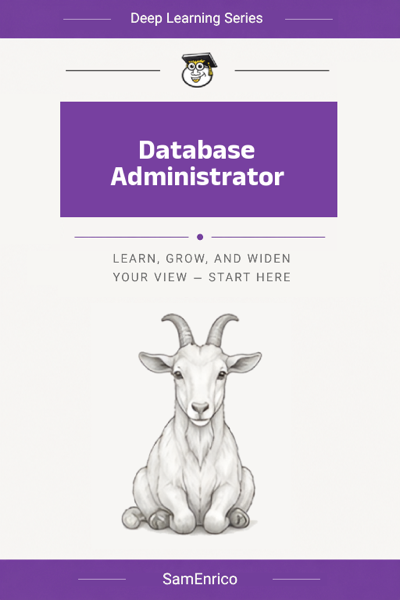
Non-FictionInformativeEducational
Database Administrator eBook
A Coursebook on Database Administrator
by Yazzie Rikki
A Coursebook on Database Administrator
Formats
Free sample
Chapter 1: The Data Guardian...–- The phone rings at 2:47 AM. On the other end, a panicked application owner says, "The website is down. Customers can't check out. We're losing ten thousand dollars a minute." Your first thought isn't about code. It isn't about the network.
Your first thought is: Is the database accessible? Is the data safe? Can I get it back?Welcome to the life of a Database Administrator. Not the "database janitor" who merely cleans up after developers. Not the silent figure in the back of a dark data center.
You are a Data Guardian – the professional responsible for the single most valuable asset any organization owns in the digital age: its data.This chapter will redefine what it means to be a DBA in the modern enterprise. We will dismantle the outdated stereotypes, explore the five pillars that govern every decision you will make, and help you chart your own path through the three major specializations within the field. By the end, you will see the DBA role not as a technical support function, but as a strategic, business-critical discipline that requires a unique blend of deep technical knowledge, operational rigor, and communication skill.The Outdated Stereotype vs. The Modern Reality If you search online for "DBA," you will still find memes and articles describing a grumpy gatekeeper – someone who says "no" to every request, hoards passwords, and spends their days running the same backup script they wrote a decade ago. This is the "Database Janitor" stereotype, and it is not only wrong, but dangerous.The modern DBA is not a gatekeeper; they are an enabler.
Your job is not to say "no"; it is to say "yes, if we meet these safety conditions." You do not hoard knowledge; you automate and document so that others can self-serve within safe boundaries. You do not run scripts from a decade ago; you constantly seek to improve performance, tighten security, and reduce downtime.The difference between the Janitor and the Guardian is proactivity. The Janitor waits for something to break. The Guardian watches for leading indicators of failure, automates repetitive tasks, and educates developers on writing efficient queries before they ever reach production. The Janitor restores from backup after a disaster.
The Guardian tests their restores weekly so the disaster is a minor inconvenience, not a career-ending event.Throughout this coursebook, you will learn the skills, tools, and mindset of the Guardian. This first chapter lays the philosophical and structural foundation for everything that follows.The Five Pillars of Database Administration Every task a DBA performs, from the most mundane password reset to the most dramatic disaster recovery, falls under one of five core responsibilities. Think of these as the pillars that hold up the entire data infrastructure. If any one pillar weakens, the entire system is at risk.Pillar One: Performance Businesses run on speed. A database query that takes five seconds instead of 500 milliseconds might not sound like much, but multiply that by ten thousand users and critical business processes grind to a halt.
The Performance pillar is about ensuring that the database returns data as quickly as business needs require.This includes tuning queries, designing efficient indexes, configuring memory and storage, and understanding execution plans. However, it is not purely technical. The DBA must also manage expectations – helping stakeholders understand that "infinite speed" costs infinite money, and that there is always a trade-off between speed, consistency, and cost. A well-tuned database on modest hardware will outperform a poorly configured database on supercomputers every time.Pillar Two: Security Data breaches make headlines, and the DBA is often the last line of defense. The Security pillar encompasses everything from authentication (who can log in) to authorization (what they can do once logged in), encryption (protecting data at rest and in transit), and auditing (knowing who did what, when).A modern DBA does not simply install the database and hand out usernames.
They implement the principle of least privilege, rotate credentials automatically, and work with security teams to ensure compliance with regulations like GDPR, HIPAA, and PCI-DSS. As we will cover in detail in later chapters, a secure database is not an accident; it is a deliberate, layered set of controls. The guardian DBA assumes breach and builds defenses accordingly.Pillar Three: Availability Availability means that the database is up and accessible when users need it. The phrase "five nines" (99.999% uptime) is often thrown around, but the DBA knows that availability is not a percentage; it is a series of design choices. Does the business need high availability (HA) to survive a server crash?
Or disaster recovery (DR) to survive a data center fire? Or both?Availability architecture includes clustering, replication, failover automation, and load balancing. But it also includes mundane tasks like monitoring disk space (a full disk will bring down any database) and ensuring network connectivity. The guardian DBA does not promise 100% uptime – because that is impossible – but they do promise to know what the recovery time will be and how much data can be lost. They document those promises as Service Level Agreements (SLAs) and measure themselves against them.Pillar Four: Automation The fourth pillar is the force multiplier.
A DBA who performs every task manually will inevitably make mistakes, miss alerts, and burn out. Automation – writing scripts and tools that perform repetitive tasks without human intervention – is what separates the amateur from the professional.This includes scheduled jobs for backups and index maintenance, monitoring that pages the on-call DBA only when truly necessary, and infrastructure-as-code that allows entire database servers to be rebuilt from a configuration file. As we will discuss later, a "lazy" DBA who automates everything is far more valuable than a "hardworking" DBA who manually clicks through the same windows every day. Automation also creates documentation: a script that works is, by definition, a correct set of instructions.Pillar Five: Compliance Compliance is often misunderstood as an annoying checklist imposed by lawyers and auditors. In fact, compliance is verified trust.
When your organization claims to handle customer data responsibly, compliance audits are how they prove it.The DBA's role in compliance includes implementing audit trails, ensuring data retention policies are enforced, proving that backups are restorable, and demonstrating that access controls are effective. In regulated industries (finance, healthcare, government), the DBA's work is scrutinized by external auditors. The guardian DBA embraces this not as a burden, but as a professional standard. They know that a compliant database is also a well-run database.The Three Faces of the DBANot all DBA roles look the same. Depending on the size of the organization and the stage of the application lifecycle, a DBA might specialize in one of three distinct areas.
Many DBAs will move between these roles over their careers. Understanding all three will make you a more versatile professional.The Development DBAThe Development DBA works closely with software engineers during the application design and coding phase. Their goal is to prevent problems before they reach production. This includes:Reviewing SQL queries for performance and correctness before they are merged into the codebase Designing database schemas that scale with the application's growth Creating and maintaining indexes based on actual query patterns Managing schema migrations and version…
This is the end of the free sample. Get the eBook to keep going. Buy now
About this book
Details
- Author
- Yazzie Rikki
- Publisher
- SamEnrico
- Language
- English
- Genre
- Non-Fiction, Informative, Educational
- Released
- 2026-05-08
- Pages (approx.)
- 160
- Available as
- eBook, Audiobook

Read better in the ZLOADR app
Your eBooks on your phone or tablet. Sign in with your SamEnrico account and start reading.
More by Yazzie Rikki
 Meditation for Knee OsteoarthritisYazzie Rikki$11.99
 Pinterest VA For NonprofitsYazzie Rikki$11.99
 Email Legal Hold GuideYazzie Rikki$11.99
 Alcohol Breast Cancer RiskYazzie Rikki$11.99
 Small Talk for Wedding ReceptionsYazzie Rikki$11.99
 The Great Bitcoin Heist: How a Single Hacker Stole $600 MillionYazzie Rikki$11.99
 Ibn Battuta: The Unseen Paths of the Islamic WorldYazzie Rikki$11.99
 Understanding Coloboma of Lens Ala NasiYazzie Rikki$17.99
 YC Interview For Pre SeedYazzie Rikki$12.99
 M&A Due Diligence BlockYazzie Rikki$12.99
 How to Start a Cartons Made of Corrugated Board Business (Beginners Guide)Yazzie Rikki$11.99
You may also like
 Hong Kong Handover 1997Dunn Johnnie$11.99
 Zumba For Postnatal Recovery CourseNeal Christian$11.99
 Zumba for BeginnersLadner Nikia$11.99
 YouTube Comment Mining GuideHumes Pandora$12.99
 Worry Box MeditationCarlin Rudy$11.99
 Workplace Stress MeditationNguyen Lynn$11.99
 Workplace Stress and Sleep RepairHawley Ivory$11.99
 Workplace Perfectionism CureDelaney Jeffry$11.99
 Workplace Injustice Anger GuideWallen Isabelle$11.99
 Work Addiction and Burnout LinkGreenwood Ester$11.99
 Women in Yoga and WellnessBeattie Galina$11.99
 Women in Stand Up ComedyChun Evangeline$11.99