
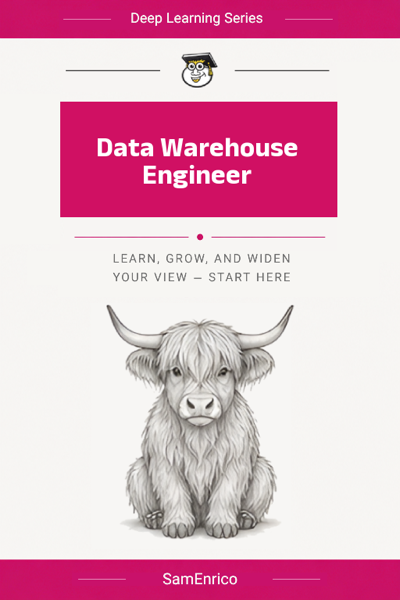
Non-FictionInformativeEducational
Data Warehouse Engineer eBook
A Coursebook on Data Warehouse Engineer
by Watts Jackie
A Coursebook on Data Warehouse Engineer
Formats
Free sample
Chapter 1: The Spinning Cursor--– Every morning, Sarah stared at the same screen. A spinning cursor. A dashboard that promised answers but delivered only frustration. Twenty-three minutes had passed since she clicked “Refresh,” and the quarterly listening report for Music Vibe’s executive team still hadn’t loaded. Her manager had already texted twice: “Numbers for the board meeting?”Sarah was a good BI analyst.
She knew SQL. She understood the business. She could build a mean pivot table. But none of that mattered when the database itself was failing.Her story is not unique. It plays out thousands of times every day in companies of every size.
A marketing manager needs to know which campaign drove the most sign-ups last week. A product leader wants to understand why user retention dropped after the latest release. A CFO needs accurate revenue numbers before the earnings call. And somewhere, a data person stares at a spinning cursor, unable to deliver because the underlying systems were never designed for the questions being asked of them.This book is for everyone who has ever felt that frustration. Whether you are a BI analyst like Sarah who wants to double your salary and escape the trap of slow dashboards, a junior data engineer who knows Python but freezes when asked about system design, or a self-taught builder whose pipelines work but you are not sure if you are doing them “right”—this book will transform how you think about data.But before we build anything, we must understand the crisis.
The modern data warehouse is not just a technical artifact. It is the nervous system of the data-driven company. When it fails, the entire organization feels the pain. When it works, it becomes a competitive weapon.The Three Curves That Determine Your Career Every data professional’s career is shaped by three hidden curves. Understanding them is the first step toward mastery.The Complexity Curve When a company grows tenfold, its data problems grow a hundredfold.
This is not an exaggeration—it is a mathematical reality. A startup with ten customers and a single Postgre SQL database can run any query instantly. That same startup with ten million customers and dozens of source systems—mobile apps, web servers, payment processors, customer support tools—cannot. The number of possible relationships between data points grows quadratically. The number of failure modes grows exponentially.Most data engineers learn only batch processing: scheduled jobs that run every night, moving data from point A to point B.
They hit a wall when the company asks for real-time insights. They panic when a pipeline breaks at two in the morning and they cannot figure out why. They feel stuck because they never learned the architectural patterns that scale.The Salary Curve Roles that understand batch processing and streaming and cloud-native architectures and governance command two to three times higher pay than those limited to batch-only skills. According to data from major job platforms, the difference between a junior data engineer earning eighty-five to one hundred ten thousand dollars and a senior data engineer earning one hundred fifty to two hundred thousand dollars is not just years of experience. It is the ability to design systems that are reliable, scalable, and maintainable.The companies paying top dollar—Snowflake, dbt Labs, Databricks, Netflix, Uber—are not looking for people who can write a Python script to copy a CSV file.
They are looking for engineers who understand dimensional modeling, idempotency, data quality frameworks, and real-time processing. They are looking for the skills this book will teach you.The Blame Curve Without a proper data warehouse, everyone blames everyone else for bad numbers. The marketing team says the sales data is wrong. The sales team says the product analytics are flawed. The product team says the finance numbers cannot be trusted.
The data engineer gets caught in the middle, spending eighty percent of their time reconciling discrepancies instead of building new capabilities.A well-designed data warehouse breaks the blame curve. When every report draws from the same gold-standard tables, when lineage shows exactly where each number came from, when quality tests run automatically before any data reaches stakeholders—trust replaces blame. And the engineer who builds that trust becomes indispensable.A Brief History of Data Warehousing You cannot understand where you are going without understanding where you have been. The history of data warehousing is a story of trade-offs: cost versus performance, flexibility versus governance, simplicity versus scalability.Gen 1: The EDW Era (1990s–2000s)The first enterprise data warehouses were built on massive, expensive appliances: Teradata, Oracle Exadata, SQL Server. They used strict schemas that required months of planning.
They processed data in batches, usually overnight. They cost millions of dollars, which meant only banks, telecoms, and large retailers could afford them.If you worked in this era, you were a specialist. You knew the quirks of your vendor’s SQL dialect. You understood indexing strategies and partition schemes. You spent more time optimizing queries than building new features.
The work was stable, well-paid, and frustratingly slow.Gen 2: The Big Data Era (2010s)Hadoop promised to democratize data. Open source, running on commodity hardware, capable of storing petabytes. The pitch was seductive: throw all your data into a data lake, and you can query it later with Hive or Spark. Schema-on-read meant you could load first and figure out the structure later.The reality was messier. Hadoop was complex to operate.
Queries were slow—often minutes or hours. The ecosystem was fragmented, with dozens of tools that sort-of-worked together. Many companies built “data swamps” instead of data lakes: repositories of unstructured, ungoverned, unusable data. Entire consulting practices emerged just to clean up the mess.Yet the Big Data era gave us two critical innovations: columnar storage formats such as Parquet and ORC that dramatically reduced storage costs and query times, and distributed processing engines like Spark that could handle workloads impossible on a single machine.Gen 3: The Cloud Data Warehouse Era (2015–Present)Snowflake changed everything. Not because their technology was uniquely brilliant—though it was—but because they solved the fundamental problem of the previous eras: separation of compute and storage.
In a cloud warehouse, you pay separately for storing data and for running queries. You can scale up either dimension independently. You never run out of space. You never wait for hardware.Big Query and Redshift followed with their own innovations. The cloud warehouses made data engineering cool again.
Suddenly, a two-person startup could have the same analytical capabilities as a Fortune 500 company. The barrier to entry dropped from millions of dollars to a credit card.Gen 4: The Lakehouse and Data Mesh (2020–Present)The latest evolution combines the best of both worlds: the flexibility and low cost of data lakes with the ACID transactions and fast SQL of data warehouses. Lakehouse formats like Delta Lake and Apache Iceberg add reliability to object storage. Data Mesh decentralizes ownership, allowing individual teams to manage their own data products while maintaining global governance.These are the technologies you will be hired to build. They are not theoretical—they are running in production at Netflix, Uber, Goldman Sachs, and thousands of other companies.
They are the focus of the advanced chapters in this book.What Is a Data Warehouse Engineer?Now that you understand the…
This is the end of the free sample. Get the eBook to keep going. Buy now
About this book
Details
- Author
- Watts Jackie
- Publisher
- SamEnrico
- Language
- English
- Genre
- Non-Fiction, Informative, Educational
- Released
- 2026-05-11
- Pages (approx.)
- 147
- Available as
- eBook, Audiobook

Read better in the ZLOADR app
Your eBooks on your phone or tablet. Sign in with your SamEnrico account and start reading.
More by Watts Jackie
 The Strategic Relationship Maturity ModelWatts Jackie$11.99
 Gut Brain Axis and Parkinson'sWatts Jackie$11.99
 Male Contraception UpdateWatts Jackie$11.99
 Letting Go of People PleasingWatts Jackie$11.99
 The Marid's Bargain: A Djinn's Price in the Sands of TimeWatts Jackie$11.99
 How to Produce Basketball NetsWatts Jackie$11.99
 Chinese Student Vocabulary GapsWatts Jackie$12.99
 How to Start a Hobby in Amateur microscopyWatts Jackie$11.99
You may also like
 Hong Kong Handover 1997Dunn Johnnie$11.99
 Zumba For Postnatal Recovery CourseNeal Christian$11.99
 Zumba for BeginnersLadner Nikia$11.99
 YouTube Comment Mining GuideHumes Pandora$12.99
 Worry Box MeditationCarlin Rudy$11.99
 Workplace Stress MeditationNguyen Lynn$11.99
 Workplace Stress and Sleep RepairHawley Ivory$11.99
 Workplace Perfectionism CureDelaney Jeffry$11.99
 Workplace Injustice Anger GuideWallen Isabelle$11.99
 Work Addiction and Burnout LinkGreenwood Ester$11.99
 Women in Yoga and WellnessBeattie Galina$11.99
 Women in Stand Up ComedyChun Evangeline$11.99