
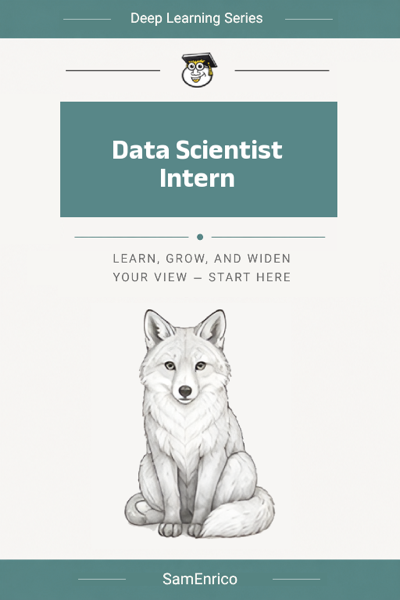
Non-FictionInformativeEducational
Data Scientist Intern eBook
A Coursebook on Data Scientist Intern
A Coursebook on Data Scientist Intern
Formats
Free sample
Chapter 1: The 99% Trap--–- Maya stared at her screen, watching the final line of her Jupyter notebook execute. The output read: Accuracy: 0.99. She smiled. Three weeks of work—cleaning, feature engineering, tuning a random forest—had produced a fraud detection model that was 99% accurate. Her internship presentation was in two hours.
She was going to nail it.The conference room held seven people: her manager, two data science leads, the head of engineering, the VP of Risk, and the VP of Product. Maya projected her notebook. "My model achieves 99% accuracy on held-out test data," she began. She walked through the confusion matrix, the ROC curve, the precision-recall tradeoff. She cited research papers.
She used words like "AUC" and "F1-score" with confidence.The VP of Risk waited until she finished. Then he asked one question: "How many legitimate transactions does your model flag as fraud?"Maya clicked to a slide she had prepared. "About 5% of all transactions," she said.The VP leaned forward. "We process 10 million transactions a month. Five percent is 500,000 false positives.
Each false positive means we freeze a customer's account, trigger a fraud alert, and require a phone call to resolve. That call costs us $15 in support time. And about 30% of those customers never come back."He paused. "Your 99% accurate model will cost us $7.5 million a month in support costs and potentially millions more in lost customers. We're not deploying it."Maya's smile vanished.
She had solved the wrong problem. Beautifully.This chapter exists so you never receive that email, hear that question, or feel that sinking feeling. You are about to learn the single most important lesson of your data science internship: starting with a model guarantees failure. Starting with a question might save your career.The Intern's Most Common Failure Mode Let me tell you a truth that no university course will admit: academic data science and workplace data science are almost opposite activities.In university, you receive a clean dataset. The problem is stated clearly ("Predict housing prices").
The evaluation metric is given ("RMSE"). The deadline is fixed. And most importantly, someone has already decided that a model is the right answer.In the workplace, none of that is true.Your manager will say something vague like "customers seem to be leaving" or "our conversion rates look weird." You will have to discover whether a model is even needed. You will have to define your own success metric. You will have to decide what "done" looks like.
And you will have to do all of this while seven other people have conflicting opinions.The most common failure mode of junior data scientists—and I have seen this across hundreds of interns at dozens of companies—is solving the wrong problem correctly. Maya built a technically perfect fraud model. It was useless because it solved a problem no one had: "maximize accuracy" instead of "minimize false positives while catching meaningful fraud."This chapter will rewire your brain. By the end, you will never write a line of analysis code before completing the Problem Definition Canvas. You will learn to ask the "So What?" Test after every number you produce.
And you will understand why business lift matters more than model accuracy.The So What? Test: Your New Best Friend Every time you produce a number, a chart, or a prediction, ask yourself one question: "So what?"Not rhetorically. Literally. Imagine a busy executive with thirty seconds to decide whether to act on your work. If you say "the average order value is 47.32,"theywillask"sowhat?"Ifyoucannotanswerimmediately—"soweshouldraisefreeshippingthresholdfrom47.32," they will ask "so what?" If you cannot answer immediately—"so we should raise free shipping threshold from 47.32,"theywillask"sowhat?"Ifyoucannotanswerimmediately—"soweshouldraisefreeshippingthresholdfrom45 to 50toincreaseaverageordervalueby50 to increase average order value by 50toincreaseaverageordervalueby8"—then your number is noise.The So What?
Test has three levels:Level 1 (Descriptive): "What happened?"Example: "Sales decreased by 12% last quarter."So what? Not clear. This is just a fact.Level 2 (Diagnostic): "Why did it happen?"Example: "Sales decreased because our main competitor launched a 20% discount on the same product category."So what? Now we have a hypothesis about causation.Level 3 (Prescriptive): "What should we do about it?"Example: "We should offer a 15% targeted discount to customers who viewed competitor pages in the last 7 days, which would recover an estimated 60% of lost sales at 40% of the cost of a full sale."So what? Now we have an actionable recommendation with a business case.Most university projects stop at Level 1.
Good interns reach Level 2. The interns who get full-time offers live at Level 3.Here is the hard truth: your manager does not need another report. They have dashboards. They have analysts. What they need is someone who can translate data into a decision.
The So What? Test is the bridge between "interesting" and "actionable."Exercise for this section: Take the last analysis you did (or a sample dataset you have). For every number you produced, write the Level 1, Level 2, and Level 3 version. If you cannot write Level 3, you are not done.The Case Study That Changed Everything Maya's story is not hypothetical. It happened at a real company—a mid-sized fintech startup that I consulted for.
The intern's name has been changed, but the numbers are accurate. Here is what happened next, because it contains the entire lesson of this chapter.After the meeting, Maya's manager pulled her aside. He did not fire her. He did not yell. He sat down and asked her four questions:"What business problem were you trying to solve?"Maya: "Fraud detection."Manager: "No.
What business problem? Why does fraud matter to us?""What did success look like to the VP of Risk?"Maya: "Catching fraud?"Manager: "No. Catching fraud without losing good customers or bankrupting support.""Did anyone ask you to maximize accuracy?"Maya: "...No.""What question should you have asked before writing any code?"Maya was silent.That fourth question is the one I want you to remember. The question is not "what model should I build?" The question is not "what algorithm is state-of-the-art?" The question is: "What decision will this analysis inform, and how will we measure success?"Maya spent the next week rebuilding her approach. She started with a blank document—no code, no notebooks, no data.
She wrote:Business goal: Reduce fraud losses without increasing false positives beyond current levels.Success metric: Fraud loss reduction per dollar spent on support. (Not accuracy. Not precision. Dollars.)Minimum viable output: A rule-based system that flags only transactions above $500 with velocity anomalies, not every large transaction.Her second presentation was four slides. The first slide stated the business problem.
The second showed her proposed success metric. The third showed the simple rule-based system (not a random forest). The fourth showed estimated cost savings: $2.3 million per year.The VP of Risk approved deployment the next day.Maya got the full-time offer.Descriptive vs. Prescriptive: The Critical Distinction Let me introduce you to two words that will define your internship: descriptive and prescriptive.Descriptive analytics answers "what happened?" It includes dashboards, summary statistics, and historical reports. It is necessary but not sufficient.
Every intern can produce descriptive statistics. That is table stakes.Prescriptive analytics answers "what should we do?" It includes recommendations, optimization…
This is the end of the free sample. Get the eBook to keep going. Buy now
About this book
Details
- Author
- Shumaker Prince
- Publisher
- SamEnrico
- Language
- English
- Genre
- Non-Fiction, Informative, Educational
- Released
- 2026-05-25
- Pages (approx.)
- 141
- Available as
- eBook, Audiobook

Read better in the ZLOADR app
Your eBooks on your phone or tablet. Sign in with your SamEnrico account and start reading.
More by Shumaker Prince
 Pain Sound Based MeditationShumaker Prince$11.99
 The 10 Minute Body ScanShumaker Prince$11.99
 Kigali AgriTech Startup ManualShumaker Prince$11.99
 HcG Therapy Testosterone GuideShumaker Prince$11.99
 Performance Review Anxiety SolutionsShumaker Prince$11.99
 Freedom Rides: The Forgotten Women of the MovementShumaker Prince$11.99
 Bones of the Lost Kingdom: Love and Fossils in the Jungles of BorneoShumaker Prince$11.99
 Understanding ChalazionShumaker Prince$17.99
 Proposal for Mixed MethodsShumaker Prince$12.99
 Subclass 190 State Nominated VisaShumaker Prince$12.99
 How to Start a Rice Milling Business (Beginners Guide)Shumaker Prince$11.99
You may also like
 Hong Kong Handover 1997Dunn Johnnie$11.99
 Zumba For Postnatal Recovery CourseNeal Christian$11.99
 Zumba for BeginnersLadner Nikia$11.99
 YouTube Comment Mining GuideHumes Pandora$12.99
 Worry Box MeditationCarlin Rudy$11.99
 Workplace Stress MeditationNguyen Lynn$11.99
 Workplace Stress and Sleep RepairHawley Ivory$11.99
 Workplace Perfectionism CureDelaney Jeffry$11.99
 Workplace Injustice Anger GuideWallen Isabelle$11.99
 Work Addiction and Burnout LinkGreenwood Ester$11.99
 Women in Yoga and WellnessBeattie Galina$11.99
 Women in Stand Up ComedyChun Evangeline$11.99