
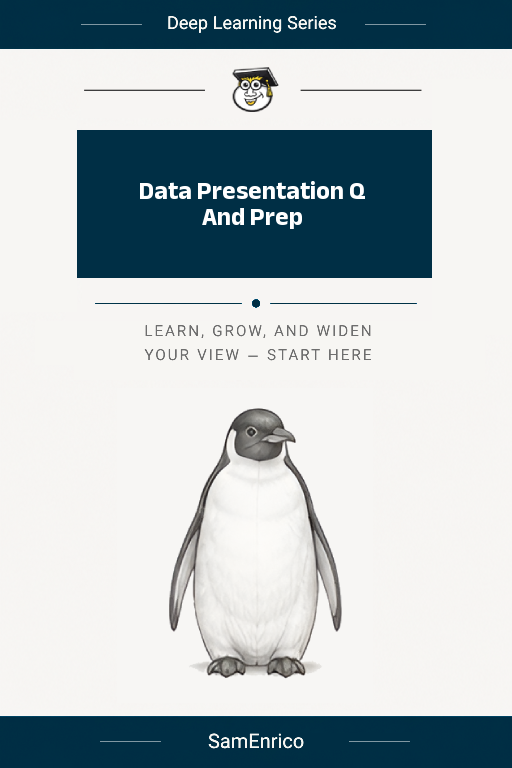
Non-FictionProfessional's Cheat SheetQ&A Prep
Data Presentation Q And Prep eBook
Anticipate audience questions about your data with
by Graff Kena
Anticipate audience questions about your data with a question preparation worksheet.
Formats
Free sample
Chapter 1: The 90-Second Reputation--Let me tell you a story about a data analyst named Priya.Priya worked at a mid-sized Saa S company called Cloud Tel. She was brilliant with numbers, meticulous with her analysis, and had spent two full weeks preparing a revenue forecast for the quarterly executive review. She pulled data from Salesforce, cleaned it meticulously, built a robust predictive model, created twenty-three beautifully formatted slides with consistent fonts, aligned logos, and carefully chosen color palettes. Her manager had reviewed the deck and called it “flawless.”The day of the presentation arrived. Priya walked into the boardroom, connected her laptop, and delivered her findings with clarity and poise.
She walked the executives through the upward trend, explained the assumptions behind her model, and concluded with a confident recommendation to increase the sales headcount by 15%.Then came the Q&A.The CEO, a woman named Sarah who had built the company from nothing, looked at the first chart—a simple line graph showing monthly recurring revenue—and asked, “Priya, why does this chart start in March?”Priya froze.Not because she didn’t know the answer. She did. The fiscal year started in March. But in that moment, standing in front of twelve executives, her mind went blank. She stammered, “Um, well, that’s when our fiscal year begins, but I could also show you…” She clicked to another slide, then another, trying to find an alternative view she hadn’t prepared.
Two minutes passed. The room grew uncomfortable.Sarah smiled politely and said, “We can look at that offline.”But the damage was done. For the rest of the meeting, every answer Priya gave was met with a furrowed brow, a skeptical follow-up, or a glance exchanged between executives. By the time she sat down, her reputation had shifted. Not because her analysis was wrong.
Not because her slides were ugly. Because she couldn’t answer one simple, predictable question.Six months later, a junior analyst named Marcus was promoted over Priya. He had less experience, less technical skill, and his slides were objectively uglier. But during his quarterly review presentation, when the CEO asked, “Why does this chart start in March?” Marcus didn’t blink. He said, “Great question.
Our fiscal year starts in March, so this aligns with our budgeting cycle. But I also have a version starting in January in my appendix—would you like to see it?”The CEO shook her head. “No, that makes sense. Continue.”Marcus got the promotion. Priya updated her resume.This is not a story about technical skill.
It is a story about question readiness. And it is happening to you, or someone on your team, right now.The Great Inversion: Why Smart People Fail at Q&AMost data professionals operate under a deeply flawed assumption. They believe that if they build beautiful slides, conduct rigorous analysis, and rehearse their delivery, they will succeed. They spend eighty percent of their preparation time on slides and delivery, and twenty percent—if any—on anticipating questions.This is exactly backwards.After studying hundreds of data presentations across technology, finance, healthcare, and nonprofit sectors, a clear pattern emerges. The presenters who leave the room with their credibility intact are not the ones with the prettiest slides.
They are the ones who have spent significant time imagining what their audience might ask and preparing answers in advance. They are question-ready.The book you are holding will teach you to become question-ready. But before we get to the tools—the Question Preparation Worksheet, the five question profiles, the shadow deck, and the live Q&A tactics—we must first understand why question readiness is the single most underrated skill in data communication.Let me show you what happens inside a typical data presentation, why your audience forgets your insights but remembers your fumbled answers, and how a simple shift in your preparation process can transform your career.Post-Presentation Amnesia: The 24-Hour Forgetting Curve In 1885, German psychologist Hermann Ebbinghaus published his groundbreaking work on the forgetting curve. He discovered that humans forget approximately fifty percent of new information within one hour and seventy percent within twenty-four hours. This is not a failure of intelligence.
It is a feature of how memory works.Your data presentation is not immune to this curve.Let us be honest with ourselves. How many presentations have you sat through where you remember the speaker’s final conclusion? Now compare that to how many presentations where you remember a specific awkward moment when the speaker could not answer a question. The asymmetry is striking. Audiences forget insights rapidly, but they remember unanswered or fumbled questions forever.
That memory becomes your reputation.I call this post-presentation amnesia. And it explains why one bad Q&A moment can undo ten great slides.Consider the research from the University of California’s Neuro Leadership Institute. Their studies show that the human brain encodes social threat memories—moments when we feel embarrassed, exposed, or incompetent—with far greater intensity than neutral information. When you fumble a question in front of your boss, their brain releases cortisol, a stress hormone that strengthens memory consolidation. They may not remember your revenue projections, but they will remember that you did not know why your chart started in March.This is not fair.
But it is biology.The implication is profound. Every question you cannot answer is not merely a missed opportunity. It is a negative memory being etched into your audience’s brains. Over time, these memories accumulate. You become known as someone who is “not on top of the data” or “hard to trust” or “good with slides but bad under pressure.”The good news is that the same biology works in your favor.
When you answer a question smoothly, confidently, and with relevant data, your audience’s brain releases dopamine—a reward chemical that enhances positive memory formation. They remember you as competent, trustworthy, and prepared.Question readiness is not about avoiding embarrassment. It is about engineering positive memories.The Three Kinds of Question Surprises Not all questions are created equal. After analyzing over five hundred Q&A sessions across industries, a clear taxonomy emerges. Every question you will ever face falls into one of three categories.Avoidable Questions (Approximately 60% of Q&A)These are questions you could have predicted with ten minutes of honest reflection.
They are the low-hanging fruit of Q&A preparation, and yet they are the most common source of presenter panic.Examples include:“Why did you start the chart in March?”“Does this include tax?”“What’s the source of this data?”“Why did you exclude Canada?”“Is this actual or forecast?”When Priya was asked why her chart started in March, she faced an avoidable question. Any reasonable person could have anticipated that an executive might ask about the date range. The answer was simple and defensible. But because she had not prepped for it, she froze.Avoidable questions are inexcusable to fumble. They signal to your audience that you did not think deeply about your own material.
They are the Q&A equivalent of showing up to a meeting with spinach in your teeth.Semi-Avoidable Questions (Approximately 30% of Q&A)These questions…
This is the end of the free sample. Get the eBook to keep going. Buy now
About this book
Details
- Author
- Graff Kena
- Publisher
- SamEnrico
- Language
- English
- Genre
- Non-Fiction, Professional's Cheat Sheet, Q&A Prep
- Released
- 2026-06-01
- Pages (approx.)
- 142
- Available as
- eBook, Audiobook

Read better in the ZLOADR app
Your eBooks on your phone or tablet. Sign in with your SamEnrico account and start reading.
More by Graff Kena
 Assertiveness Goal Setting GuideGraff Kena$11.99
 Recovery From Chronic Low Grade BurnoutGraff Kena$11.99
 Breaking the Humor Deflect HabitGraff Kena$11.99
 Anger After Partner's LyingGraff Kena$11.99
 Pre Talk Momentum CheckGraff Kena$11.99
 Shadows of the Warring States: Sun Tzu's Battles That Redefined WarGraff Kena$11.99
 EV Motorcycle Adoption GuideGraff Kena$12.99
 Lead ProgrammerGraff Kena$11.99
 Understanding Macrodactyly of The FootGraff Kena$17.99
 How to Become a Draw-bench OperatorGraff Kena$11.99
You may also like
 Hong Kong Handover 1997Dunn Johnnie$11.99
 Zumba For Postnatal Recovery CourseNeal Christian$11.99
 Zumba for BeginnersLadner Nikia$11.99
 YouTube Comment Mining GuideHumes Pandora$12.99
 Worry Box MeditationCarlin Rudy$11.99
 Workplace Stress MeditationNguyen Lynn$11.99
 Workplace Stress and Sleep RepairHawley Ivory$11.99
 Workplace Perfectionism CureDelaney Jeffry$11.99
 Workplace Injustice Anger GuideWallen Isabelle$11.99
 Work Addiction and Burnout LinkGreenwood Ester$11.99
 Women in Yoga and WellnessBeattie Galina$11.99
 Women in Stand Up ComedyChun Evangeline$11.99