
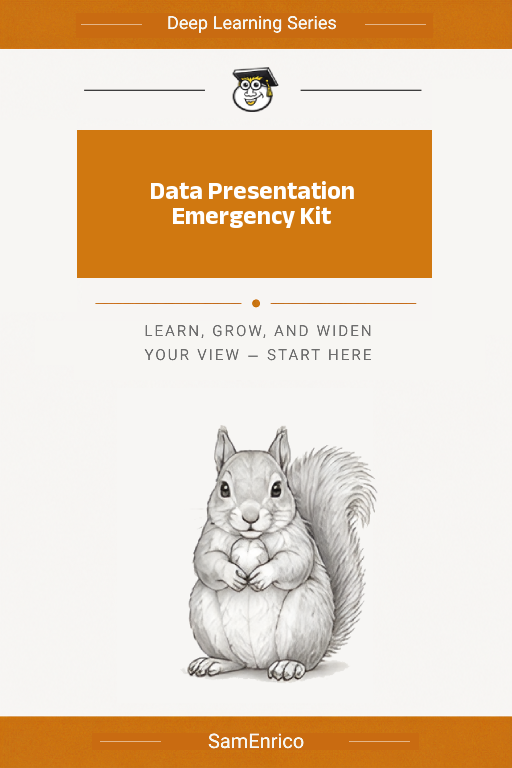
Non-FictionProfessional's Cheat SheetEmergency Kit
Data Presentation Emergency Kit eBook
Prepare an emergency kit of backup slides and quic
by Higgs Billye
Prepare an emergency kit of backup slides and quick fixes for last-minute data presentation crises.
Formats
Free sample
Chapter 1: The Engine-Out Landing--It is 8:47 AM. You are standing in a glass-walled conference room on the forty-second floor. Twenty-three people are settling into their chairs, including the Chief Financial Officer, the Vice President of Sales, and two external consultants who bill more per hour than you make in a week. The meeting starts at 9:00. You have just opened your laptop to do a final check of your slides.The file is corrupted.You click again.
Nothing. You try the backup file. Also corrupted. The auto-save version from yesterday is intact, but that deck contains numbers that were superseded by a 7:30 AM email from the data team. If you show yesterday's numbers, the CFO will correct you within ten seconds, and you will spend the next hour defending data you knew was wrong.
If you try to reconstruct the slides from memory, you will forget something important. If you cancel the meeting, you will never be invited back.Your heart is now beating at approximately one hundred and thirty beats per minute. Your palms are wet. Your mouth is dry. The voice in your head – let us call it the Gremlin, because that is what it is – whispers exactly what it always whispers at moments like this: You should have prepared more.
You should have checked the file last night. Everyone is about to see that you are a fraud. Just apologize and sit down.This is the moment that separates people who present data from people who command it. Not the moment when everything goes right – anyone can look brilliant when the projector works and the numbers align. The moment that defines you is the moment when everything goes wrong, and you have approximately ninety seconds to decide whether you will freeze or fly.Welcome to the engine-out landing.The Anatomy of a Data Panic Before we fix anything, we need to understand what is happening inside your skull right now.
Because you cannot solve a problem you refuse to name.Your brain contains a small, almond-shaped cluster of neurons called the amygdala. Its job is simple: detect threats and activate the body’s defense systems. Two million years ago, that threat was a saber-toothed cat. Today, it is a corrupted Power Point file in front of twenty-three senior executives. Your amygdala does not know the difference.
It only knows that something is wrong, and wrong means danger, and danger means you need to fight, flee, or freeze.Here is the problem. The amygdala processes threats in approximately three-tenths of a second. The prefrontal cortex – the part of your brain responsible for rational thought, planning, and impulse control – takes two to three seconds to engage. In that two-second gap, you will do something stupid. You will apologize before you know what you are apologizing for.
You will open the wrong file. You will say “I’m sorry, the slides are messed up” which is the verbal equivalent of showing up to a duel with your pants around your ankles. You will click randomly, hoping something works.This is not weakness. This is biology. Every single person who has ever presented data has experienced this exact physiological response.
The difference between the people who recover and the people who spiral is not that the first group is braver or smarter. It is that the first group has a protocol.A pilot does not panic when an engine fails because panic is not part of the procedure. The pilot runs the checklist. Engine out. Altitude.
Airspeed. Best glide speed. Mayday call. The checklist does not eliminate the danger, but it eliminates the gap between recognition and action. It replaces the question “What do I do?” with the command “Do this now.”You need a checklist.
Not because you are a pilot, but because you are a presenter, and the engine just failed.The 60-Second Triage Checklist Here is your protocol. I want you to memorize it. Not because you will have time to look at a piece of paper when your amygdala is screaming, but because memorization moves the protocol from your conscious mind to your procedural memory. When you need it, you will not think about it. You will just do it.Step Zero: Breathe.This sounds ridiculous.
I know it sounds ridiculous. Every book about stress tells you to breathe, and you roll your eyes, and then you skip that paragraph, and then you panic again the next time something goes wrong. Do not skip this paragraph.The 5-second box breath is not mindfulness nonsense. It is a physiological override. Inhale for four counts.
Hold for four counts. Exhale for four counts. Hold for four counts. Do this one time. That is five seconds.
In those five seconds, you are forcing your parasympathetic nervous system to engage. Your heart rate will drop by approximately ten to fifteen beats per minute. Your palms will stop sweating. The amygdala will receive a signal that says, actually, maybe we are not being eaten by a tiger.Five seconds. That is all it takes to move from panic to protocol.Step One: Ask the three triage questions.You have sixty seconds.
Not two minutes. Not “as long as it takes.” Sixty seconds. Use a timer if you have to. The audience will wait exactly sixty seconds before they start checking their phones. After sixty seconds, they are gone.Question one: Is the data wrong, or is the story wrong?This is the most important distinction you will ever make in a crisis.
Wrong data means the numbers on the slide are inaccurate. The story – your argument, your recommendation, your conclusion – might still be correct. Wrong story means the data is accurate but your interpretation is flawed. The fix for wrong data is a correction slide. The fix for a wrong story is a complete pivot.
Most people assume the worst and try to fix everything. Stop. Diagnose first.Question two: Can I remove the bad element without destroying the narrative?Look at your deck. Is the problematic slide a supporting slide or a spine slide? Supporting slides provide evidence for a point already made.
Spine slides are the point itself. If you can remove the bad slide and still make your argument, remove it. Do not hesitate. Do not explain. Just skip it.
If removing the slide breaks the logic, you need a different fix.Question three: Does the audience already know the correct information?This question saves more careers than any other. If the audience already knows the right numbers, your only job is to acknowledge the error and move on. Do not explain. Do not apologize profusely. Do not spend five minutes describing how the error happened.
Say “That number is incorrect. The correct number is X. Moving on.” The audience will respect the brevity. If the audience does not know the correct information, you need to provide it – but you can do that in thirty seconds.Step Two: Buy time verbally.You cannot fix anything while the room is staring at you. You need to redirect their attention while you execute the protocol.
The script below is not an apology. It is not an excuse. It is a professional pause button. Use it…
This is the end of the free sample. Get the eBook to keep going. Buy now
About this book
Details
- Author
- Higgs Billye
- Publisher
- SamEnrico
- Language
- English
- Genre
- Non-Fiction, Professional's Cheat Sheet, Emergency Kit
- Released
- 2026-05-28
- Pages (approx.)
- 138
- Available as
- eBook, Audiobook

Read better in the ZLOADR app
Your eBooks on your phone or tablet. Sign in with your SamEnrico account and start reading.
More by Higgs Billye
 The Emotional Agility WorkbookHiggs Billye$11.99
 Senior Dance Movement Self Esteem GuideHiggs Billye$11.99
 The EQ for Parents HandbookHiggs Billye$11.99The EQ for Parents HandbookHiggs Billye$11.99
 Anger After Partner's Phone UseHiggs Billye$11.99
 Media Literacy Body Image GuideHiggs Billye$11.99
 The Spice Kings of Lisbon: How Portugal Built a Culinary EmpireHiggs Billye$11.99
 Understanding Madokoro–ohdo–sonoda SyndromeHiggs Billye$17.99
 Contract Lifecycle Efficiency HandbookHiggs Billye$12.99
 Logistical SupportHiggs Billye$11.99
 How to Start a Hobby in Start A BandHiggs Billye$11.99
You may also like
 Hong Kong Handover 1997Dunn Johnnie$11.99
 Zumba For Postnatal Recovery CourseNeal Christian$11.99
 Zumba for BeginnersLadner Nikia$11.99
 YouTube Comment Mining GuideHumes Pandora$12.99
 Worry Box MeditationCarlin Rudy$11.99
 Workplace Stress MeditationNguyen Lynn$11.99
 Workplace Stress and Sleep RepairHawley Ivory$11.99
 Workplace Perfectionism CureDelaney Jeffry$11.99
 Workplace Injustice Anger GuideWallen Isabelle$11.99
 Work Addiction and Burnout LinkGreenwood Ester$11.99
 Women in Yoga and WellnessBeattie Galina$11.99
 Women in Stand Up ComedyChun Evangeline$11.99