
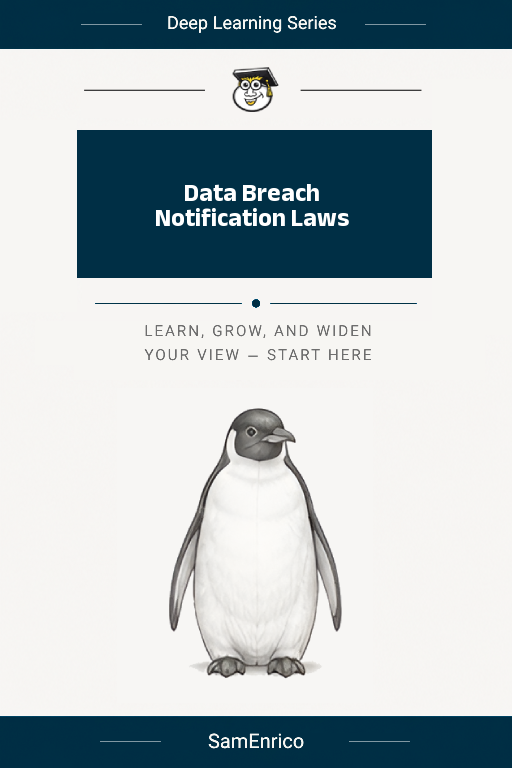
Data Breach Notification Laws
Comply with data breach notification requirements
Comply with data breach notification requirements across fintech, healthtech, and edtech sectors by state.
Formats
About this book
Free sample
Chapter 1: The $450,000 Lunch Code--–- The breach alert arrived at 2:14 AM on a Tuesday. Maria Chen, the Chief Privacy Officer of a rapidly growing Edtech platform called Learn Well, stared at the forensic report in disbelief. The report stated that an unauthorized actor had accessed a database containing student records from twelve different school districts across seven states. The data fields included student names, email addresses, and a column labeled “meal_eligibility_code.” Maria had reviewed the data inventory just six months earlier. She knew that student lunch codes were not considered personally identifiable information under FERPA, the federal education privacy law.
She knew that no Social Security numbers, no credit card numbers, and no health records had been accessed. She made a decision that would cost her company $450,000 and her career its upward trajectory. She decided not to notify anyone.Eight months later, Maria sat across from the New York Attorney General’s lead investigator, who slid a document across the table. The document cited New York Education Law Section 2-d, a statute Maria had never read. It defined “personally identifiable information” for students to include, among other things, “a student’s lunch account number or code when combined with a name.” The investigator explained that Learn Well had failed to notify the families of 8,900 students, had delayed notifying the school districts, and had compounded the violation by submitting a breach report that stated, falsely under New York law, that “no PII was compromised.” The proposed settlement was $450,000.
Maria’s company would also be required to hire an independent privacy monitor for three years. Her boss, the CEO, asked her one question in the hallway afterward: “How did we not know that lunch codes count?”This chapter answers that question. It reveals the dangerous illusion that “personal information” is a universal concept that means the same thing in every state and under every federal law. It explains why the breach notification trigger is not a single on-off switch but a complex matrix of definitions that change based on where your customer lives, what sector you operate in, and what data elements…
This is the end of the free sample. Get the eBook to keep going. Buy now
Contents
- Chapter 1
- Chapter 2
- Chapter 3
- Chapter 4
- Chapter 5
- Chapter 6
- Chapter 7
- Chapter 8
- Chapter 9
- Chapter 10
- Chapter 11
- Chapter 12
Details
- Author
- Oconnor Tuyet
- Publisher
- SamEnrico
- Language
- English
- Genre
- Non-Fiction, Annual Checkup, Cross Sector, Breach
- Released
- 2026-05-29
- Pages (approx.)
- 156
- Available as
- eBook, Audiobook

Read better in the ZLOADR app
Your eBooks on your phone or tablet. Sign in with your SamEnrico account and start reading.
More by Oconnor Tuyet
 Loving Kindness for Political Polarization WorkbookOconnor Tuyet$11.99
 Self Talk for Spiritual CrisisOconnor Tuyet$11.99
 Religious Difference Relationship GuideOconnor Tuyet$11.99
 Strength Band Workout SeniorsOconnor Tuyet$11.99
 Beginner Mindfulness for SurgeonsOconnor Tuyet$11.99
 The First Lady Who Defied a King: The Untold Story of Queen Elizabeth The Queen MotherOconnor Tuyet$11.99
 The Frozen Rescue: The Legend of the Pamir Ice WarriorsOconnor Tuyet$11.99
 Understanding Dementia, VascularOconnor Tuyet$17.99
 How to Become a CharterOconnor Tuyet$11.99
 Bilkent University GuideOconnor Tuyet$12.99