
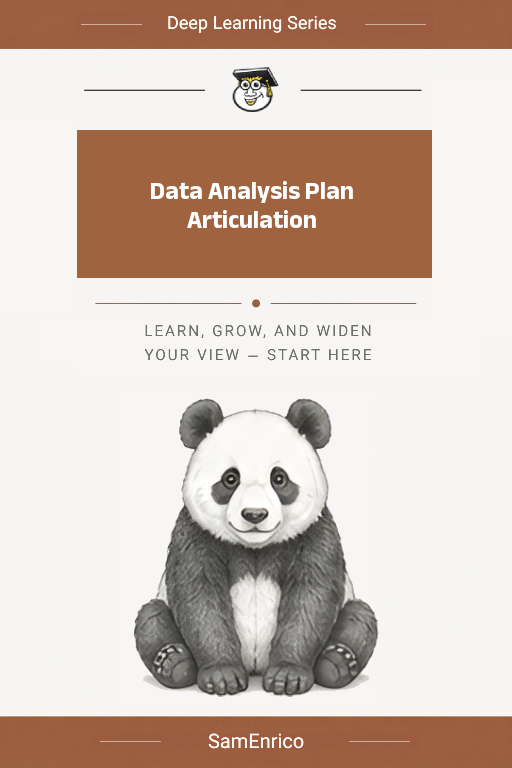
Non-FictionStudent's ShortcutData Analysis
Data Analysis Plan Articulation Audiobook
Describe statistical tests or qualitative coding p
Describe statistical tests or qualitative coding procedures in grad proposals. Align analytic choices with research questions and methodological approach.
Formats
Free sample
Chapter 1: The Alignment Matrix--–- Dr. Elena Vasquez had just rejected her third dissertation proposal of the semester, and for the exact same reason as the first two. The literature reviews were competent. The methodologies were defensible. The research questions were, at least on the surface, plausible.
But when she turned to the section labeled "Data Analysis Plan," she found the same hollow promise repeated like a mantra across all three documents: "The data will be analyzed using appropriate statistical techniques."She closed the third proposal and rubbed her temples. "Appropriate to what?" she muttered to her empty office. "Appropriate according to whom? Appropriate for which question?"This moment, familiar to committee members and advisors everywhere, is the precise problem this book exists to solve. Graduate students across the social sciences, health professions, education, and business are spending months conducting literature reviews, designing studies, and agonizing over theoretical frameworks – only to sabotage their proposals with an analysis section that reads like a Fortune Cookie of methodological vagueness.The Proposal Graveyard: Where Vague Analysis Plans Go to Die Let us be brutally honest about what happens on the other side of the proposal.
Your committee members have between twelve and forty-five minutes to read your document before offering feedback. They are not scanning for typos or admiring your citation style. They are looking for one thing: evidence that you know what you are doing.The analysis plan is where that evidence lives or dies.Consider what a vague plan communicates to a reviewer. When you write, "I will analyze the data using statistics," you are effectively saying, "I have not thought about this." When you write, "Themes will be identified from the interview transcripts," you are saying, "I do not know how qualitative analysis actually works." These are not neutral statements. They are active signals of unpreparedness that will, in the vast majority of cases, trigger a revision request at minimum and a full rejection at maximum.I have seen precisely three types of proposals cross my desk over fifteen years of committee service:The Vague Promise.
Example: "Descriptive statistics will be calculated, followed by inferential tests appropriate to the research questions." This proposal typically receives the longest review letter because the committee has to guess what the student intends. The outcome is almost always "Revise and resubmit with a detailed analysis plan."The Kitchen Sink. Example: "I will use t-tests, ANOVA…
This is the end of the free sample. Get the Audiobook to keep going. Buy now
About this book
Details
- Author
- Qualls Sanjuana
- Publisher
- SamEnrico
- Language
- English
- Genre
- Non-Fiction, Student's Shortcut, Data Analysis
- Released
- 2026-05-30
- Pages (approx.)
- 158
- Available as
- eBook, Audiobook

Listen in the VoxFlicks app
Audiobooks and audio dramas wherever you go. Sign in with your SamEnrico account and press play.
More by Qualls Sanjuana
 Choosing Harvard Extension SchoolQualls Sanjuana$11.99
 The Bottled Water GuideQualls Sanjuana$11.99
 Nonverbal in Coaching GuideQualls Sanjuana$11.99
 The Troll King's Last Lesson: A Nordic Mentor's WisdomQualls Sanjuana$11.99
 Burnout and Vacation RefusalQualls Sanjuana$11.99
 Product Development SpecialistQualls Sanjuana$11.99
 How to Produce Bicycle Cleat AccessoriesQualls Sanjuana$11.99
 How to Become a Stitch-bonding-machine TenderQualls Sanjuana$11.99
You may also like
 Hong Kong Handover 1997Dunn Johnnie$11.99
 Zumba For Postnatal Recovery CourseNeal Christian$11.99
 Zumba for BeginnersLadner Nikia$11.99
 YouTube Comment Mining GuideHumes Pandora$12.99
 Worry Box MeditationCarlin Rudy$11.99
 Workplace Stress MeditationNguyen Lynn$11.99
 Workplace Stress and Sleep RepairHawley Ivory$11.99
 Workplace Perfectionism CureDelaney Jeffry$11.99
 Workplace Injustice Anger GuideWallen Isabelle$11.99
 Work Addiction and Burnout LinkGreenwood Ester$11.99
 Women in Yoga and WellnessBeattie Galina$11.99
 Women in Stand Up ComedyChun Evangeline$11.99