
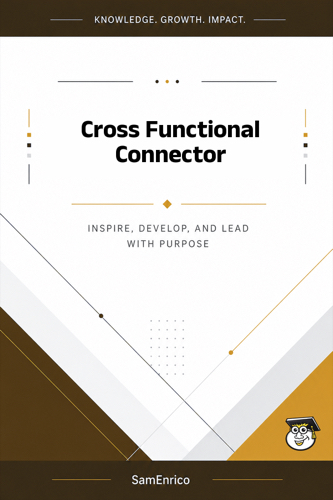
Cross Functional Connector eBook
Build relationships across departments to improve
by Barry Claude
Build relationships across departments to improve collaboration and visibility.
Formats
Free sample
Chapter 1: The Meeting That Ate Tuesday--It was 2:47 PM on a Tuesday when I realized I had become a ghost in my own career. I had been in back-to-back “alignment sessions” since 8:00 AM. My to-do list had grown by fourteen items. Zero had been checked off. My coffee had gone cold three hours ago, and someone had just said the seven most terrifying words in the English language: “Let’s schedule a follow-up to recap what we covered.”I wanted to scream.Instead, I smiled, nodded, and opened my calendar to find the next available slot.
It was eleven days away. The room collectively sighed. Someone muttered, “This is why nothing ever gets done around here.” And then we all shuffled back to our desks, carrying the same unresolved problems we had walked in with.That Tuesday was not unusual. It was not a crisis. It was just another day in the life of a well-intentioned, hardworking professional trapped inside a system that rewarded activity over progress, attendance over impact, and siloed heroics over shared success.If you are reading this book, you already know that feeling.You know what it is like to send an email to another department, wait three days for a response, and then receive a one-word answer that raises twelve new questions.
You know what it is like to sit in a room where six people from six different teams use the same word to mean six different things, and no one bothers to notice. You know what it is like to watch a project fail not because the work was hard, but because the handoff between Design and Engineering was a black hole where information went to die.You also know the worst part: none of this is anyone’s fault.No one wakes up in the morning thinking, “How can I make my colleagues’ lives harder today?” No one deliberately hoards information out of malice. Your peers in Finance are not lazy. Your counterparts in Sales are not stupid. The people in Legal are not trying to kill your project.
They are all responding rationally to the incentives, pressures, and constraints of their own departments. And somewhere in the gap between those rational responses, your work goes to die.This is the problem this book exists to solve. And it starts with naming the enemy.The Silent Tax There is a cost to working across departments that never appears on any profit and loss statement. It does not show up in your quarterly review. It is not tracked in your project management software.
But it is the single largest drag on productivity, morale, and innovation in modern organizations.I call it the Silent Tax.The Silent Tax is the invisible cost of withheld information—not malicious secrecy, but the accidental hoarding of context, deadlines, and constraints. It is the email that should have been sent but wasn’t. The meeting note that should have been shared but sat in someone’s local drive. The assumption that “everyone already knows” that turned out to be catastrophically wrong.Consider this statistic, which should scare you as much as it scared me when I first encountered it: 67% of organizations cite poor horizontal collaboration as their primary barrier to success. That is not a niche problem.
That is not a “soft skill” issue. That is two out of every three companies admitting that the way they work across departments is actively undermining their ability to deliver results.Let me make this concrete.A few years ago, I consulted for a mid-sized software company that was launching a new product. The marketing team had promised a key feature in all the pre-launch materials. The engineering team had no idea. For six months, marketing built campaigns around a capability that engineering had never committed to building.
When the disconnect was finally discovered, the company had a choice: launch without the feature and lose credibility with customers, or delay the launch by six months to build it. They chose the delay. The cost was over two million dollars in lost revenue and a permanent hit to their brand reputation.Was marketing malicious? No. They were eager to win customers.Was engineering lazy?
No. They were overwhelmed with existing commitments.The problem was not people. The problem was the gap between them.That gap is the Silent Tax. And you are paying it right now, whether you realize it or not.The Anatomy of a Silo Before we can break silos, we need to understand how they are built. Most people imagine silos as walls—rigid, intentional barriers erected by territorial managers.
That is not quite right. Silos are not built. They grow. Like coral reefs, they form slowly, invisibly, from the accumulated debris of unreturned emails, unclear handoffs, and the quiet exhaustion of people who have given up on asking for help.A silo is simply a pattern of behavior where information, context, and accountability stop flowing horizontally. That is it.
No malice required. No conspiracy. Just a thousand small failures of connection, each one too small to notice on its own, but together forming an impenetrable barrier.I want you to visualize your own organization for a moment. Think about the last time you needed something from another department. How many emails did you send?
How many meetings did you attend? How many times did you explain the same context to the same person? Now think about the answer you eventually received. Was it timely? Was it complete?
Did it anticipate your next three questions, or did it force you to start the entire process over again?If you are like most professionals, that experience was frustrating, inefficient, and exhausting. And here is the cruel irony: the people on the other side of that exchange felt exactly the same way about you. They were frustrated by your “unrealistic deadlines.” They were exhausted by your “changing requirements.” They were annoyed by your “failure to understand their constraints.”Neither of you was wrong. You were just speaking different languages, operating on different timelines, and answering to different bosses. And no one had given either of you the tools to bridge that gap.The Villain of This Story Every good book needs a villain.
Not a person—a pattern. I want you to meet the antagonist of this story. I call it the Silo Keeper.The Silo Keeper is not a specific individual. It is a role, a system, a set of incentives that rewards hoarding information and punishes sharing it. The Silo Keeper can be your boss, who withholds context because “you don’t need to know that yet.” It can be your peer in another department, who guards their team’s time like a dragon guarding gold.
It can be a company culture that treats “need to know” as a virtue and transparency as a weakness. It can even be you—when you are too busy, too tired, or too cynical to send that one extra email that would save someone else three hours of confusion.I have seen the Silo Keeper in dozens of organizations. Here is what it looks like in practice:In a financial services firm, the Silo Keeper was a…
This is the end of the free sample. Get the eBook to keep going. Buy now
About this book
Details
- Author
- Barry Claude
- Publisher
- SamEnrico
- Language
- English
- Genre
- Non-Fiction, Self-Help
- Released
- 2026-06-06
- Pages (approx.)
- 137
- Available as
- eBook, Audiobook

Read better in the ZLOADR app
Your eBooks on your phone or tablet. Sign in with your SamEnrico account and start reading.
More by Barry Claude
 Opioid Taper MeditationBarry Claude$11.99
 Hypnotic Injury Rehab GuideBarry Claude$11.99
 Postpartum Emotional EatingBarry Claude$11.99
 Surgeon Stress Recovery HandbookBarry Claude$11.99
 The Last Pharaoh's Shadow: Cleopatra's Untold Legacy in the Modern WorldBarry Claude$11.99
 Wings Over the Iron Curtain: The Cold War's Secret Airline WarBarry Claude$11.99
 How to Start a Cyclic Hydrocarbons (wholesale) Business (Beginners Guide)Barry Claude$11.99
 Procurement Process MiningBarry Claude$12.99
 Executive Summary Expert Shortcuts for Time SavingsBarry Claude$12.99
 Understanding Facio Digito Genital Syndrome Recessive FormBarry Claude$17.99
 PapermakerBarry Claude$11.99
You may also like
 Hong Kong Handover 1997Dunn Johnnie$11.99
 Zumba For Postnatal Recovery CourseNeal Christian$11.99
 Zumba for BeginnersLadner Nikia$11.99
 YouTube Comment Mining GuideHumes Pandora$12.99
 Worry Box MeditationCarlin Rudy$11.99
 Workplace Stress MeditationNguyen Lynn$11.99
 Workplace Stress and Sleep RepairHawley Ivory$11.99
 Workplace Perfectionism CureDelaney Jeffry$11.99
 Workplace Injustice Anger GuideWallen Isabelle$11.99
 Work Addiction and Burnout LinkGreenwood Ester$11.99
 Women in Yoga and WellnessBeattie Galina$11.99
 Women in Stand Up ComedyChun Evangeline$11.99