
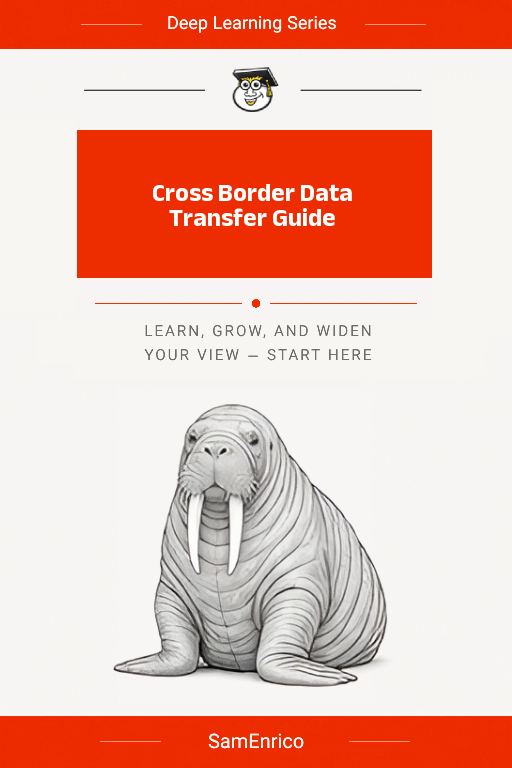
Cross Border Data Transfer Guide eBook
Handle cross-border data transfers under GDPR, CCP
Handle cross-border data transfers under GDPR, CCPA, and Nigeria DPR. SCCs and adequacy decisions.
Formats
Free sample
Chapter 1: The Billion-Dollar Click--It was a Tuesday morning in May 2023 when a mid-level compliance officer at Meta’s Dublin office clicked “approve” on a routine data transfer request. The request was unremarkable—a batch of user data from EU servers to US-based storage for backup purposes. Standard operating procedure. Thousands of similar clicks happened every day across the company.That single click cost Meta €1.2 billion.The largest GDPR fine in history was not for a massive data breach. No hacker broke through firewalls.
No malicious insider stole customer records. The violation was something far more mundane and far more dangerous for every company reading this book: Meta had transferred personal data from the European Union to the United States using Standard Contractual Clauses without adequately assessing whether US surveillance laws would undermine EU privacy rights.If a trillion-dollar company with a global team of hundreds of privacy lawyers could get this wrong, what chance does your organization have?The answer is better than you think—but only if you stop treating cross-border data transfers as a legal checkbox and start treating them as a strategic risk management discipline. This book exists because the old ways of thinking about international data flows have become not just insufficient but actively dangerous.The Three Forces Tearing Your Compliance Program Apart Every time your company moves personal data across a national border—whether from a Lagos call center to a London server, from a Berlin headquarters to a San Francisco cloud provider, or from a Tokyo subsidiary to a Mumbai analytics firm—you step into a regulatory minefield. Three powerful, often contradictory forces are pulling your compliance program in different directions.Force One: Data Sovereignty. Nations increasingly want to keep data within their borders.
They pass laws requiring local storage, restricting exports, and giving their regulators jurisdiction over any data that touches their citizens. Russia’s data localization law, China’s Cybersecurity Law, and India’s Personal Data Protection Bill all reflect this impulse. Even democratic nations are joining the trend—Nigeria’s NDPA now prohibits the export of government data entirely and restricts health records without explicit permission.Force Two: Data Globalization. Your business cannot function without moving data across borders. Cloud servers are everywhere.
Your CRM provider hosts data in three countries. Your customer support team in Manila needs access to EU user records. Your AI model training pipeline pulls data from a dozen jurisdictions. Stopping cross-border data flows is not an option—it would mean stopping business.Force Three: Individual Rights. Consumers and regulators demand privacy.
The GDPR gives EU citizens the right to know where their data goes and to stop transfers they do not consent to. California’s CCPA gives consumers the right to delete data and opt out of sales, regardless of where that data ends up. Nigeria’s NDPA grants similar rights with an African development twist. Non-compliance is no longer just a fine—it is a class-action lawsuit waiting to happen.These three forces create what this book calls the Digital Trilemma. You cannot satisfy all three perfectly.
But you can manage them intelligently. That is what this book teaches.Why This Book? Why Now? And Why Nigeria?Walk into any major bookstore or search on Amazon for “cross-border data transfer,” and you will find shelves of books about the GDPR. A smaller but growing section covers California privacy law.
Almost nothing exists that treats these regimes as a single, integrated compliance challenge—and absolutely nothing gives serious attention to Africa’s fastest-growing data protection framework, Nigeria’s NDPA.This is a dangerous gap.Nigeria is not a niche jurisdiction. It is Africa’s largest economy, its most populous nation, and increasingly its digital leader. The Nigeria Data Protection Act of 2023 (NDPA) created a statutory framework with enforcement teeth, including fines, imprisonment for officers, and a proactive regulator—the Nigeria Data Protection Commission (NDPC). The implementing GAID 2025 framework (Schedule 5 of the NDPA regulations) establishes a sophisticated two-pillar system for cross-border transfers: adequacy decisions (a “whitelist” of safe countries) and Cross-Border Data Transfer Instruments (CBDTIs), Nigeria’s version of Standard Contractual Clauses.If your company does business in Nigeria, processes data about Nigerians, or uses Nigerian service providers, you must comply. And because Nigerian law is a thoughtful hybrid of EU and US approaches, understanding it gives you a roadmap for much of the developing world.This book covers three jurisdictions not because they are the only ones that matter—they are not—but because they represent three distinct, influential models: the EU’s fundamental rights approach, California’s consumer opt-out regime, and Nigeria’s pragmatic developing-economy framework.
Master these three, and you can handle almost any other jurisdiction by analogy.The Real Stakes: Fines, Jail Time, and Reputational Ruin Before we dive into the technical details of SCCs, TIAs, and CBDTIs, let us be absolutely clear about what is at stake. This is not academic. Regulators are enforcing, plaintiffs are suing, and executives are going to jail.The Meta Precedent. The €1.2 billion fine we opened with was not an outlier. It was the culmination of a decade-long battle between EU privacy activists and US tech giants.
The Court of Justice of the European Union’s Schrems II decision (2020) invalidated the EU-US Privacy Shield and held that Standard Contractual Clauses require a case-by-case assessment of destination country surveillance laws. Meta used SCCs. Meta did not adequately assess US surveillance laws (FISA 702, Executive Order 12333). Meta paid €1.2 billion.The Tik Tok Warning. In 2023, Tik Tok was fined €345 million for violating GDPR children’s data rules, including unlawful transfers of child data to China.
The fine was not the worst part. The worst part was the reputational damage—governments around the world began banning Tik Tok from official devices, and the company’s US future remains in legal limbo.The Amazon Earthquake. Luxembourg’s data protection authority fined Amazon €746 million in 2021 for “processing personal data in violation of the GDPR.” While the specific violations were complex, the message was simple: no company is too big to fine.Nigeria’s Emerging Enforcement. The NDPC has not yet issued a headline-grabbing fine, but the legal authority exists. Under Section 65 of the NDPA, the Commission can impose fines of up to ₦10 million (approximately $12,000 USD) for controllers and ₦2 million for processors—significant for Nigerian businesses.
More importantly, Section 66 provides for imprisonment of up to one year for officers who willfully violate the Act. Nigerian regulators are watching, and they are learning from Europe.Private Litigation. The Austrian Post case established that GDPR Article 82 allows individuals to claim damages for “loss of control” over personal data, even without financial harm. Dozens of class actions are now pending across Europe. In the US, California’s Private Right of Action (for data breach cases under CCPA) and the rise of “reverse” class actions (users suing companies for unlawful data sharing) are creating new liability vectors.The common thread across all these cases is cross-border transfers.
Almost every major privacy enforcement action in the past five years has involved data moving across borders. That is not a coincidence. It is the single most complex, most poorly understood, and most aggressively enforced area of privacy law today.Who This Book…
This is the end of the free sample. Get the eBook to keep going. Buy now
About this book
Details
- Author
- Seidel Farrah
- Publisher
- SamEnrico
- Language
- English
- Genre
- Non-Fiction, Professional's Cheat Sheet, Compliance Overview
- Released
- 2026-05-29
- Pages (approx.)
- 157
- Available as
- eBook, Audiobook

Read better in the ZLOADR app
Your eBooks on your phone or tablet. Sign in with your SamEnrico account and start reading.
More by Seidel Farrah
 Remote Work Task ChunkingSeidel Farrah$11.99
 Gambling Addiction for RealtorsSeidel Farrah$11.99
 Flow State for Remote WorkersSeidel Farrah$11.99
 Financial Stress Parent GuideSeidel Farrah$11.99
 The Vanishing Crown: The Untold Story of the Last British Monarch Who Refused to AbdicateSeidel Farrah$11.99
 National Account DirectorSeidel Farrah$11.99
 Learn to Play the RavanahathaSeidel Farrah$11.99
 How to Start a Blackcurrant Growing Business (Beginners Guide)Seidel Farrah$11.99
You may also like
 Privacy Policy RequirementsWoodruff Enda$12.99
 Nigeria DPR Compliance GuideHorner Kenton$12.99
 GDPR Key Requirements SheetCorley Milo$12.99
 GDPR Compliance GuideLanham Marylouise$12.99
 GDPR CCPA Nigeria DPR GuideAli Booker$12.99
 Data Subject Rights GuideEutsey Anjelica$12.99
 Data Protection Officer GuideKincaid Altha$12.99
 Data Privacy Comparison TableDupuis Lavern$12.99
 Data Breach Notification GuideFrasier Jannette$12.99
 CCPA Compliance GuideGroce Malvina$12.99