
Non-FictionSelf-HelpTechnical WritingCommunication
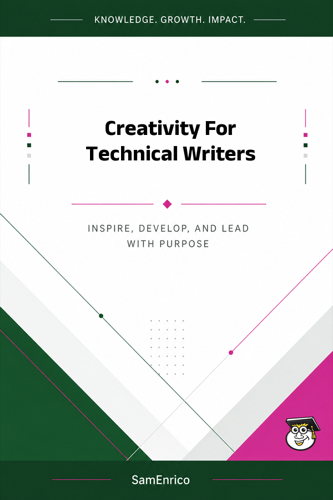
Creativity For Technical Writers eBook
Make documentation engaging and clear using creati
Make documentation engaging and clear using creative communication techniques.
Formats
Free sample
Chapter 1: The Corpse on the Page...--The first corpse I ever wrote was an installation guide.It was thorough. It was precise. It followed the Microsoft Manual of Style to the letter. Every step was numbered. Every warning was bolded.
Every screenshot was annotated with red circles and Arial 9pt text. I spent three weeks on that document, checking every cross-reference, verifying every command, making sure no user could possibly go wrong.After it published, support calls for that product dropped by exactly zero percent.A month later, I sat in a user research session behind a one-way mirror. A system administrator named Diane—forty-seven years old, twenty-three years in IT, certified in three cloud platforms—opened my installation guide. She stared at page one for eleven seconds. Then she closed it.She opened You Tube instead.She searched for a video tutorial.
The first result was a teenager in a bedroom with poor lighting, a headset microphone, and an accent that made "directory" sound like "die-rect-oh-ree." The video had no table of contents, no style guide compliance, and at one point the teenager accidentally typed the wrong command, laughed, and said "Oops, don't do that."Diane followed that video. The software installed correctly. She left a comment: "Thanks, this was actually helpful."I sat behind the mirror and realized something terrible.My perfect, correct, style-guide-compliant manual was a corpse. It had all the right organs in all the right places. It was technically alive.
But no one would read it because it felt dead on the page.This book is about why that happens and what to do about it.The Myth We Have All Inherited Let me name the lie clearly: Professional documentation must be boring.You have heard this lie in at least three forms. First, the form of style guides that treat personality as a typo to be corrected. Second, the form of senior writers who say "we're not here to entertain" with the same tone they might use to say "we're not here to commit fraud." Third, the form of job descriptions that ask for "clear and concise documentation" but punish any sentence that contains a joke, a voice, or a moment of genuine human warmth.The lie has deep roots. In the 1970s and 80s, technical writing professionalized itself by borrowing the aesthetics of engineering. Engineers respected precision, neutrality, and reproducibility.
So technical writers made their documents look like engineering artifacts: gray paragraphs, numbered lists, passive voice, and a complete absence of any indicator that a human being had written the words.This was a successful strategy for gaining respect. It was a terrible strategy for gaining readers.The engineering aesthetic assumed that users read documentation the way engineers read specifications: carefully, completely, and with great patience. But users do not read documentation. They hunt documentation. They arrive with a specific problem, a limited amount of time, and a low tolerance for friction.
If your document feels like work to read, they will leave. They will go to You Tube, to Stack Overflow, to a coworker's desk, to anywhere except your perfectly formatted corpse.Here is what the research says. Nielsen Norman Group has spent decades studying how people read on screens. Their findings are brutal: users read only about twenty percent of the words on an average page. They scan in an F-shaped pattern—two horizontal movements across the top, then a vertical scan down the left side.
They do not read sequentially. They hunt for keywords like animals hunting for prey.Your beautifully structured manual, with its careful transitions and complete sentences, is invisible to a hunting animal.The Curse That Makes Us Boring There is a second, deeper reason technical writing tends toward the corpse-like. It has a name: the curse of knowledge.The curse of knowledge is a cognitive bias. Once you know something, you cannot easily imagine what it is like not to know it. You forget the confusion, the false starts, the moments of not understanding.
You remember only the final, clear understanding—and you assume your reader will arrive there instantly.Steven Pinker, in The Sense of Style, calls this "the curse of knowledge" and identifies it as the single greatest cause of bad writing across all genres. In technical writing, the curse is amplified because the gap between expert and novice is enormous. You have spent months learning the system. The user has spent ninety seconds. You know that "authentication token" is a simple concept with a straightforward definition.
The user sees two words that could mean anything.The curse of knowledge produces writing that is clear to you but opaque to everyone else. It produces sentences like these, all taken from real documentation I have collected over the years:"The system may exhibit non-deterministic behavior under certain conditions." (Translation: It sometimes breaks. We don't know why.)"User credentials must be provisioned prior to initiating a session." (Translation: Log in first.)"A fatal exception has occurred at memory address 0x7F." (Translation: Something went wrong. We saved a log file. Start there.)Each of these sentences is grammatically correct.
Each follows some style guide somewhere. Each is utterly useless to a stressed user.The curse of knowledge also makes us boring because we mistake information for communication. Information is the raw material—the facts, the steps, the specifications. Communication is the act of transferring that information into another human's brain. Information can be neutral.
Communication cannot. Communication requires empathy, attention to the reader's state, and a willingness to be understood rather than merely correct.A corpse contains all the information of a living body. It has the same organs, the same chemical composition, the same physical structure. But it does not communicate life. The same is true of a dead manual.Usability Delight: The Antidote So what is the alternative?Let me introduce a concept that will run through every chapter of this book: Usability Delight.Usability Delight is the small, surprising moment when a user encounters documentation and feels something other than frustration.
It might be relief—"Oh thank god, they actually explained that." It might be recognition—"Yes, that's exactly my problem." It might even be a smile—a well-placed joke, a human moment, an error message that says "We couldn't save that file. Let's try again" instead of "Save operation failed."Usability Delight is not about being funny. It is about being present. It is about acknowledging that there is a human being on the other side of the screen, and that human being is probably confused, stressed, or in a hurry. Usability Delight says: I see you.
I know what you need. Let me help you quickly.Usability Delight is measurable. When you replace a robotic error message with a human one, support tickets drop. When you add a scenario that matches a user's actual situation, time-to-completion drops. When you structure a tutorial like a conversation rather than a lecture, retention rates rise.
Delight is not frivolous. It is a usability feature.Here is an example from a real company. Mailchimp, the email marketing platform, is famous for its documentation voice. Where most error messages say "Invalid input," Mailchimp says "Whoops, that email…
This is the end of the free sample. Get the eBook to keep going. Buy now
About this book
Details
- Author
- Schmitt Scott
- Publisher
- SamEnrico
- Language
- English
- Genre
- Non-Fiction, Self-Help, Technical Writing, Communication
- Released
- 2026-06-11
- Pages (approx.)
- 138
- Available as
- eBook, Audiobook

Read better in the ZLOADR app
Your eBooks on your phone or tablet. Sign in with your SamEnrico account and start reading.
More by Schmitt Scott
 Cali Cartel Extortion NetworkSchmitt Scott$11.99
 Asbestos In Older Homes GuideSchmitt Scott$11.99
 Notarbartolo Prison InterviewSchmitt Scott$11.99
 Stress and Frequent Illness GuideSchmitt Scott$11.99
 The Silk Road to the Pacific: Cook’s Secret Charts and the Forgotten Asian ExplorersSchmitt Scott$11.99
 The Silk Road Enigma: How a Mysterious Founder Built a Darknet EmpireSchmitt Scott$11.99
 School Social WorkerSchmitt Scott$11.99
 How to Start a Power Generators Business (Beginners Guide)Schmitt Scott$11.99
 Nigeria VAT for SMEsSchmitt Scott$12.99
 Running Strategy Meetings for Risk ReviewsSchmitt Scott$12.99
 Understanding Febrile SeizureSchmitt Scott$17.99
You may also like
 Hong Kong Handover 1997Dunn Johnnie$11.99
 Zumba For Postnatal Recovery CourseNeal Christian$11.99
 Zumba for BeginnersLadner Nikia$11.99
 YouTube Comment Mining GuideHumes Pandora$12.99
 Worry Box MeditationCarlin Rudy$11.99
 Workplace Stress MeditationNguyen Lynn$11.99
 Workplace Stress and Sleep RepairHawley Ivory$11.99
 Workplace Perfectionism CureDelaney Jeffry$11.99
 Workplace Injustice Anger GuideWallen Isabelle$11.99
 Work Addiction and Burnout LinkGreenwood Ester$11.99
 Women in Yoga and WellnessBeattie Galina$11.99
 Women in Stand Up ComedyChun Evangeline$11.99