
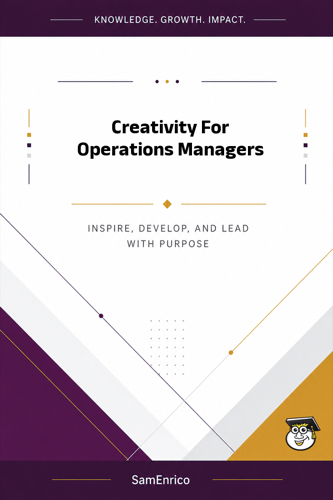
Creativity For Operations Managers eBook
Improve supply chain, logistics, and processes usi
by Clark Emmett
Improve supply chain, logistics, and processes using operational creativity techniques.
Formats
Free sample
Chapter 1: The Immunity Illusion–- In March 2020, a global automotive parts manufacturer did everything right. They had state-of-the-art forecasting software, decades of demand data, long-standing relationships with tier-one suppliers, and a logistics network optimized to the decimal point. Their inventory turns were the envy of the industry. Their lean initiatives had won awards. And within six weeks of the pandemic lockdowns, they shut down three assembly plants, laid off 1,200 workers, and lost $47 million in unrealized revenue.
Their CEO, in a leaked internal memo, wrote something that should haunt every operations manager reading this book: "We followed the playbook perfectly. The playbook was wrong."This chapter is not about the pandemic. The pandemic was simply the most visible example of a permanent condition that operations managers have refused to acknowledge. That condition is permanent non-stationarity—a statistical term meaning that the rules of the game change constantly, without warning, and without respect for your historical data. The tariff wars of 2025–2026, the Suez Canal blockage of 2021, the unprecedented container rates of 2021–2022, the sudden collapse of Silicon Valley Bank, the Red Sea shipping crisis of late 2023—these are not anomalies.
They are the new weather. And your old forecasting models are not just useless against this weather. They are dangerous.This book argues that the era of "set it and forget it" supply chains is dead. The modern Operations Manager must act like a jazz musician—improvising within constraints, listening for cues that were not in the sheet music, and sometimes playing a wrong note on purpose to find a new harmony. The central thesis, which we will explore across twelve chapters, is this: constraints—budget cuts, port strikes, supplier failures, tariff shocks—are not barriers to creativity.
They are the fuel for it. The most innovative supply chain solutions in history emerged not from abundance but from scarcity, not from stability but from crisis, not from unlimited resources but from the desperate need to do more with less.But before we can build creative solutions, we must first dismantle the illusion that has held operations management hostage for decades: the illusion of business as usual.The Forecasting Trap: Why Your Data Is Lying to You Let me be precise about what I mean when I say your data is lying to you. I do not mean your data contains errors, though it probably does. I mean that the statistical assumptions underlying almost every forecasting method used in operations today are fundamentally incompatible with the world we now inhabit.Most forecasting models—whether exponential smoothing, ARIMA, moving averages, or even many machine learning approaches—rely on an assumption called stationarity. Stationarity means that the statistical properties of a process (mean, variance, autocorrelation) do not change over time.
When you calculate a twelve-month moving average, you are implicitly assuming that next month will look, statistically speaking, like the last twelve months. When you fit a seasonal decomposition, you assume that next year's holiday spike will resemble last year's.The pandemic, the tariff wars, the canal blockages, the bank failures—these are non-stationary shocks. They change the underlying process itself. After a port strike, the distribution of transit times does not simply shift slightly to the right. It develops a second peak, a long tail, a completely different shape.
Your historical average of fourteen days becomes meaningless when one shipment takes forty days and the next takes seven, with no pattern you can model.Consider the Suez Canal blockage of March 2021. The Ever Given, a container ship the length of the Empire State Building, ran aground and blocked the canal for six days. But the ripple effects lasted six months. Companies that relied on historical transit times continued to plan as if the canal were open. They sent ships toward the blockage, created queues of hundreds of vessels, and then spent weeks rerouting around the Cape of Good Hope.
Their forecasting models, trained on years of smooth Suez transit data, could not conceive of a thirty-day delay. So they planned for fifteen-day delays and got thirty. Their confidence intervals—those pretty ranges of uncertainty that give planners a false sense of control—were calibrated on a world that no longer existed.The reframing question: Instead of asking "How do we forecast more accurately?" we must ask "How do we build immunity to inaccurate forecasts?" Because you will never forecast perfectly. The future is not a smoother version of the past. It is a stranger, and it will keep surprising you.Reframing: The Creative Act That Precedes All Others Before you can solve a problem creatively, you must first reframe the problem.
Reframing is the act of stepping back from the question you are asking and asking a different question entirely. It is the most fundamental creative technique in operations management, and it is free. It requires no budget, no software, no executive approval. It requires only the courage to admit that you might be solving the wrong problem.Most operations managers are trained to ask efficiency questions. "How do we reduce cost per unit?" "How do we increase inventory turns?" "How do we optimize truck utilization?" These are not bad questions.
They are simply second-order questions—questions that assume the first-order question has already been answered correctly. The first-order question, the one almost no one asks, is: "What are we actually trying to achieve?"The reframing technique has four steps, which we will use throughout this book. Let me walk you through them with a concrete example from a mid-sized consumer goods company that faced a seemingly impossible logistics problem.Step 1: Identify the Hidden Assumption Every process, every policy, every metric contains hidden assumptions. These assumptions were probably correct when they were written. They may even be correct most of the time.
But they become invisible over time, hardening into "the way things are done." Your job is to excavate them.In the consumer goods case, the company had a standard policy: all customer orders ship within 24 hours of receipt. The hidden assumption was: "Fast shipping is what customers value most." This assumption had never been tested. It was simply inherited from the founder, who had built the company on a promise of overnight delivery.Step 2: Invert the Assumption Inversion is a mental model borrowed from the Stoics and popularized by investors like Charlie Munger. Instead of asking "What do we need to do to succeed?" ask "What would guarantee failure?" Instead of "How do we increase speed?" ask "What if speed didn't matter?"The team inverted their assumption: "What if customers value reliability more than speed?" What if a customer would happily wait five days for an order if they knew—with 99.9% certainty—that it would arrive exactly on the fifth day? What if the real driver of customer satisfaction was not how fast the order arrived but how accurately the arrival date was predicted?Step 3: Find Edge Cases and Historical Near-Misses Edge cases are the exceptions that break the rule.
They are your best teachers because they reveal the hidden assumptions most clearly. The team looked at their customer service logs and found something fascinating: the customers who complained most loudly were not the ones who waited the longest. They were the ones…
This is the end of the free sample. Get the eBook to keep going. Buy now
About this book
Details
- Author
- Clark Emmett
- Publisher
- SamEnrico
- Language
- English
- Genre
- Non-Fiction, Self-Help, Operations, Supply Chain
- Released
- 2026-06-09
- Pages (approx.)
- 147
- Available as
- eBook, Audiobook

Read better in the ZLOADR app
Your eBooks on your phone or tablet. Sign in with your SamEnrico account and start reading.
More by Clark Emmett
 Escobar Drug Lord RoutineClark Emmett$11.99
 Tap Water Toxin Filter GuideClark Emmett$11.99
 Diamond Center Security FailureClark Emmett$11.99
 Stress and Diabetes Management GuideClark Emmett$11.99
 The Unlikely Alliance: How a Pop Star and a Dictator’s Daughter Changed HistoryClark Emmett$11.99
 Ballots & Shadows: The Phantom Voters of 1824Clark Emmett$11.99
 Understanding Fanconi Syndrome, Renal, With Nephrocalcinosis and Renal StonesClark Emmett$17.99
 Sales Enablement ManagerClark Emmett$11.99
 UAE Designated Zone RulesClark Emmett$12.99
 Strategy Meeting One Hour Mastery GuideClark Emmett$12.99
 Ultimate Handbook Guide to Samut Prakan : (Thailand) Travel GuideClark Emmett$11.99