
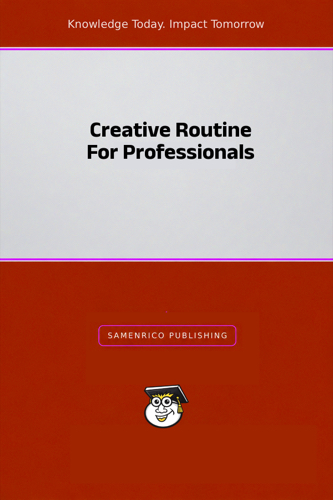
Non-FictionSelf-HelpDaily Creativity
Creative Routine For Professionals eBook
Build daily habits that unlock creativity for anal
by Bruton Ronni
Build daily habits that unlock creativity for analytical minds without woo woo.
Formats
Free sample
Chapter 1: The Logic Labyrinth–- The first time Sarah, a senior data scientist at a fintech startup, tried to “be more creative,” her manager suggested vision boarding. She sat in a conference room with magazines, scissors, and a glue stick, surrounded by colleagues who seemed genuinely transported by images of tropical beaches and mountain summits. Sarah cut out a picture of a well-organized spreadsheet. She felt nothing. Later, she tried a creativity app that played binaural beats and asked her to “surrender to the universe.” She lasted four minutes.
The final blow came when a well-meaning mentor told her to “just trust the process and let go of logic.” Sarah, whose entire professional identity was built on rigorous analysis,因果推断, and A/B testing, walked away convinced that creativity was not for her.That was three years ago. Today, Sarah leads a product innovation team that has filed twelve patents in eighteen months. She does not own a glue stick. She has never journaled about her feelings. And she has absolutely, definitively, never surrendered to the universe.
What changed? She stopped trying to be creative and started building a creative system.This book is for every professional who has been told to “think outside the box” without being given a map, a flashlight, or even a clear definition of where the box is. It is for the analyst who stares at a blank page and feels not a lack of imagination but a surfeit of anxiety. It is for the engineer, the lawyer, the accountant, the project manager, the data scientist, the software developer, and the operations director who have been force-fed “woo-woo” creativity methods that feel like intellectual surrender rather than professional development.Here is the truth that vision boards and binaural beats will never tell you: creativity is not a mystical force. It is a cognitive process.
It responds to inputs, respects constraints, and rewards repetition. It can be measured, optimized, and systematized. And the people who produce the most creative work in any field—from particle physics to punk rock—are not the ones who wait for lightning to strike. They are the ones who have built a lightning rod.The Myth That Paralyzes Professionals Let us begin by naming the enemy. It is not a lack of talent.
It is not a deficiency of imagination. It is a story—a deeply ingrained, culturally reinforced myth that has probably been repeated to you so many times that you have accepted it as truth. The myth goes like this: creativity is a spontaneous, unpredictable, almost magical event. It arrives in a flash. It cannot be summoned.
It favors the young, the eccentric, and the emotionally unhinged. And most damning of all: if you have to try to be creative, you are not a creative person.This is the Myth of the Muse. In ancient Greece, poets and artists believed that creative inspiration came from the nine Muses, goddess daughters of Zeus who would—if they chose to favor you—whisper ideas into your ear. You could not control them. You could only hope.
Two thousand years later, we have repackaged this superstition in secular language, but the underlying belief remains unchanged. We talk about “waiting for inspiration,” “the spark,” “the bolt from the blue,” and “the lightbulb moment.” All of these phrases share a common assumption: creativity happens to you, not because of you.Cognitive science has thoroughly demolished this assumption. In the 1980s, psychologist John Hayes studied the careers of over seventy classical composers and found that virtually every significant work was produced after at least ten years of sustained, deliberate practice. This became known as the “ten-year rule.” Later research by Anders Ericsson (the psychologist behind the “10,000-hour rule”) showed that even undisputed geniuses—Mozart, Einstein, Picasso—spent years accumulating domain-specific knowledge and skills before producing anything we would call revolutionary. Mozart’s first works are not the ones we remember.
They are competent, derivative, and forgettable. The magic came after a decade of showing up.More recent neuroscience has identified exactly what happens in the brain during so-called “aha moments.” Using f MRI scans, researchers have observed that creative insights are preceded by a period of intense preparation (feeding the brain with relevant and irrelevant information), followed by a period of incubation (stepping away from the problem), and finally a burst of activity in the anterior superior temporal gyrus—a region associated with making remote associations between seemingly unrelated concepts. In other words, the brain solves problems by recombining existing information in novel ways. It does not conjure something from nothing. It remixes what you have already put into it.This is extraordinarily good news for analytical professionals.
It means creativity is not a personality trait you either have or lack. It is a process you can learn. It is a muscle you can train. And the training regimen looks less like a meditation retreat and more like a manufacturing production line: input, process, output, iteration, rest, repeat.Introducing Resistance: The Real Enemy If the Muse is a myth, then what actually stops us from doing creative work? Not a lack of talent.
Not a shortage of ideas. Something far more insidious and far more universal. The writer Steven Pressfield, in his exceptional book The War of Art, gave this force a name: Resistance.Resistance is not laziness. It is not procrastination in the ordinary sense of poor time management. It is a subconscious, self-protective fear response that manifests in dozens of specific behaviors, all of which have the same effect: they prevent you from doing the work that matters.Here is how Resistance operates in the analytical professional’s daily life.
You sit down to write a proposal, design a presentation, draft a strategy, or code a new feature. Almost immediately, you feel a subtle discomfort. It might be a slight tension in your shoulders, a vague sense of dread, or a sudden conviction that you need more information. Your brain, which is wired to avoid uncertainty and social judgment, offers you a series of very reasonable-sounding alternatives. “Let me just check my email first.” “I should really clean up my desktop folders.” “This would be better if I did another round of research.” “I’m not in the right headspace right now; I’ll start after lunch.”Resistance is exquisitely adapted to fool analytical minds because it speaks your language.
It does not tell you to watch television or scroll through social media (though it will happily accept those outcomes). It tells you that you need more data. It tells you that your logic is not yet complete. It tells you that a truly rational person would prepare further before committing to a path. These are all lies, but they are lies wrapped in the elegant clothing of reason.The most dangerous disguise Resistance wears is perfectionism.
The perfectionist says, “I cannot show this draft to anyone because it is not good enough yet.” The perfectionist says, “I will write the proposal when I have found the perfect structure.” The perfectionist says, “I am not ready.” But here is the truth that perfectionism hides: you will never be ready. Readiness is not a state…
This is the end of the free sample. Get the eBook to keep going. Buy now
About this book
Details
- Author
- Bruton Ronni
- Publisher
- SamEnrico
- Language
- English
- Genre
- Non-Fiction, Self-Help, Daily Creativity
- Released
- 2026-06-10
- Pages (approx.)
- 147
- Available as
- eBook, Audiobook

Read better in the ZLOADR app
Your eBooks on your phone or tablet. Sign in with your SamEnrico account and start reading.
More by Bruton Ronni
 Recovery After Relapse ProtocolBruton Ronni$11.99
 The UAE CV and Resume GuideBruton Ronni$11.99
 Mediterranean and Gut HealthBruton Ronni$11.99
 Forgiveness for CaregiversBruton Ronni$11.99
 The Charge of the Light Brigade: A Cavalry's Doomed Glory (1854)Bruton Ronni$11.99
 Understanding Trismus Pseudocamptodactyly SyndromeBruton Ronni$17.99
 Franchise Conflict of LawsBruton Ronni$12.99
 How to Start a Cigarillo Business (Beginners Guide)Bruton Ronni$11.99
 Client Interfaces DeveloperBruton Ronni$11.99
You may also like
 Hong Kong Handover 1997Dunn Johnnie$11.99
 Zumba For Postnatal Recovery CourseNeal Christian$11.99
 Zumba for BeginnersLadner Nikia$11.99
 YouTube Comment Mining GuideHumes Pandora$12.99
 Worry Box MeditationCarlin Rudy$11.99
 Workplace Stress MeditationNguyen Lynn$11.99
 Workplace Stress and Sleep RepairHawley Ivory$11.99
 Workplace Perfectionism CureDelaney Jeffry$11.99
 Workplace Injustice Anger GuideWallen Isabelle$11.99
 Work Addiction and Burnout LinkGreenwood Ester$11.99
 Women in Yoga and WellnessBeattie Galina$11.99
 Women in Stand Up ComedyChun Evangeline$11.99