
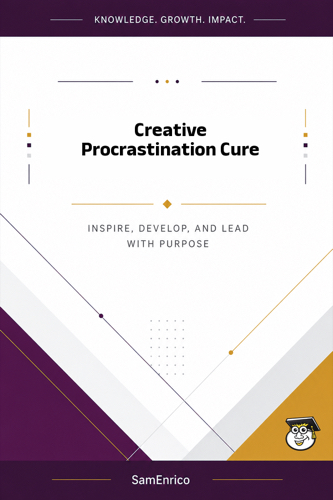
Non-FictionSelf-HelpProcrastination
Creative Procrastination Cure eBook
Understand avoidance patterns and build momentum w
by Mccrary Ola
Understand avoidance patterns and build momentum with tiny first steps.
Formats
Free sample
Chapter 1: The "Later" Lie...--–- The email arrived at 9:14 AM. It was a simple request from a client, requiring maybe twenty minutes of work. Nothing urgent. Nothing difficult. Just a small, administrative task that needed doing.
She read it, felt a tiny prickle of boredom at the prospect, and told herself exactly what you have told yourself thousands of times: "I'll do it later."That "later" never came.Three weeks later, the client followed up. Now the twenty-minute task had become a crisis. The delay had damaged trust. The relationship that took two years to build was now fraying because of an email that should have taken less time to answer than a lunch break. When asked why she hadn't responded, she couldn't give a good answer.
Not because she was hiding something, but because she genuinely didn't know. She wasn't lazy. She wasn't incompetent. She just... didn't do it.
And the cost of that small delay ended up being measured not in minutes, but in thousands of dollars of lost future business.This is not a story about a disorganized person. This is a story about you. And me. And everyone who has ever stared at a simple task and felt an inexplicable, gravitational pull toward anything else.The Most Expensive Lie You Tell Yourself"I'll do it later" is the most dangerous sentence in the English language. Not because it's always false, but because it is almost never interrogated.
When you say "later," you are not making a plan. You are not scheduling a task. You are performing a magical ritual designed to make the discomfort of this moment disappear without actually solving anything.Here is what "later" actually means in the neuroscience of procrastination: "I am currently experiencing discomfort, and rather than tolerate that discomfort for the short time required to complete this task, I will trick my brain into feeling better right now by pushing the discomfort into an imaginary future where I have infinite energy, perfect focus, and no competing priorities."Later is not a time. Later is a feeling you don't want to have right now.And the cruelest trick of all is that "later" works perfectly as a short-term mood repair strategy. When you say it, you genuinely feel relief.
The anxiety drops. The pressure releases. You can go back to scrolling, cleaning, eating, or staring into space without that nagging voice in your head. For about thirty seconds, you have successfully escaped.Then the guilt arrives.The Procrastination-Anxiety Loop Let me show you exactly what happens inside your brain when you say "later." I call this the Procrastination-Anxiety Loop, and understanding its mechanics is the single most important insight in this entire book.Stage One: Trigger You face a task that creates some form of discomfort. This discomfort might be boredom (the task is dull), fear of failure (what if I do it wrong?), ambiguity (I don't know the first step), or even fear of success (what if this changes everything?).
Your brain does not distinguish between these flavors of discomfort. It only knows one thing: this feels bad right now.Stage Two: Escape Your brain, specifically your limbic system (what I call the Emotional Bear in Chapter 3), immediately seeks an escape route. It wants the discomfort to stop, and it wants it to stop now. Distraction is the fastest, most reliable painkiller available. Social media.
Snacks. Cleaning the kitchen. Checking email (ironically). Reorganizing your desktop folders. Anything that provides a small, immediate hit of relief.Stage Three: Temporary Relief The distraction works.
For a few glorious moments, you feel better. The task is gone from your consciousness. You are not failing, not struggling, not bored. You are scrolling, eating, organizing. The Emotional Bear is satisfied.
You have successfully repaired your mood.Stage Four: Guilt But the relief is always temporary. Within minutes, sometimes seconds, the guilt arrives. And not just guilt—a specific, insidious kind of guilt that includes self-criticism. "Why can't I just do things? What's wrong with me?
I'm so lazy. Everyone else can handle this. I'm a fraud."This guilt is not harmless. It is not motivational. It is jet fuel for more procrastination.Stage Five: Amplified Anxiety The guilt makes the original task feel even heavier.
Now you haven't just failed to do the thing. You have also failed to be the person who does the thing. The task has grown from "twenty minutes of boring work" to "twenty minutes of boring work PLUS the shame of having avoided it PLUS the evidence that you are fundamentally flawed."How do you respond to amplified anxiety? You guessed it. More escape.
More distraction. More "I'll do it later."Stage Six: Panic or Abandonment The loop continues until one of two things happens. Either a deadline arrives and triggers panic (which finally overrides the avoidance), or there is no deadline and the task is quietly abandoned, joining the graveyard of Ghost Tasks we will identify at the end of this chapter.This is not weakness. This is not laziness. This is the fundamental architecture of how your brain responds to discomfort.
Every single person who has ever procrastinated has run this exact loop. The only difference between chronic procrastinators and productive people is not that productive people don't feel the discomfort. It's that they have learned to interrupt the loop before it spirals.The Two Kinds of Delay Before we go any further, I need to make a critical distinction that will echo throughout this book. Not all delay is bad. In fact, some delay is essential for creative work, strategic thinking, and good decision-making.Productive Strategic Delay This is intentional waiting.
You choose to delay because you are waiting for better information, better timing, or better resources. Examples include:Not sending an important email until you have slept on it Delaying a hiring decision until you have interviewed all candidates Postponing a creative project until after you have completed necessary research Waiting to launch a product until the market conditions are right Productive strategic delay has three defining characteristics:You choose it consciously, not reflexively You have a specific timeline or condition attached You feel calm and in control, not guilty and anxious Destructive Passive Procrastination This is automatic avoidance. You delay because you are escaping discomfort, not because you have a strategic reason. Examples include:Putting off a difficult conversation because it feels awkward Avoiding a simple email because it's boring Delaying exercise because you're tired (when you know you'll feel worse later)Procrastinating on a creative project because you're afraid it won't be perfect Destructive procrastination has three defining characteristics:It happens automatically, without conscious choice There is no timeline or condition attached—just vague "later"You feel guilty, anxious, and self-critical afterward The difference is everything. Throughout this book, we will focus on eliminating destructive procrastination while preserving and even enhancing productive strategic delay.
Chapter 7 is dedicated entirely to this distinction, teaching you how to use "incubation" and strategic waiting as creative tools rather than escape hatches.The Ghost Task: Your First Diagnosis Every chronic procrastinator has one. The Ghost Task. The thing that floats through your mind at 3 AM, on Sunday afternoons…
This is the end of the free sample. Get the eBook to keep going. Buy now
About this book
Details
- Author
- Mccrary Ola
- Publisher
- SamEnrico
- Language
- English
- Genre
- Non-Fiction, Self-Help, Procrastination
- Released
- 2026-06-09
- Pages (approx.)
- 144
- Available as
- eBook, Audiobook

Read better in the ZLOADR app
Your eBooks on your phone or tablet. Sign in with your SamEnrico account and start reading.
More by Mccrary Ola
 Wholesaling Direct Mail GuideMccrary Ola$11.99
 The Comparison CurseMccrary Ola$11.99
 Mindful Stress Reduction for Social WorkersMccrary Ola$11.99
 Teen Active Listening Skills GuideMccrary Ola$11.99
 Sports Massage for RecoveryMccrary Ola$11.99
 Morning Commute Anger FixMccrary Ola$11.99
 Weight Childhood Shame HealingMccrary Ola$11.99
 Baldwin Dynasty - William BaldwinMccrary Ola$11.99
 Tangaroa’s Tide: The Birth of the Pacific’s First NavigatorMccrary Ola$11.99
 Gwythaint: The Ravenous Shadow of CamelotMccrary Ola$11.99
 Whispers of the Forbidden: The Secret Love Letters of Eleanor Roosevelt and Lorena HickokMccrary Ola$11.99
 Search Ads Conversion OptimizationMccrary Ola$11.99
You may also like
 Hong Kong Handover 1997Dunn Johnnie$11.99
 Zumba For Postnatal Recovery CourseNeal Christian$11.99
 Zumba for BeginnersLadner Nikia$11.99
 YouTube Comment Mining GuideHumes Pandora$12.99
 Worry Box MeditationCarlin Rudy$11.99
 Workplace Stress MeditationNguyen Lynn$11.99
 Workplace Stress and Sleep RepairHawley Ivory$11.99
 Workplace Perfectionism CureDelaney Jeffry$11.99
 Workplace Injustice Anger GuideWallen Isabelle$11.99
 Work Addiction and Burnout LinkGreenwood Ester$11.99
 Women in Yoga and WellnessBeattie Galina$11.99
 Women in Stand Up ComedyChun Evangeline$11.99