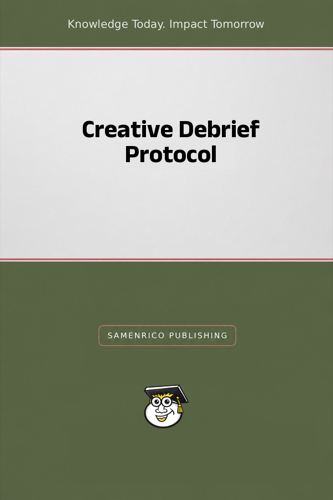
Creative Debrief Protocol eBook
Runs after-action reviews focused on process impro
Runs after-action reviews focused on process improvements for future sessions.
Formats
Free sample
Chapter 1: The $10,000 Mistake--–- The conference room smelled of stale coffee and exhausted ambition. Six senior creatives, three strategists, and two account managers had just spent four hours in what was supposed to be the breakthrough session of the quarter. Whiteboards were filled with half-formed ideas. Sticky notes carpeted the walls like multicolored scales. Laptops were closing, one by one.
The creative director leaned back in her chair, looked around the room, and asked the question that everyone dreaded but no one knew how to answer: "So... what did we just do?"The silence that followed was not contemplative. It was empty.Someone joked nervously, "Well, we definitely had a lot of ideas." Someone else said, "I think we lost the plot around the two-hour mark." A third person checked their phone and announced they had another meeting. Within ninety seconds, the room had emptied. The sticky notes remained on the walls until the cleaning crew arrived at midnight.
The whiteboards were erased by morning. The $10,000 investment in collective time—six senior staff at fully loaded hourly rates for four hours—had produced nothing that would ever see the light of day.Worse, no one would learn anything from the experience. The same team would reassemble next quarter and repeat the exact same patterns. They would make the same mistakes, suffer the same frustrations, and produce the same mediocre results. They would mistake activity for progress, attendance for contribution, and duration for depth.
And they would never, ever debrief properly.This book exists because that scenario plays out thousands of times every single day in agencies, studios, innovation labs, and corporate strategy departments around the world. The cost of unexamined creative work is staggering—not just in dollars, but in morale, momentum, and the slow erosion of trust that happens when smart people keep failing in predictable ways and no one has the tools to stop the cycle.The Learning Paradox: Why Smart Teams Stay Stuck Before we can fix the problem, we must understand why it persists. The Learning Paradox is a concept drawn from the work of Artie Mahal, whose research on After-Action Reviews revealed a disturbing pattern across industries: teams that believe they are learning are often doing nothing of the sort. They mistake the feeling of having discussed something for the reality of having changed something.Here is how the paradox works in creative settings. A team finishes a grueling brainstorming session.
Everyone is tired. The facilitator asks, "What did we learn?" Two or three people offer observations: "We should have started earlier." "We need clearer goals." "Someone should have brought snacks." Everyone nods. The meeting ends. Everyone feels a small sense of closure, as if the learning has occurred. But nothing has actually changed.
The next session will start late again. The goals will still be vague. The snacks will still be forgotten.The paradox has three root causes, each more insidious than the last.First, confusing discussion with documentation. Verbal agreement in a meeting feels productive, but it leaves no trace. Without a written record of what was learned and what will change, the insights evaporate within hours.
Human memory is not designed to retain process improvements; it is designed to retain stories and threats. The casual debrief conversation is forgotten before the next session even begins.Second, confusing diagnosis with action. Identifying a problem is not the same as solving it. Most debriefs stop at the "why was there a difference?" stage. They never reach the "what will we do differently next time?" stage because that requires concrete commitments, assigned owners, and follow-through—all of which feel like additional work on top of already exhausting creative labor.Third, confusing activity with learning.
This is the deepest trap. Teams that hold regular "post-mortems" or "retrospectives" often believe they are learning because they are doing the thing that learning looks like. They schedule the meeting, they ask the questions, they nod thoughtfully. But if the output of those meetings never changes the input of future sessions, no learning has occurred. The team has merely performed a ritual.The Critical Distinction: Project Debriefs vs.
Process Debriefs To escape the Learning Paradox, we must draw a hard line between two concepts that most teams treat as identical. Project debriefs ask: Did we deliver the asset on time? Did we hit the budget? Did the client approve the work? These are important questions, but they are questions about outputs.
They tell you whether you shipped the thing. They do not tell you how to ship the next thing better.Process debriefs ask: How did we think? How did we collaborate? Where did our energy spike and crash? What patterns of behavior produced our best ideas, and what patterns produced our worst?
These are questions about capabilities. They tell you whether your team is getting smarter, faster, and more fluent—or whether it is slowly calcifying into predictable mediocrity.Here is the painful truth that most creative leaders do not want to admit: project debriefs are easy, and process debriefs are hard. Project debriefs feel productive because they produce closure. A project is done; you review it; you move on. Process debriefs feel like opening a wound.
They ask you to look at how you work, not just what you made. They require vulnerability, honesty, and a willingness to admit that your beloved habits might be the very things holding you back.Yet the organizations that dominate their industries—the Pixars, the IDEOs, the innovative powerhouses that consistently produce breakthrough work—are not necessarily the ones with the most talent or the biggest budgets. They are the ones with the most disciplined process debriefs. They have institutionalized the uncomfortable practice of looking backward in order to move forward more intelligently.The Real Cost of Skipping the Debrief Let us put numbers on the problem. A typical creative session involves five to eight people.
The fully loaded cost of a senior creative (salary, benefits, overhead, opportunity cost) averages between $150 and $300 per hour. A four-hour session therefore costs between $3,000 and $10,000 in direct labor. If your team runs two such sessions per week, you are investing between $300,000 and $1,000,000 per year in creative sessions.Now ask yourself: what percentage of those sessions produce work that actually moves the needle? What percentage produce ideas that die on the whiteboard? What percentage could have been cut in half with better process, or avoided entirely with clearer preparation?The research on meeting effectiveness is sobering.
Studies consistently find that executives rate more than half of the meetings they attend as unproductive. For creative sessions specifically, the problem is worse because creative work is harder to measure and easier to fake. A bad status meeting is obviously bad. A bad brainstorming session can feel exciting in the moment—people are talking, ideas are flying, energy is high—while producing nothing of strategic value.But the cost is not only financial. There is also the cost of creative attrition.
When talented people repeatedly waste their time in poorly designed sessions that never improve, they become cynical. They stop contributing fully. They start looking for jobs where their time is respected. The best creatives are not the ones who…
This is the end of the free sample. Get the eBook to keep going. Buy now
About this book
Details
- Author
- Brandt Shaina
- Publisher
- SamEnrico
- Language
- English
- Genre
- Non-Fiction, Self-Help, Retrospectives
- Released
- 2026-06-07
- Pages (approx.)
- 137
- Available as
- eBook, Audiobook

Read better in the ZLOADR app
Your eBooks on your phone or tablet. Sign in with your SamEnrico account and start reading.
More by Brandt Shaina
 Cooling Breath TechniqueBrandt Shaina$11.99
 Car Research by GenerationBrandt Shaina$11.99
 Low Carb Vegan GuideBrandt Shaina$11.99
 Morning Dog Walk GuideBrandt Shaina$11.99
 Workplace Control ReleaseBrandt Shaina$11.99
 Anger De escalation in PoliticsBrandt Shaina$11.99
 Networking for PoliceBrandt Shaina$11.99
 The Children of the Prophet: Canada’s First Cult MassacreBrandt Shaina$11.99
 The Iron Geniuses of Meroë: Engineering the Nile's Mighty DamsBrandt Shaina$11.99
 How to Produce Wakeboard PartsBrandt Shaina$11.99
 How to Produce Leather and Fabric WaterproofingBrandt Shaina$11.99
 Cranial Self Holding GuideBrandt Shaina$12.99