
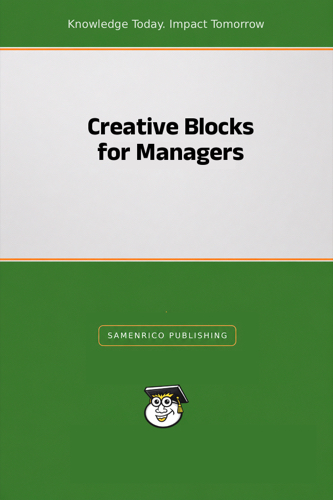
Creative Blocks for Managers eBook
undefined
undefined
Formats
Free sample
Chapter 1: The Efficiency Trap--Every manager I have ever worked with begins with the same confession. It comes somewhere in the first hour of our first conversation, usually after we have discussed their industry, their team size, and their latest quarterly results. They lean forward, lower their voice, and say something like: "I know we need more creativity. But every time someone brings me a new idea, I find myself asking about the budget, the timeline, and whether we have done this before. I am not trying to kill innovation.
I am just being practical."That moment of confession is the entire thesis of this book in miniature. The manager is not wrong to ask practical questions. They are not wrong to want predictability, efficiency, and risk control. Those instincts got them promoted. Those instincts kept their team afloat through reorgs, market shifts, and leadership changes.
Those instincts are valuable. They are also, quietly and systematically, strangling every creative impulse their team might have.This is the Efficiency Trap. It is not a failure of intent. It is a failure of design. The manager wants innovation but has built a machine that punishes it.
The manager asks for bold thinking but rewards safe execution. The manager loves the idea of breakthrough ideas but fears the reality of failed experiments. This contradiction is so common, so deeply embedded in how organizations operate, that most managers never even notice it. They are swimming in water and asking why they feel wet.This chapter is about making that water visible. We will explore the structural conflict between operational reliability and creative exploration.
We will name the Manager's Paradox. We will show how process becomes a substitute for judgment. And we will give you a diagnostic tool to measure exactly how much of your team's creative potential is being crushed by systems you thought were helping.The Manager's Paradox: Why We Say One Thing and Do Another Let us start with an uncomfortable truth. Every leadership survey ever conducted shows that innovation is a top-three priority for executives. Every mission statement ever written includes words like "creative," "bold," and "forward-thinking." Every performance review I have ever read rewards managers for "driving innovation" and "encouraging new ideas."Now let us look at what actually gets rewarded.In most organizations, the fastest path to promotion is not launching a bold experiment that fails.
It is delivering predictable results quarter after quarter. The manager who misses their numbers because they tried something new is not celebrated for their courage. They are put on a performance improvement plan. The manager who shoots the lights out on their KPIs by optimizing existing processes is called a rock star. They get the bonus.
They get the promotion. They get the corner office.This is the Manager's Paradox: leaders genuinely want innovation, but the systems they design and the behaviors they reward systematically favor efficiency over exploration.The paradox operates at every level of the organization. At the individual contributor level, an engineer who spends 20 percent of their time on a speculative side project is admired in theory but questioned in practice. ("Shouldn't you be focused on the Q3 deliverables?") At the team level, a group that proposes a radical new approach is asked for five rounds of validation before being allowed to proceed. At the manager level, the person who greenlights a risky initiative knows that if it fails, their career will bear the scars long after everyone has forgotten the upside they were chasing.This is not a failure of individual character.
It is a structural feature of how most companies operate. We have built temples to efficiency. We have enshrined predictability as a virtue. We have created incentive systems that punish deviation from the plan. Then we stand at the altar and pray for innovation to appear.It will not.
Not because your team is untalented. Not because they lack ideas. But because you have accidentally taught them that their job security depends on playing it safe.When Zero Mistakes Equals Zero Creativity The most dangerous phrase in management is not "we have always done it this way." It is "zero defects."Zero defects is a noble goal for a manufacturing line. If you are making airbags or heart valves, you want every single unit to work perfectly. Zero defects saves lives.
But when you import that mindset into knowledge work, into creative problem-solving, into the messy process of inventing something new, zero defects becomes zero learning.Creativity is not manufacturing. It does not produce identical outputs from identical inputs. It produces variation. Most of that variation is useless. Some of it is interesting.
A tiny fraction is transformative. If you demand zero defects from the creative process, you are not demanding high quality. You are demanding that no one ever show you anything that might fail. And the only way to guarantee that nothing fails is to never try anything genuinely new.I have watched this play out in dozens of organizations. A team is given a bold mandate: redesign the customer experience, invent a new revenue stream, reimagine the product.
The team gets excited. They generate wild ideas. They bring a rough prototype to their manager. And the manager, acting out of perfectly understandable instincts, asks: "Where is the data supporting this?" "Have we stress-tested the assumptions?" "What is the ROI projection?"These are reasonable questions. They are also lethal to early-stage creativity.
At the moment an idea is born, it has no data. It has no stress test. It has no ROI projection. It is fragile, half-formed, and deeply uncertain. Asking for proof at that stage is not diligence.
It is infanticide.The manager does not see it that way. They see themselves as being responsible. They see themselves as protecting the company from waste. They see themselves as doing their job. And they are right.
The tragedy is that the job they have been trained to do is actively incompatible with the innovation they have been asked to produce.The Hidden Curriculum of Process Every organization has what I call a hidden curriculum: the unwritten lessons that employees learn about what actually matters. The employee handbook says "innovation is valued." But the hidden curriculum teaches something else. It teaches that proposals with more slides get approved. It teaches that ideas that have been vetted by three levels of management are safer than ideas that have not. It teaches that the person who points out why something cannot work is more respected than the person who dreams up something that might.This hidden curriculum is delivered through process.
Process is not neutral. Every step in every workflow sends a signal about what the organization cares about. A fifteen-page approval template signals that thorough documentation matters more than speed. A mandatory legal review for every customer-facing message signals that risk avoidance matters more than authentic communication. A requirement that all new projects show a six-month ROI projection signals that short-term predictability matters more than long-term discovery.None of these signals are malicious.
They are usually the accumulated sediment of past mistakes, past crises, past moments when something went wrong and a new rule was added to prevent…
This is the end of the free sample. Get the eBook to keep going. Buy now
About this book
Details
- Author
- Quinn Charlie
- Publisher
- SamEnrico
- Language
- English
- Genre
- Non-Fiction, Self-Help
- Released
- 2026-06-09
- Pages (approx.)
- 126
- Available as
- eBook, Audiobook

Read better in the ZLOADR app
Your eBooks on your phone or tablet. Sign in with your SamEnrico account and start reading.
More by Quinn Charlie
 CrossFit Older Athlete GuideQuinn Charlie$11.99
 The Rural Financial StressQuinn Charlie$11.99
 Anki For Political ScienceQuinn Charlie$11.99
 Myanmar Jungle Gold MinersQuinn Charlie$11.99
 The Alcohol and PTSD GuideQuinn Charlie$11.99
 Cognitive Reserve GuideQuinn Charlie$11.99
 Distraction Management for TruckersQuinn Charlie$11.99
 The Lion Tamers of Timbuktu: Africa's Forgotten Circus RevolutionQuinn Charlie$11.99
 Elizabeth I: The Lioness of EnglandQuinn Charlie$11.99
 Tomato: Beefsteak & CherryQuinn Charlie$11.99Tomato: Beefsteak & CherryQuinn Charlie$11.99
 How to Start a Financial Investment Activities BusinessQuinn Charlie$11.99
You may also like
 Hong Kong Handover 1997Dunn Johnnie$11.99
 Zumba For Postnatal Recovery CourseNeal Christian$11.99
 Zumba for BeginnersLadner Nikia$11.99
 YouTube Comment Mining GuideHumes Pandora$12.99
 Worry Box MeditationCarlin Rudy$11.99
 Workplace Stress MeditationNguyen Lynn$11.99
 Workplace Stress and Sleep RepairHawley Ivory$11.99
 Workplace Perfectionism CureDelaney Jeffry$11.99
 Workplace Injustice Anger GuideWallen Isabelle$11.99
 Work Addiction and Burnout LinkGreenwood Ester$11.99
 Women in Yoga and WellnessBeattie Galina$11.99
 Women in Stand Up ComedyChun Evangeline$11.99