
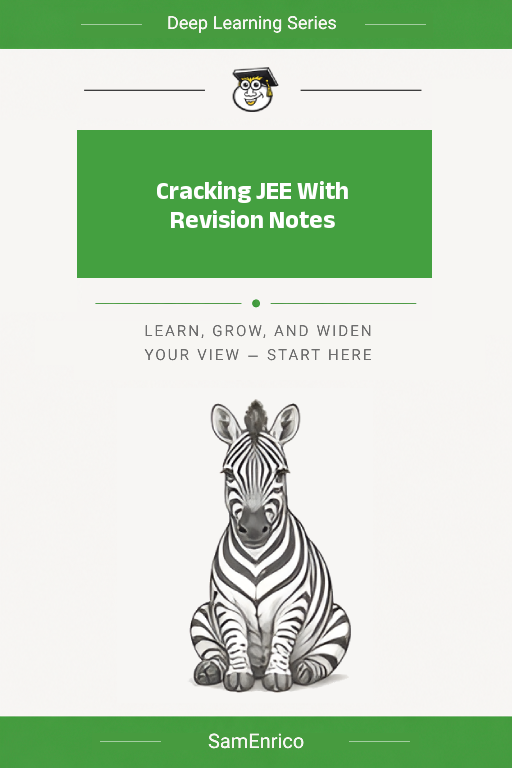
Cracking JEE With Revision Notes eBook
Create concise formula sheets and reaction summari
Create concise formula sheets and reaction summaries for last minute revision before exam.
Formats
Free sample
Chapter 1: The Final Countdown...--The night before the JEE is not the time to learn something new. It is not the time to open a thick textbook, watch a three-hour lecture, or solve a hundred unfamiliar problems. Yet, year after year, thousands of aspirants make the same catastrophic mistake: they panic-study until 2 AM, cramming formulas they have never seen before, only to walk into the exam hall with bloodshot eyes, a racing heart, and a brain that refuses to recall even the things they once knew well.This chapter exists to ensure that does not happen to you.Think of this chapter as your mission control center for the final 24 hours before the JEE Main exam. It contains no formulas, no reactions, no derivations, and no practice problems. Instead, it provides something far more valuable at this stage: a strategic timeline, a psychological framework, and a set of rules that will maximize the return on every single minute you have left.
The students who score in the 99th percentile are not necessarily the ones who know the most chemistry or the hardest physics problems. They are the ones who know how to deploy their knowledge efficiently under pressure. This chapter teaches you how to do exactly that.The 24-Hour Countdown: A Strategic Timeline The final 24 hours before the JEE exam should be divided into four distinct phases. Each phase has a specific purpose, and violating the boundaries between phases is the fastest way to sabotage your own performance.Phase 1: T-Minus 24 to 12 Hours (The Active Review Window)This is your last opportunity to actively engage with new or rusty material. During these twelve hours, you should focus exclusively on high-yield, low-complexity topics.
What does that mean? It means memorizing the "Happy Exceptions" list from Inorganic Chemistry (Chapter 4). It means reviewing the 20 derivative-integral pairs from Chapter 13. It means running through the color-coded mind maps in Chapter 11. It does NOT mean attempting to understand a difficult concept you have avoided for six months.
That ship has sailed. Trying to learn electrochemistry from scratch at 8 PM the night before the exam is not ambition; it is self-destruction.During Phase 1, use the "5-Minute Subject Switch" technique. Do not study any single subject for more than five minutes at a time. Set a timer. Five minutes of Physics formulas.
Switch. Five minutes of Organic Chemistry reactions. Switch. Five minutes of Calculus integrals. Switch.
Research on cognitive fatigue shows that context-switching in short bursts keeps the brain alert and prevents the diminishing returns that set in after twenty minutes of continuous focus on a single topic. The goal of Phase 1 is not depth. It is breadth of recall.Phase 2: T-Minus 12 to 4 Hours (The Passive Review Window)Twelve hours before your exam, you must stop active studying. This is non-negotiable. During Phase 2, you do not write anything down.
You do not solve any problems. You do not test yourself. Instead, you engage in passive review only. Read through the 20 mind maps in Chapter 11. Flip through the Exam Hall Companion booklet (Appendix B).
Review the "Silly Mistakes" checklist from Chapter 12. But do not attempt to memorize anything new. Do not write anything down. Your brain needs to shift from encoding mode to consolidation mode, and that shift requires rest and reduced cognitive load.Phase 3: T-Minus 4 to 1 Hour (The Power-Down Window)Four hours before the exam, put the book down entirely. Eat a light meal—nothing heavy, nothing sugary, nothing you have never eaten before.
(The exam hall is not the place to discover that a new breakfast food upsets your stomach.) Take a shower. Stretch. Listen to music without lyrics, or sit in complete silence. If you feel the urge to open a book, resist it. At this stage, every additional minute of studying provides negative returns.
You are not going to learn anything new that will appear on the exam. But you are very likely to induce anxiety, fatigue, or confusion that will cost you points.Phase 4: T-Minus 1 Hour to Exam Start (The No-Study Zone)One hour before the exam, you enter the No-Study Zone. You do not open a book. You do not look at your phone. You do not discuss formulas with friends outside the exam center.
The students who gather in circles and frantically ask each other "What is the formula for the Nernst equation?" are not helping themselves. They are spreading panic. Walk away from them. Put on headphones if you have to. Sit alone.
Breathe. Your only job in this hour is to arrive at the exam center with your hall ticket, your admit card, two pens, a transparent water bottle, and a calm mind.The JEE Main 2026 Heat-Map: Where to Focus Your Final Hours Not all chapters are created equal. Based on the analysis of JEE Main 2026 session papers (January and April attempts), certain topics appear with significantly higher frequency than others. The heat-map below ranks chapters by their recent weightage. Use this to prioritize your Phase 1 review.Physics High-Yield Chapters (Priority 1)Modern Physics leads the pack, appearing in 2-3 questions per paper on average.
Within Modern Physics, the most common subtopics are photoelectric effect (direct application of Einstein's equation), nuclear decay (half-life calculations), and dual nature of matter (de Broglie wavelength). Electromagnetic Induction and Alternating Current follow closely, with Lenz's Law and transformer efficiency problems appearing frequently. Optics, particularly ray optics with mirror and lens formulas, remains a reliable scoring zone. Thermodynamics and Kinetic Theory appear in 1-2 questions per paper, usually involving the first law (ΔU=Q−W\Delta U = Q - WΔU=Q−W) or efficiency of heat engines. Rotational Motion, especially moment of inertia and torque problems, rounds out the top five.Chemistry High-Yield Chapters (Priority 1)In Physical Chemistry, Electrochemistry and Chemical Kinetics dominate.
The Nernst equation and the integrated rate laws (zero, first, and second order) appear in almost every paper. Solutions, particularly colligative properties and Van't Hoff factor problems, are also heavily represented. In Inorganic Chemistry, Coordination Compounds (IUPAC naming, CFT splitting, magnetic moments) appear in 2-3 questions per paper. The periodic table trends (ionization energy, electronegativity, atomic radius) and chemical bonding (hybridization, VSEPR theory, molecular orbital theory) are也必须 mastered. In Organic Chemistry, General Organic Chemistry (GOC) concepts—stability of carbocations, carbanions, and free radicals; acidity and basicity comparisons—form the foundation for at least 4-5 questions across the paper.
Hydrocarbons, especially reactions of alkenes and alkynes (ozonolysis, hydrogenation, addition reactions), and Oxygen Compounds (alcohols, aldehydes, ketones, carboxylic acids) are consistently tested. Biomolecules and Polymers, while small chapters, appear in every single paper—usually one direct memory-based question from each.Mathematics High-Yield Chapters (Priority 1)In Mathematics, Calculus is king. Definite integration (properties, area under curves, application of King's rule) appears in 2-3 questions. Limits and continuity, particularly using L'Hospital's rule and standard limits, appear in 1-2 questions. Differential calculus, including finding maxima and minima and tangents/normals, appears regularly.
Algebra chapters: Matrices and Determinants (inverse, rank, solving linear equations) appear in 2 questions per paper. Probability, especially Bayes' theorem and conditional probability, appears in 1-2 questions. Coordinate Geometry: Circles, parabolas, ellipses, and hyperbolas appear in 2-3 combined questions. The ellipse and hyperbola, while less intuitive than the circle and parabola, are disproportionately represented relative to…
This is the end of the free sample. Get the eBook to keep going. Buy now
About this book
Details
- Author
- Morton Roland
- Publisher
- SamEnrico
- Language
- English
- Genre
- Non-Fiction, Student's Shortcut
- Released
- 2026-05-30
- Pages (approx.)
- 136
- Available as
- eBook, Audiobook

Read better in the ZLOADR app
Your eBooks on your phone or tablet. Sign in with your SamEnrico account and start reading.
More by Morton Roland
 Cybersecurity Incident ResponderMorton Roland$11.99
 Overcoming Exercise Obsession For Self EsteemMorton Roland$11.99
 Bryce Canyon Missing CasesMorton Roland$11.99
 Second Marriage PlanningMorton Roland$11.99
 Mike Krieger InstagramMorton Roland$11.99
 Anger Antecedent LogMorton Roland$11.99
 Borneo Headhunter TerritoryMorton Roland$11.99
 Mindfulness For Work StressMorton Roland$11.99
 The Healers of the Nile: The Secret Medical Corps of Ancient KushMorton Roland$11.99
 Sand and Shadows: Love Letters from the Sinai FrontMorton Roland$11.99
 The Mineral Guide to AllaniteMorton Roland$11.99
 Ultimate Handbook Guide to Las Vegas : (United States) Travel GuideMorton Roland$11.99
You may also like
 Hong Kong Handover 1997Dunn Johnnie$11.99
 Zumba For Postnatal Recovery CourseNeal Christian$11.99
 Zumba for BeginnersLadner Nikia$11.99
 YouTube Comment Mining GuideHumes Pandora$12.99
 Worry Box MeditationCarlin Rudy$11.99
 Workplace Stress MeditationNguyen Lynn$11.99
 Workplace Stress and Sleep RepairHawley Ivory$11.99
 Workplace Perfectionism CureDelaney Jeffry$11.99
 Workplace Injustice Anger GuideWallen Isabelle$11.99
 Work Addiction and Burnout LinkGreenwood Ester$11.99
 Women in Yoga and WellnessBeattie Galina$11.99
 Women in Stand Up ComedyChun Evangeline$11.99