
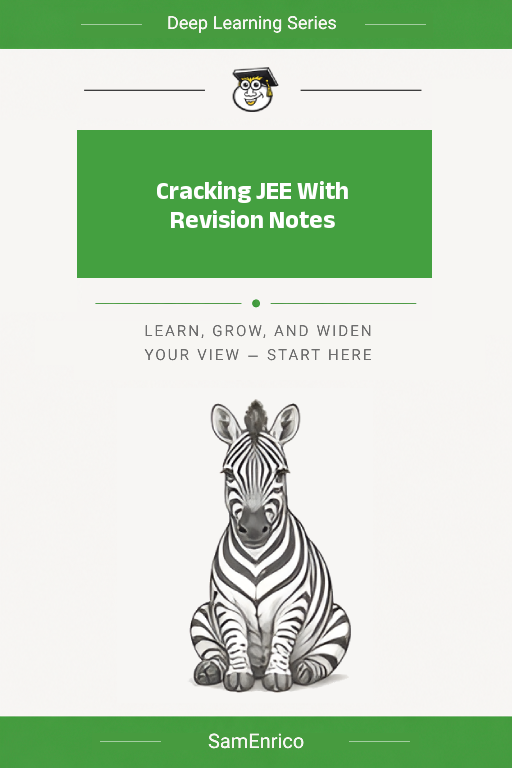
Cracking JEE With Revision Notes
Create concise formula sheets and reaction summari
Create concise formula sheets and reaction summaries for last minute revision before exam.
Formats
About this book
Free sample
Chapter 1: The Final Countdown...--The night before the JEE is not the time to learn something new. It is not the time to open a thick textbook, watch a three-hour lecture, or solve a hundred unfamiliar problems. Yet, year after year, thousands of aspirants make the same catastrophic mistake: they panic-study until 2 AM, cramming formulas they have never seen before, only to walk into the exam hall with bloodshot eyes, a racing heart, and a brain that refuses to recall even the things they once knew well.This chapter exists to ensure that does not happen to you.Think of this chapter as your mission control center for the final 24 hours before the JEE Main exam. It contains no formulas, no reactions, no derivations, and no practice problems. Instead, it provides something far more valuable at this stage: a strategic timeline, a psychological framework, and a set of rules that will maximize the return on every single minute you have left.
The students who score in the 99th percentile are not necessarily the ones who know the most chemistry or the hardest physics problems. They are the ones who know how to deploy their knowledge efficiently under pressure. This chapter teaches you how to do exactly that.The 24-Hour Countdown: A Strategic Timeline The final 24 hours before the JEE exam should be divided into four distinct phases. Each phase has a specific purpose, and violating the boundaries between phases is the fastest way to sabotage your own performance.Phase 1: T-Minus 24 to 12 Hours (The Active Review Window)This is your last opportunity to actively engage with new or rusty material. During these twelve hours, you should focus exclusively on high-yield, low-complexity topics.
What does that mean? It means memorizing the "Happy Exceptions" list from Inorganic Chemistry (Chapter 4). It means reviewing the 20 derivative-integral pairs from Chapter 13. It means running through the color-coded mind maps in Chapter 11. It does NOT mean attempting to understand a difficult concept you have avoided for six months.
That ship has sailed. Trying to learn electrochemistry from scratch at 8 PM the night before the exam is not…
This is the end of the free sample. Get the eBook to keep going. Buy now
Contents
- Chapter 1
- Chapter 2
- Chapter 3
- Chapter 4
- Chapter 5
- Chapter 6
- Chapter 7
- Chapter 8
- Chapter 9
- Chapter 10
- Chapter 11
- Chapter 12
Details
- Author
- Morton Roland
- Publisher
- SamEnrico
- Language
- English
- Genre
- Non-Fiction, Student's Shortcut
- Released
- 2026-05-30
- Pages (approx.)
- 136
- Available as
- eBook, Audiobook

Read better in the ZLOADR app
Your eBooks on your phone or tablet. Sign in with your SamEnrico account and start reading.
More by Morton Roland
 Cybersecurity Incident ResponderMorton Roland$11.99
 Overcoming Exercise Obsession For Self EsteemMorton Roland$11.99
 Bryce Canyon Missing CasesMorton Roland$11.99
 Second Marriage PlanningMorton Roland$11.99
 Mike Krieger InstagramMorton Roland$11.99
 Anger Antecedent LogMorton Roland$11.99
 Borneo Headhunter TerritoryMorton Roland$11.99
 Mindfulness For Work StressMorton Roland$11.99
 The Healers of the Nile: The Secret Medical Corps of Ancient KushMorton Roland$11.99
 Sand and Shadows: Love Letters from the Sinai FrontMorton Roland$11.99
 The Mineral Guide to AllaniteMorton Roland$11.99
 Ultimate Handbook Guide to Las Vegas : (United States) Travel GuideMorton Roland$11.99
You may also like
 LSE Online Program LengthAgee Letisha$11.99
 Harvard Extension School for Working AdultsRoush Yer$11.99
 LSE Online Reading ListAshford Ludivina$11.99
 LSE Online Language RequirementsWhitten Daphine$11.99
 LSE Online Class SizeHughey Garret$11.99
 LSE Online Alumni MentorshipWild Lyla$11.99
 London School of Economics Alumni NetworkDutton Chantal$11.99
 Harvard Extension School Student SupportCantrell Christene$11.99
 Harvard Extension School Library AccessSantana Adah$11.99
 Harvard Extension School Degree CompletionBray Wyatt$11.99
 Harvard Extension School Course AuditingAbbott Craig$11.99
 Harvard Extension School Extension DiplomaNew Joane$11.99