
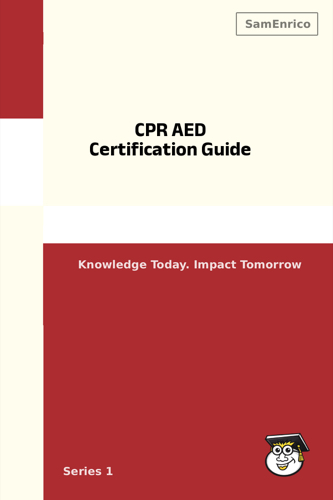
CPR AED Certification Guide eBook
Master lifesaving chest compressions and defibrill
Master lifesaving chest compressions and defibrillator use for cardiac emergencies.
Formats
Free sample
Chapter 1: The Forgotten Window--–- The paramedics arrived in seven minutes. They found a 52-year-old man lying on the gym floor, surrounded by well-intentioned bystanders. Someone had placed a towel under his head. Someone else had fanned him with a magazine. No one had touched his chest.
The man’s name was David. He was a father of three, a marathon runner, and he had just experienced sudden cardiac arrest. The gym had an AED mounted on the wall near the juice bar. The battery light was green. The pads were still sealed.
No one had opened the box because no one knew what was happening. David did not survive.Across town, three weeks later, a 45-year-old woman named Maria collapsed in a grocery store checkout line. A cashier named James had completed CPR training six years earlier as a high school graduation requirement. He had never used it. When Maria fell, James vaulted over the counter, checked her breathing, and started chest compressions before she had been on the floor for thirty seconds.
A customer ran to get the AED. Another called 911. When paramedics arrived four minutes later, Maria’s heart was beating on its own. She walked out of the hospital five days later. She met James at a ceremony and hugged him for thirty seconds.
She said, “You gave me my life back.”The difference between David and Maria was not luck. It was not the location of the nearest hospital. It was not the speed of the ambulance. The difference was that one bystander recognized sudden cardiac arrest and acted immediately, while another group of bystanders waited for help that arrived too late. This chapter will ensure you are never part of the wrong group.The Most Dangerous Misconception in Emergency Medicine If you take only one concept from this entire book, let it be this: a heart attack is not the same thing as cardiac arrest.
Confusing these two conditions has killed more people than any failure of CPR technique. The confusion is understandable. In movies and television, characters clutch their chests, stagger, and fall. The screen fades to black. A doctor says, “He had a heart attack.” In reality, that character almost always died of cardiac arrest.
The writers got it wrong. Now you will get it right.A heart attack, medically known as a myocardial infarction, is a plumbing problem. Your heart is a muscle, and like every muscle in your body, it needs oxygen-rich blood to function. It receives this blood through the coronary arteries, which wrap around the outside of the heart like vines on a trellis. When one of these arteries becomes blocked—usually by a cholesterol-rich plaque that ruptures—the section of heart muscle downstream of that blockage begins to die.
The heart itself is still beating. The electrical system is still working. But the muscle is starving. That starving muscle sends pain signals that the brain interprets as chest pressure, squeezing, or discomfort that often radiates to the left arm, jaw, or back. The victim of a heart attack is typically awake, conscious, and breathing.
They may be sweating, nauseous, or short of breath. But they are alive. Their heart is pumping.Cardiac arrest is an electrical problem. Deep within the heart, a small cluster of cells called the sinoatrial node generates an electrical impulse about sixty to one hundred times per minute. That impulse spreads through the heart’s chambers like a wave, causing them to contract in perfect sequence.
In sudden cardiac arrest, that electrical system malfunctions. The most common malfunction is ventricular fibrillation—a chaotic, disorganized electrical storm during which the lower chambers of the heart quiver like a bag of worms instead of contracting in rhythm. No blood is pumped. The victim collapses instantly, loses consciousness within seconds, and stops breathing normally. The heart is not failing to pump.
It is not pumping at all.Here is the critical connection that most people miss: a heart attack can cause cardiac arrest, but cardiac arrest is not a heart attack. When a large section of heart muscle dies from a blocked artery, that dead tissue can disrupt the heart’s electrical system, triggering ventricular fibrillation. In this sense, a heart attack is a potential cause of cardiac arrest. But the majority of cardiac arrests occur from electrical problems that have nothing to do with blocked arteries—problems like cardiomyopathy, blunt force trauma to the chest (commotio cordis), drug-induced arrhythmias, or inherited channelopathies. You do not need to memorize these terms.
You only need to remember this: if a person collapses, stops responding, and is not breathing normally, do not waste time asking yourself whether they are having a heart attack. Assume cardiac arrest. Start CPR. The heart attack victim will still be conscious and will tell you not to hurt them. The cardiac arrest victim will not.The Timeline That Kills Every second that passes without intervention during cardiac arrest is a small but measurable step toward irreversible death.
Understanding this timeline is not meant to frighten you. It is meant to motivate you. When you know exactly how fast the brain deteriorates without oxygen, you will understand why waiting for paramedics is not an option and why your hands are the only thing standing between a living person and a dead one.When the heart stops pumping, blood pressure drops to zero instantly. The brain, which consumes twenty percent of the body’s oxygen despite being only two percent of its weight, has no oxygen reserves. It depends entirely on continuous blood flow.
At the moment of cardiac arrest, the victim has approximately four to six minutes of consciousness left. This is not a sliding scale. The brain does not gradually fade. It shuts down.0 to 4 minutes: The brain’s oxygen stores are depleted. Brain cells begin to switch from aerobic to anaerobic metabolism, a process that produces lactic acid and causes cellular swelling.
Some cells die. Many are damaged but potentially salvageable. If CPR is started in this window, the chances of survival with good neurological function are high.4 to 6 minutes: Cell death accelerates dramatically. The hippocampus, the region responsible for memory, is particularly vulnerable. The basal ganglia, which control movement, begin to deteriorate.
A victim who survives after this window may wake up with permanent memory loss, cognitive impairment, or movement disorders. They may never return to work or independent living.6 to 8 minutes: Widespread cortical death occurs. The outer layers of the brain, responsible for reasoning, language, and conscious thought, are now irreversibly damaged. Survival is possible but survival with meaningful brain function is unlikely. Many survivors from this window remain in a persistent vegetative state.8 to 10 minutes: Biological death.
The brainstem, which controls breathing and heart rate, fails. No amount of CPR, defibrillation, or advanced medical care can reverse this. The victim is gone.These numbers assume normal body temperature. Hypothermia slows metabolism and can extend the window. Hyperthermia shortens it.
Children and infants have higher metabolic rates and may deteriorate faster. But for the overwhelming majority of cardiac arrests, you are working against a ten-minute clock. Paramedics in most urban areas have an average response time of seven to twelve…
This is the end of the free sample. Get the eBook to keep going. Buy now
About this book
Details
- Author
- Cabral Merlene
- Publisher
- SamEnrico
- Language
- English
- Genre
- Non-Fiction, Health & Wellness, First Aid
- Released
- 2026-06-07
- Pages (approx.)
- 121
- Available as
- eBook, Audiobook

Read better in the ZLOADR app
Your eBooks on your phone or tablet. Sign in with your SamEnrico account and start reading.
More by Cabral Merlene
 Stress and Neurodiverse PartnershipsCabral Merlene$11.99
 Gratitude for Senses GuideCabral Merlene$11.99Gratitude for Senses GuideCabral Merlene$11.99
 Addiction Craving Breath SurfingCabral Merlene$11.99
 Round the World, No StopsCabral Merlene$11.99
 Bipolar Electroconvulsive GuideCabral Merlene$11.99
 Shift Worker Nap StrategiesCabral Merlene$11.99
 Fred DeLuca Subway StoryCabral Merlene$11.99
 Cognitive Restructuring DIYCabral Merlene$11.99
 The Silk and Gold Weavers of Axum: Crafting Royalty in Ancient AfricaCabral Merlene$11.99
 Whispers in the Dark: The Lost Library of Alexandria’s Final KeeperCabral Merlene$11.99
 The Balloon Boy Hoax: A Carnival of DeceptionCabral Merlene$11.99
You may also like
 Adult HeimlichHogan Mike$11.99
 Overdose Education TrainingBurgess Kim$11.99
 Essential Oil First Aid KitNegron Anderson$11.99
 The CPR and AED HandbookCarvalho Tanesha$11.99
 First Degree BurnHeaton Wyatt$11.99
 First Degree Burn GuideNguyen Omar$11.99
 First Aid Kit for EmergenciesButler Charlene$11.99
 Direct Pressure GuideJenson Elouise$11.99
 Hands Only CPRCarlin Rudy$11.99
 Cocaine Nosebleed First AidKirby Shonna$11.99
 Ayurvedic First Aid GuideGoetz Lenora$11.99
 Hands Only CPR GuideCrabtree Agustin$11.99