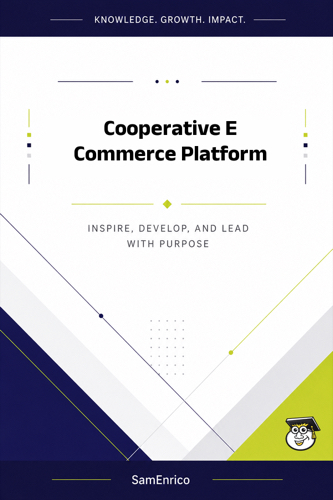
Cooperative E Commerce Platform eBook
Sell member products online through a shared digit
Sell member products online through a shared digital marketplace.
Formats
Free sample
Chapter 1: The Million-Dollar Statement...–- Maria Cortez stared at her Etsy seller dashboard, the blue light from her laptop illuminating the small studio apartment she’d converted into a pottery workshop. It was 11:47 PM on a Tuesday. Her hands, still caked with dried clay, hovered over the keyboard. On the screen, a single number blinked back at her: $8,423.17. That was her gross revenue for the month of April 2022.
Twelve years of hand-thrown mugs, custom wedding platters, and delicate vases had led to this—a five-figure month. She should have been ecstatic. Instead, she clicked a second tab. The "Payment Account" page loaded slowly, as if the website itself was ashamed of what it was about to show her. The net deposit amount appeared: $1,187.44.
Maria did the math twice, then a third time, because surely the universe had made a mistake. Eighty-six percent. That’s what the platform had taken. Between the transaction fees, the mandatory offsite ads she never asked for, the shipping labels, and the mysterious "regulatory operating fee," Maria had worked 300 hours to keep less than a thousand dollars. She wasn't a business owner.
She was a tenant, paying rent to a digital landlord who could evict her with a single algorithm change. And she was not alone.Across the country, in a textile studio in Portland, James Nguyen was having the same realization. He sold hand-dyed fabrics. His math was worse: $12,000 gross, $1,400 net. But the real knife twist came at 3:00 AM when he received an automated email.
Subject line: "Important Update Regarding Your Seller Status." His shop had been suspended. Reason: "Suspicious review activity." James hadn't bought a review in his life. He had no appeals process, no phone number to call, no human to plead with. There was only a blue "Submit Appeal" button that led to an AI-generated rejection four hours later. By sunrise, James had lost his primary income.
His landlord didn't care about Etsy's algorithm. His rent was still due.This book is for Maria. For James. For the 75 million sellers globally who are currently paying rent to platforms they do not own, governed by rules they did not vote on, and locked out of the profits they generate. This is not a book about how to sell better on Amazon or hack the Etsy algorithm.
This is the manual for burning down the landlord's business model and building your own building.The Great Heist: How "Platforms" Became Landlords We need to rewind thirty years to understand how we got here. In the early days of the commercial internet, the promise was radical disintermediation. Ebay launched in 1995 with a mission to "democratize commerce." Etsy followed in 2005, promising a "people-powered economy." Amazon’s marketplace opened its doors to third-party sellers in 2000, inviting the little guy to sell alongside the giant. For a brief, shining decade, it worked. Sellers could reach customers in Tokyo from a garage in Tulsa.
The middleman—the mall, the catalog company, the distributor—was supposedly dead.But the middleman didn't die. He just went digital and got greedy.The structural reality of investor-owned platforms is simple, brutal, and rarely discussed in MBA programs. A platform like Etsy or Amazon has exactly two customer groups: the buyers and the sellers. But only one of those groups generates revenue for shareholders. Wall Street does not reward Etsy for happy sellers; it rewards Etsy for take rate—the percentage of every transaction the platform captures.
In 2013, Etsy’s take rate was roughly 11%. By 2022, it had climbed to over 24%. That’s not inflation. That’s extraction. Every time a platform raises fees, changes search algorithms to favor paid ads, or holds payouts for "risk management," it is not making a mistake.
It is executing its business model.Economists call this "two-sided market dynamics." I call it the Rent Trap.Here is the mental model you need to carry through this entire book: Selling on an investor-owned platform is economically identical to renting an apartment. You pay every month. You follow the landlord's rules. You can be evicted without recourse. And when the building appreciates in value because of the community you helped build, the landlord keeps 100% of the profit.
You see none of it.The 2022 Etsy Strike: A Tipping Point Let’s return to Maria in April 2022. She wasn't just watching her own numbers collapse. She was watching a movement.On April 11, 2022, Etsy announced a 30% increase in transaction fees, raising them from 5% to 6.5%. To the average customer, 1.5% sounds like nothing. To a seller operating on a 10% net margin, that 1.5% fee hike represented a 15% cut in their take-home pay.
But the fee hike was just the spark. The gasoline was Etsy’s mandatory "Offsite Ads" program, which forced sellers to pay 12-15% on any sale originating from Google, Facebook, or Instagram—whether the seller wanted those ads or not. Sellers could not opt out.What happened next was unprecedented in the history of e-commerce. A loosely organized group of sellers on Reddit and Discord called for a strike. The demands were simple: remove mandatory offsite ads, raise seller standards to kick out drop-shippers, and establish a seller advisory board.
Thousands of shops went into "vacation mode," refusing to process orders. The media coverage was brutal: "Etsy Sellers Revolt," "The Handmade Economy Fights Back."Etsy’s stock dipped 3%. Then the company did what all platforms do when challenged: nothing substantial. They offered a few tweaks to the ad program, but the fee hike stuck. The seller advisory board was never created.
The drop-shippers remained.But here is the detail that the financial press missed, and the detail that changes everything. The strike did not fail. It succeeded in an unexpected way. In the aftermath, a group of 67 sellers—including several of the strike organizers—did not go back to business as usual. They started a private Discord server.
They called it "The Escape Pod." Their question was not "How do we make Etsy listen?" Their question was "How do we build our own Etsy?"That Discord server became the founding meeting of the Artisans Cooperative, the first modern multi-stakeholder e-commerce platform built and owned by the sellers themselves. Within eighteen months, they had 300 seller-owners, $1.2 million in gross merchandise value, and a legal structure that guaranteed every single member a vote and a dividend.This book is the autopsy of the old model and the blueprint for the new one.The Anatomy of Value Extraction To build the alternative, we must name the enemy precisely. The enemy is not technology, not capitalism, and certainly not individual platform employees. The enemy is a specific governance structure: the investor-owned, extractive platform.These platforms share five poison traits:1. Unilateral Rule Changes.
When Etsy raised fees, no seller voted. When Amazon changes its search algorithm, no seller is consulted. The platform holds all the power because it holds the customer relationship. You are a tenant.2. Algorithmic Opacity.
You do not know why your listing ranks third instead of first. You do not know why your shop was suspended. The platform has no incentive to tell you, because transparency would limit its ability to extract.3. Data Asymmetry. The platform sees every seller’s prices, inventory turnover, and customer emails.
It uses this data to launch competing products (Amazon Basics) or to adjust fees dynamically. You see nothing about the…
This is the end of the free sample. Get the eBook to keep going. Buy now
About this book
Details
- Author
- Nolen Sharron
- Publisher
- SamEnrico
- Language
- English
- Genre
- Non-Fiction, Business Brief, E commerce
- Released
- 2026-06-11
- Pages (approx.)
- 134
- Available as
- eBook, Audiobook

Read better in the ZLOADR app
Your eBooks on your phone or tablet. Sign in with your SamEnrico account and start reading.
More by Nolen Sharron
 Underwater Acoustic PositioningNolen Sharron$11.99
 MDD and Sleep Disturbance GuideNolen Sharron$11.99
 Pomodoro for Digital DeclutterNolen Sharron$11.99
 MBSR 8 Week Program PrimerNolen Sharron$11.99
 Ghosts of the Hindukush: The Soviet-Afghan War's Forgotten Frontlines (1979-1989)Nolen Sharron$11.99
 Pricing Strategy for Family Owned BusinessNolen Sharron$12.99
 US Bootcamp vs Degree GuideNolen Sharron$12.99
 Understanding Oral Facial Digital Syndrome Type 3Nolen Sharron$17.99
 Operations Assistant ManagerNolen Sharron$11.99
 How to Become a Shank ThreaderNolen Sharron$11.99