
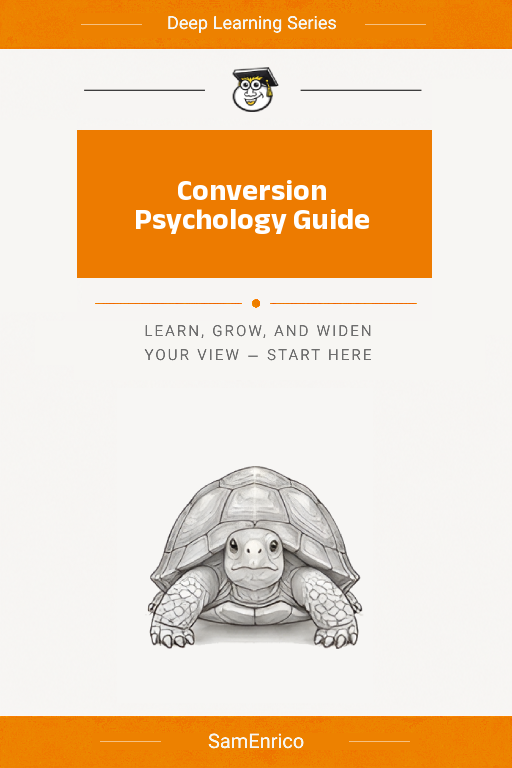
Non-FictionStartup GuideMonetization Strategy
Conversion Psychology Guide eBook
Understand psychology behind free to paid conversi
Understand psychology behind free to paid conversion. Loss aversion, scarcity, and social proof.
Formats
Free sample
Chapter 1: The Penny Gap--A few years ago, I sat across from a founder who had just raised twelve million dollars for a productivity app with 1.2 million active free users. She was miserable. Her team had built something people clearly wanted—they used it daily, recommended it to colleagues, even tweeted about it unprompted. But only 0.8 percent of those users paid a single dollar. She was burning through investor money while a million people happily used her product for free.
She looked at me and asked a question I have heard hundreds of times since: "Do they not see the value? Are they just cheap?"Neither, I told her. Your users are not blind to value, and they are not cheap. They are trapped.They are trapped by a cognitive quirk so powerful that it has been replicated in dozens of academic studies across six continents. It is the reason people will enthusiastically use a product for two years and still refuse to pay four dollars a month.
It is the reason your free tier feels like a success but your bank account tells a different story. It is called the Zero Price Effect, and until you understand it, every conversion strategy you try will fail.Let me tell you a story about chocolate.In the early 2000s, behavioral economist Dan Ariely ran an experiment at a university cafeteria. He set up a table with two types of high-quality European chocolates: Lindt truffles, which normally retail for fifty cents each, and Hershey's Kisses, which are much cheaper. He offered the Lindt truffles for fifteen cents and the Hershey's Kisses for one cent. At those prices, about seventy-three percent of students chose the Lindt truffle.
The rational choice. The higher-quality chocolate for only fourteen cents more.Then he changed one thing. He lowered the price of both chocolates by one cent. The Lindt truffle became fourteen cents. The Hershey's Kiss became free.Suddenly, the preference flipped.
Now, sixty-nine percent of students chose the free Hershey's Kiss, even though the Lindt truffle was objectively a better value—a high-end chocolate for only fourteen cents. The same students who had rationally chosen quality over price moments before now abandoned that quality for free. The price of the Lindt truffle had dropped, but demand for it collapsed.This is the Zero Price Effect. When something is free, the emotional benefit of avoiding any cost overwhelms rational cost-benefit analysis. Your brain does not compare features, calculate ROI, or evaluate long-term value.
It says, "Free means no risk. Free means no loss. Free means take it." And then it stops thinking.Your free users are not making a calculated decision to reject your paid plan. They are operating in a different decision-making mode entirely. They are in "free brain."The problem is that once users enter free brain, they tend to stay there.
The Zero Price Effect creates a reference point—zero—that becomes the baseline against which all future prices are judged. And here is the cruel math of human psychology: the gap between zero and one cent is psychologically wider than the gap between one cent and ten dollars.I call this the Penny Gap.The Penny Gap explains why a user will enthusiastically use your product for five hundred hours, tell three friends about it, and then balk at a five-dollar monthly subscription. It is not that five dollars is too much money. It is that the reference point is zero, and any move away from zero feels like a loss. And as we will explore in Chapter 4, losses feel about twice as painful as gains feel pleasurable.
Your five-dollar price tag is not being evaluated as "five dollars for value." It is being evaluated as "a painful loss of the free state I currently enjoy."This is why most freemium businesses fail to convert. They design their free tier to be generous, delightful, and habit-forming. They make users fall in love with the free product. And then they wonder why those same users refuse to pay. You have trained them to love free.
You have made free the reference point. You have built your own Penny Gap.Consider the most painful statistic in freemium business: converting the first one percent of your free users to paid is exponentially harder than converting from one percent to ten percent. The first cohort of paid users has no social proof to follow, no benchmark for what "fair payment" looks like, and the strongest possible attachment to the free reference point. They are pioneers, and pioneers get slaughtered.I have seen this pattern repeat across hundreds of companies. A productivity app with two hundred thousand free users and two percent conversion.
A project management tool with five hundred thousand free users and one point one percent conversion. A meditation app with three million free users and zero point seven percent conversion. Each founder believed the problem was product-market fit, feature gaps, or pricing strategy. Each founder was wrong.The problem was the Penny Gap.But here is the good news: the Penny Gap is not permanent. You cannot eliminate it—the Zero Price Effect is a fundamental feature of human cognition, not a bug.
But you can reframe it. You can destroy the free reference point without removing the free tier entirely. You can make free feel temporary, limited, or legacy rather than the comfortable default.Let me show you how.The most common mistake I see is the Freemium Trio: a free tier, a basic paid tier, and a pro paid tier presented side by side in equal visual weight. This design is a disaster because it makes free look like a legitimate, permanent choice. The user scans the three columns, sees that free has some features, and thinks, "This seems fine.
I'll start here and maybe upgrade later." Later never comes.I once audited a file storage company with exactly this problem. They had one hundred gigabytes free, one terabyte for ten dollars a month, and five terabytes for twenty dollars a month. Their conversion rate was one point eight percent. The free tier was so generous that users felt no pressure to leave. The paid tiers were not framed as upgrades—they were framed as "more of the same."We ran a simple experiment.
We did not change the free tier's storage limit. We did not change the paid pricing. We only changed the language around the free tier. Instead of "Free forever," we wrote "Free for personal use with limits." Instead of "100 GB included," we wrote "100 GB trial allocation." Instead of presenting the free tier as a column equal to the paid tiers, we shrank it, moved it to the right side of the page, and added a line above it that said: "Legacy plan. New users should choose Starter or Pro."Conversion rate increased to four point three percent within thirty days.
We did not change the product. We changed the reference point.This is the core strategy of this chapter and this book: do not remove free. Remove free as the comfortable default. Frame free as temporary, limited, or legacy. Make staying free feel like a conscious choice to accept constraints, not…
This is the end of the free sample. Get the eBook to keep going. Buy now
About this book
Details
- Author
- Murray Travis
- Publisher
- SamEnrico
- Language
- English
- Genre
- Non-Fiction, Startup Guide, Monetization Strategy
- Released
- 2026-06-01
- Pages (approx.)
- 144
- Available as
- eBook, Audiobook

Read better in the ZLOADR app
Your eBooks on your phone or tablet. Sign in with your SamEnrico account and start reading.
More by Murray Travis
 Validation For Angry PeopleMurray Travis$11.99
 HIIT Overtraining Warning GuideMurray Travis$11.99
 Cocaine Anonymous Step GuideMurray Travis$11.99Cocaine Anonymous Step GuideMurray Travis$11.99
 The Angry Parent WorkbookMurray Travis$11.99
 The Three Field Rotation GuideMurray Travis$11.99
 The Cosmic Visionaries: Black Nobel Laureates Who Shaped the UniverseMurray Travis$11.99
 Informatica DeveloperMurray Travis$11.99
 Customer Health Scoring GuideMurray Travis$12.99
 How to Start a Beach Club - Recreational BusinessMurray Travis$11.99
 The Breeder's Guide to La Fleche ChickensMurray Travis$11.99
You may also like
 Hong Kong Handover 1997Dunn Johnnie$11.99
 Zumba For Postnatal Recovery CourseNeal Christian$11.99
 Zumba for BeginnersLadner Nikia$11.99
 YouTube Comment Mining GuideHumes Pandora$12.99
 Worry Box MeditationCarlin Rudy$11.99
 Workplace Stress MeditationNguyen Lynn$11.99
 Workplace Stress and Sleep RepairHawley Ivory$11.99
 Workplace Perfectionism CureDelaney Jeffry$11.99
 Workplace Injustice Anger GuideWallen Isabelle$11.99
 Work Addiction and Burnout LinkGreenwood Ester$11.99
 Women in Yoga and WellnessBeattie Galina$11.99
 Women in Stand Up ComedyChun Evangeline$11.99