
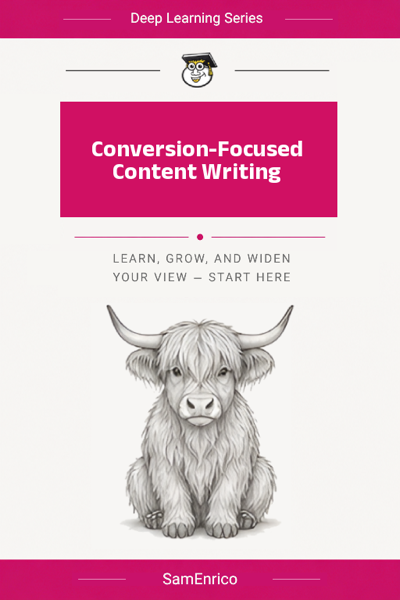
Conversion-Focused Content Writing eBook
A Coursebook on Conversion-Focused Content Writing
A Coursebook on Conversion-Focused Content Writing
Formats
Free sample
Chapter 1: The Two Gatekeepers...--Every morning, millions of people wake up, pour coffee, and open their browsers. They type questions into Google. They click ads on Instagram. They open emails from brands they trust. And within three seconds of landing on a website, the vast majority of them leave.Not because they aren't interested.
Not because they don't have money. Not because your product is bad.They leave because the page they landed on failed to answer two questions in the time it takes to blink.These two questions are the gatekeepers of every conversion. If your copy answers them correctly, you've earned the right to continue the conversation. If you fail—even slightly—the visitor is gone, often never to return. The average website loses 80% of its traffic to these two gatekeepers alone.
That means for every five people who click through to your site, four disappear into the digital ether, never having seen your pricing, your testimonials, your guarantee, or your offer.This chapter is about identifying those two gatekeepers, understanding why they hold so much power, and learning exactly how to satisfy them every single time a visitor arrives.The Myth of the Traffic Problem Before we talk about solutions, we need to talk about a lie that has cost businesses billions of dollars.The lie sounds like this: "If we just had more traffic, we'd make more sales."It's whispered in boardrooms, shouted in marketing meetings, and reinforced by every SEO agency that promises to "drive more visitors" without ever asking what happens after they arrive. The lie is seductive because it shifts blame away from your copy and onto something external. Traffic is low? That's the algorithm's fault. Sales are flat?
We need more eyeballs.But here's the truth that most marketers learn too late: traffic without conversion is just expensive window dressing.I've consulted for companies with 50,000 monthly visitors and a 0.5% conversion rate. I've also consulted for companies with 5,000 monthly visitors and a 10% conversion rate. The second company generated the same revenue from one-tenth the traffic. Which business would you rather own?The difference between these two scenarios isn't luck. It isn't ad spend.
It isn't product quality. It's the ability to convert the traffic you already have before you spend another dollar acquiring more.This is the central argument of this entire book: most businesses don't have a traffic problem. They have a relevance problem and a resonance problem. These are the two gatekeepers. And until you fix them, more traffic will only mean faster failure.Introducing the C.O.N.V.E.R.T.
Framework Before we dive into the two gatekeepers, let me briefly orient you to the structure of this book. The chapters ahead are organized around an acronym that spells C.O.N.V.E.R.T. Each letter represents a pillar of conversion-focused content writing:C stands for Clarity (Chapter 1, this chapter) — ensuring your message is understood instantly O stands for Objection Beating (Chapter 3) — answering the five doubts every customer has N stands for Nurturing & Navigation (Chapter 4) — removing friction from every click path V stands for Voice (Chapters 2, 5, 7, 10) — the emotional and linguistic tone of your copy E stands for Efficiency (Chapters 4 and 9) — applying the 80/20 rule to your efforts R stands for Relevance (this chapter) — matching visitor expectations to your message T stands for Testing (Chapter 9) — using data to validate your copy decisions Throughout the book, each chapter will anchor to one of these pillars. But in this first chapter, we're focusing on the first two pillars of the framework: Clarity and Relevance. These are the gatekeepers.
Get them right, and everything else becomes easier. Get them wrong, and nothing else matters.Gatekeeper One: Relevance Relevance answers the most immediate question in your visitor's mind: "Am I in the right place?"This question is asked subconsciously within the first 300 milliseconds of landing on a page. That's faster than a hummingbird flaps its wings. It's faster than you can read the word "hello." Your visitor's brain is making a rapid pattern-matching calculation between what they expected to find and what they actually see.When these two things match, the visitor's brain releases a small hit of dopamine—the reward chemical. They feel a sense of confirmation, of being on the right track.
They relax. They keep reading.When these two things don't match, the visitor's brain triggers a small stress response. Something feels off. The page might be wrong. They might have been misled.
The safe move is to hit the back button and try again. And most people do exactly that.This is what I call "click dissonance"—the gap between what was promised and what is delivered. Every click carries an implicit promise. An ad that says "50% off all running shoes" promises discounts on running shoes. A Google search for "best CRM for freelancers" promises a list of CRM options specifically for solo operators.
An email subject line that says "Your account needs attention" promises urgent, account-specific information.When the landing page delivers exactly what was promised, click dissonance is zero. When it delivers something slightly different—running shoes mixed with basketball shoes, or a generic CRM comparison that includes enterprise systems, or a generic marketing newsletter instead of account information—dissonance spikes and conversions collapse.The Source-to-Headline Match The single most important application of relevance is what I call the source-to-headline match. It's simple but powerful: the headline on your landing page must explicitly confirm the promise made by the source that sent the visitor.Let me show you what this looks like in practice.Imagine you're running a Facebook ad for a weight loss program. Your ad copy says: "Lose 12 pounds in 30 days without giving up carbs." Someone clicks. Where do they land?
Most businesses send them to their generic homepage, which has a headline that says: "Transform Your Health with Our Holistic Wellness Platform."What's wrong with this picture? The ad promised a specific, aggressive result with a specific constraint (no carb-cutting). The headline delivers a vague, feel-good statement about "holistic wellness." The visitor experiences click dissonance. They think: "This isn't what I clicked for. This is some generic wellness thing." And they leave.Now imagine the same ad sends the visitor to a landing page with this headline: "Lose 12 Pounds in 30 Days—While Eating Bread, Pasta, and Potatoes." The source-to-headline match is perfect.
The visitor thinks: "Yes. This is exactly what I clicked for." They stay. They read. They convert.This principle applies to every traffic source:For paid ads, your headline should echo or directly repeat the core promise from the ad. If your ad says "Get a free consultation," your headline should say "Get Your Free Consultation" (not "Welcome to Our Firm").For organic search, your headline should match the searcher's intent.
If someone searches for "how to clean a cast iron skillet," your headline should say "How to Clean a Cast Iron Skillet in 3 Minutes" (not "The Ultimate Guide to Cookware Maintenance").For email, your headline should fulfill the promise of the subject line. If your email subject says "Your 20% discount expires tonight," your landing page headline should say "Claim Your 20% Discount Before Midnight" (not "Welcome to Our Sale").For…
This is the end of the free sample. Get the eBook to keep going. Buy now
About this book
Details
- Author
- Dayton Mellissa
- Publisher
- SamEnrico
- Language
- English
- Genre
- Non-Fiction, Informative, Educational
- Released
- 2026-05-11
- Pages (approx.)
- 152
- Available as
- eBook, Audiobook

Read better in the ZLOADR app
Your eBooks on your phone or tablet. Sign in with your SamEnrico account and start reading.
More by Dayton Mellissa
 Chunking Lecture NotesDayton Mellissa$11.99
 The Everyday Mindfulness WorkbookDayton Mellissa$11.99
 Black Codes ReconstructionDayton Mellissa$11.99
 Parenting Stress Relief WorkbookDayton Mellissa$11.99
 The Coral Sea Gambit: The Carrier Duel That Saved Australia (1942)Dayton Mellissa$11.99
 Returns Management for Cross-Continental DropshippingDayton Mellissa$12.99
 How to Produce Bra Straps and ExtendersDayton Mellissa$11.99
 How to Start a Production Riser Tensioners Business (Beginners Guide)Dayton Mellissa$11.99