
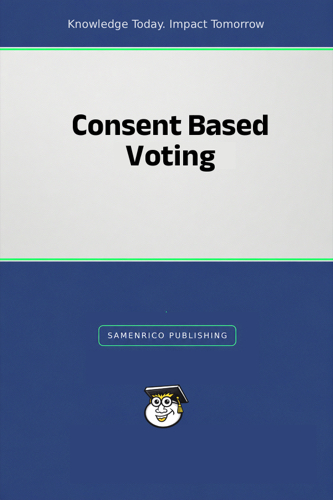
Consent Based Voting eBook
Teams approve ideas using 'consent not consensus'
by Decker Tama
Teams approve ideas using 'consent not consensus' for faster decisions.
Formats
Free sample
Chapter 1: The Million-Dollar Meeting--–- The Tuesday morning meeting started like any other. Fourteen people sat around a polished conference table, laptops open, coffee cooling, faces arranged in that careful mask of professional patience that signals the actual work has not yet begun. The agenda item was simple: approve the Q3 marketing campaign. The creative team had spent 220 hours preparing it. The projected ROI was 340%.
The launch window was six weeks away, narrowing by the day.Three hours later, nothing had been approved. The meeting ended with the familiar refrain: "Let's circle back after we get more data." The team filed out, exhausted and empty-handed. The campaign launched late, missed the window, and generated only 40% of its projected return. The finance team later calculated the cost of that delay at $1.2 million in lost revenue.The meeting wasn't exceptional. It was Tuesday.The Silent Epidemic Bad decisions get all the attention.
We study catastrophic failures, post-mortem disastrous launches, and analyze why leaders chose poorly. Business schools teach entire courses on decision traps and cognitive biases. Consulting firms make millions diagnosing why executives make bad calls.But there is a far more common and insidious problem that plagues organizations of every size, from two-person startups to multinational corporations. It is not bad decisions. It is no decisions—or decisions made so late they might as well have never been made at all.This is the hidden tax of organizational life.
It is invisible because it never appears on a balance sheet. No line item reads "opportunity cost of delayed approval." No quarterly report tracks "hours lost to decision paralysis." No one gets fired for slowing things down because slowing things down is seen as careful, prudent, responsible.But the tax is real, and it is enormous.Consider what happens in a typical decision meeting. A proposal is presented. Someone raises a concern. Another person agrees with the concern but adds a different concern.
Someone else suggests an alternative. The group begins debating the relative merits of the original proposal versus the alternative. An hour passes. The debate shifts to a different aspect. Another hour passes.
Someone points out that they don't have enough data. Someone else says they need to loop in another stakeholder. The meeting ends with no resolution, and the entire process will repeat next week, probably with more people and less clarity.This scene is so familiar that most professionals have stopped noticing how dysfunctional it is. They have accepted slow decisions as the price of collaboration, the inevitable friction of working with other humans. They have built their calendars around it, padding timelines, scheduling buffer meetings, and learning to do their real work in the cracks between decision sessions.But it does not have to be this way.The Real Cost of Delay Let us put a number on the hidden tax.
The million-dollar marketing meeting is not an outlier. It is a representative sample of a much larger pattern.A study of 250 product development teams found that the average decision—from proposal to approval—took 11.3 days. That is nearly two and a half weeks. For strategic decisions, the average was 27.4 days. Nearly a month.
In fast-moving industries like software, e-commerce, and consumer goods, a month is an eternity. Competitors launch features, capture market share, and build customer loyalty while you are still scheduling follow-up meetings.But the cost is not just calendar time. The cost includes:Frustrated talent. High-performing employees want to ship. They want to see their work in the world.
When every decision is a multi-week ordeal, they stop initiating. They stop caring. They update their resumes.Missed opportunities. Markets move fast. A window that is open today may be closed next month.
The team that cannot decide quickly does not just lose time; it loses the chance altogether.Meeting debt. Every unresolved decision spawns another meeting. Those meetings spawn follow-up meetings. The calendar fills with decision-making sessions, leaving no room for actual execution.Risk aversion. When decisions are painful, teams stop making them.
They default to the status quo, even when the status quo is failing. Better to do nothing than to endure another three-hour debate.Political behavior. In slow decision environments, the game is not about making good choices. The game is about positioning, alliance-building, and procedural manipulation. The person who controls the process controls the outcome.These costs are real, measurable, and devastating.
But because they are distributed across hundreds of small decisions and thousands of hours of meeting time, no one sees the whole picture. The organization bleeds value drop by drop, and no one notices until the patient is exsanguinated.The Wisdom of Crowds, Perverted In 2004, James Surowiecki published The Wisdom of Crowds, a book that became required reading for anyone interested in group decision-making. His central insight was powerful and counterintuitive: under the right conditions, groups make better decisions than the smartest person in the room.The key conditions are these:Diversity of opinion. Group members bring different perspectives, experiences, and information.Independence. Group members form their judgments without being unduly influenced by others.Decentralization.
Group members draw on local knowledge rather than centralized directives.Aggregation. There is a mechanism for turning individual judgments into a collective decision.When these conditions are met, crowds are remarkably smart. They outperform experts, beat prediction markets, and solve problems that stump individuals.But Surowiecki also documented when crowds fail. The most common failure mode is when the decision-making process becomes too slow, too formal, or too constrained by social pressure. When crowds are bogged down by parliamentary procedure, they become conservative, risk-averse, and slow.
They lose the very agility that makes collective intelligence valuable in the first place.This is the paradox at the heart of modern teamwork. We know that groups can be smarter than individuals, but our methods for harvesting that intelligence often destroy it. We layer on process, add approval gates, require multiple signatures, and schedule endless review meetings. Each layer is added with good intentions—we want to avoid mistakes, ensure alignment, and give everyone a voice. But the cumulative effect is paralysis.We have taken the wisdom of crowds and perverted it into the paralysis of committees.The Two Failure Modes of Traditional Decision-Making Before we can understand what consent based voting offers, we must understand what it replaces.
Traditional decision-making in organizations typically falls into one of two traps, each with its own pathology, its own defenders, and its own costs.Failure Mode One: The Tyranny of the Majority Majority voting is the default decision rule for most organizations. It is simple, familiar, and feels democratic. Someone makes a motion. Someone seconds it. The group votes.
Fifty-one percent wins. The decision is made.What could be wrong with that?Consider what happens after the vote. Forty-nine percent of the team just lost. Some of them may have lost by a single vote. They may have strong convictions that the chosen path is wrong.
They may have expertise that the majority ignored. They may have access to information that the majority does not possess.Regardless of the specifics, they are now expected to implement a decision they actively opposed.What do they actually do?Some disengage. They stop contributing ideas…
This is the end of the free sample. Get the eBook to keep going. Buy now
About this book
Details
- Author
- Decker Tama
- Publisher
- SamEnrico
- Language
- English
- Genre
- Non-Fiction, Self-Help, Governance
- Released
- 2026-06-09
- Pages (approx.)
- 152
- Available as
- eBook, Audiobook

Read better in the ZLOADR app
Your eBooks on your phone or tablet. Sign in with your SamEnrico account and start reading.
More by Decker Tama
 HGH Longevity Science ReviewDecker Tama$11.99
 Binary Code Peg MethodDecker Tama$11.99
 Dream Journaling for CoachesDecker Tama$11.99
 Dyslexic Student Study GuideDecker Tama$11.99
 Cigarette Pack A Day RoutineDecker Tama$11.99
 TM for City LivingDecker Tama$11.99
 Amino Acids For HGHDecker Tama$11.99
 The Blood Tax of Chittor: How Money Fueled the Rajput ResistanceDecker Tama$11.99
 Shadows of the Shah: The Assassination That Shook a NationDecker Tama$11.99
 Merlin's Harp: The Enchanted Melodies of CamelotDecker Tama$11.99
 The Dancer's Guide to Latin DanceDecker Tama$11.99
 Growing Rubus (Raspberry)Decker Tama$11.99
You may also like
 Personal Ing For Success Board SeatsWorden Debby$11.99
 Digital Communication for Remote BoardsNicholas Hyacinth$11.99
 Remote Board Communication GuideFord Jason$11.99
 Navigating Boardroom ConflictHutchinson Romelia$11.99
 Imposter Syndrome for Board MembersArroyo Yang$11.99
 Difficult Conversations with Board MembersByers Scott$11.99
 Board Member ImposterMaldonado Jorge$11.99