
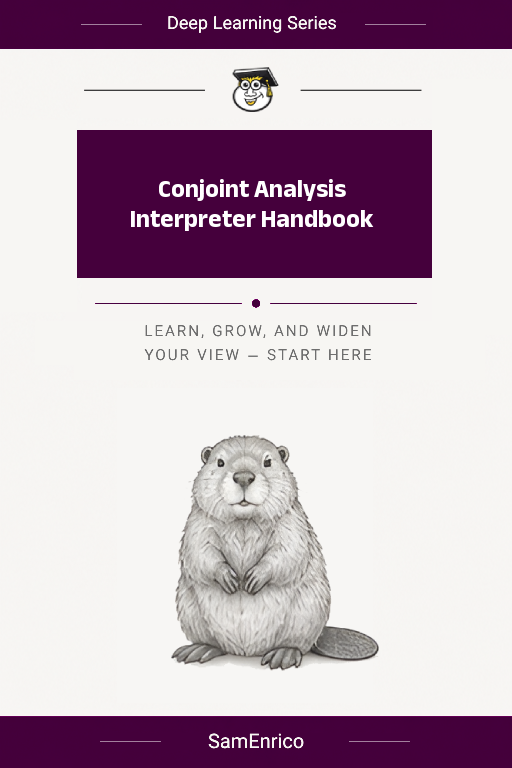
Non-FictionAI OperatorConsumer InsightsConjoint Guide
Conjoint Analysis Interpreter Handbook
Convert conjoint survey outputs into feature impor
Convert conjoint survey outputs into feature importance rankings, trade-off insights, and market simulation results using AI. Includes utility scores, preference shares, and what-if prompts.
Formats
About this book
Free sample
Chapter 1: The Preference Mirage--–- In a windowless conference room on the thirty-seventh floor of a Manhattan skyscraper, a senior vice president of product strategy stared at a spreadsheet that had just cost her company two hundred thousand dollars. The survey was pristine: eighteen thousand respondents, forty-seven questions, and a ninety-eight percent completion rate. The data said, with ninety-five percent confidence, that customers wanted eco-friendly packaging, premium customer support, and a longer warranty. The product team built exactly that. Six months later, sales were flat.
Post-launch research revealed that customers liked the new features in principle but consistently chose the cheaper, plainer competitor when both were side by side. The VP had paid for stated preferences but needed revealed preferences. She needed conjoint analysis.The gap between what people say and what people do is not a design flaw in human psychology—it is the central fact that market research exists to navigate. Direct surveys ask customers to predict their own behavior, a task at which humans are demonstrably terrible. We overstate our appetite for virtue, underestimate our sensitivity to price, and genuinely believe we will read the terms and conditions next time.
Conjoint analysis does not ask what customers want. It asks what customers choose. That distinction is the difference between a product that wins and a post-launch apology letter.This chapter dismantles the fallacy that asking customers directly yields actionable data. It establishes the foundational logic of conjoint analysis, introduces the core vocabulary of utility scores and attribute importance, and—crucially—explains why this half-century-old methodology has become unexpectedly central to modern artificial intelligence. By the end of this chapter, you will understand why a properly designed conjoint study is the single best input for large language models tasked with product strategy, and you will have a one-page health checklist to validate any study before you trust its outputs.The Preference–Action Chasm Every market researcher knows a version of the following story.
A global beverage company asked consumers whether they would buy a low-sugar version of their flagship soda. Seventy-two percent said yes. The company reformulated, relaunched…
This is the end of the free sample. Get the eBook to keep going. Buy now
Contents
- Chapter 1
- Chapter 2
- Chapter 3
- Chapter 4
- Chapter 5
- Chapter 6
- Chapter 7
- Chapter 8
- Chapter 9
- Chapter 10
- Chapter 11
- Chapter 12
Details
- Author
- Roland Robbie
- Publisher
- SamEnrico
- Language
- English
- Genre
- Non-Fiction, AI Operator, Consumer Insights, Conjoint Guide
- Released
- 2026-05-30
- Pages (approx.)
- 129
- Available as
- eBook, Audiobook

Read better in the ZLOADR app
Your eBooks on your phone or tablet. Sign in with your SamEnrico account and start reading.
More by Roland Robbie
 Critical Parent Internal Voice GuideRoland Robbie$11.99
 Wilderness Guide Career GapRoland Robbie$11.99
 Bifidobacterium Anxiety ReliefRoland Robbie$11.99
 Disappointment in Retirement LifeRoland Robbie$11.99
 The Gambling Addiction Spouse Support GuideRoland Robbie$11.99
 Quetzalcoatl's Flight: The Feathered Serpent's WisdomRoland Robbie$11.99
 Understanding Laryngomalacia Dominant CongenitalRoland Robbie$17.99
 Logistics Technology InvestmentRoland Robbie$12.99
 Card TricksRoland Robbie$11.99
 How to Start a Burglar Alarm and System Business (Beginners Guide)Roland Robbie$11.99
You may also like
 Hong Kong Handover 1997Dunn Johnnie$11.99
 Zumba For Postnatal Recovery CourseNeal Christian$11.99
 Zumba for BeginnersLadner Nikia$11.99
 YouTube Comment Mining GuideHumes Pandora$12.99
 Worry Box MeditationCarlin Rudy$11.99
 Workplace Stress MeditationNguyen Lynn$11.99
 Workplace Stress and Sleep RepairHawley Ivory$11.99
 Workplace Perfectionism CureDelaney Jeffry$11.99
 Workplace Injustice Anger GuideWallen Isabelle$11.99
 Work Addiction and Burnout LinkGreenwood Ester$11.99
 Women in Yoga and WellnessBeattie Galina$11.99
 Women in Stand Up ComedyChun Evangeline$11.99