
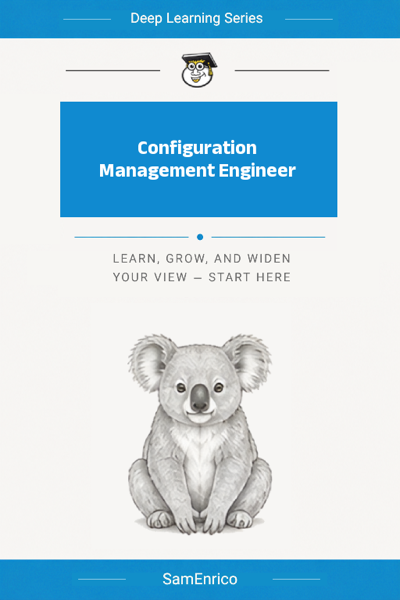
Non-FictionInformativeEducational
Configuration Management Engineer eBook
A Coursebook on Configuration Management Engineer
by Walter Cole
A Coursebook on Configuration Management Engineer
Formats
Free sample
Chapter 1: The $400 Million Typo--–- The pager woke me at 2:17 AM on a Tuesday. Not the gentle buzz of a low-priority alert, but the full-throated scream of a Sev-1 incident. My phone screen glowed with a single sentence that made my stomach drop: "Payment processing subsystem – 100% failure rate – all regions."I pulled up the dashboard. Red everywhere. Every transaction attempt for the past twenty-three minutes had failed.
At 2 AM, that meant only a trickle of insomniac shoppers and night-shift workers. By 6 AM, when the East Coast woke up, it would be a tsunami of failed payments, angry customers, and a very short phone call with the CEO.I joined the war room bridge. Forty-seven engineers, product managers, and executives, most of them clearly dragged from bed. Voices overlapped in that unique panic cadence that only a production outage can produce. "Roll back the last deployment!" someone shouted.
"We didn't deploy anything today," another voice countered. "Check the database!" "The database is fine." "Check the cache layer!" "Cache is fine too."Twenty-seven minutes of chaos later, someone finally thought to check the configuration repository.A senior engineer had made a change at 1:55 AM. A security patch. A good thing, actually—a critical vulnerability in the payment gateway's TLS configuration had been disclosed that afternoon, and the engineer was being proactive. The change was simple: update the cipher suite list to exclude the vulnerable algorithm.
One line in one configuration file. The change was reviewed by—well, actually, no one. The engineer had marked it as an "emergency change" and deployed it directly to production, bypassing the normal peer review and change control processes.The typo was subtle. Instead of TLS_ECDHE_RSA_WITH_AES_128_GCM_SHA256, the engineer had typed TLS_ECDHE_RSA_WITH_AES_128_GCM_SHA256_OLD. The underscore and three letters that didn't belong.
The payment gateway, receiving an unrecognized cipher suite, simply refused all connections. Not an error message that would have alerted anyone. Just silence. Failed connections logged and forgotten.The fix took forty-seven seconds once identified. The damage: $1.2 million in failed transactions, fourteen hours of engineering time wasted, and one engineer who would never again make a change without a second pair of eyes.I tell you this story not to shame that engineer—I've made similar mistakes myself, and so has everyone reading this book—but to introduce a fundamental truth about modern technology systems: Configuration is the single most common cause of production failures, and the least controlled artifact in your entire stack.This book is about changing that.The Configuration Problem Nobody Talks About Let me ask you a question.
When was the last time your team had an outage that was caused by a code change? Not a logical bug in your business logic, but a genuine code error that passed tests and review and still made it to production?Now ask yourself: when was the last time an outage was caused by a configuration change? A flag flipped in the wrong environment. A timeout value set too low. A cipher suite list with a typo.
A database connection pool size that was perfect for staging but disastrous for production.If you're like most engineers I've worked with, the second list is much longer than the first. And yet, most organizations have rigorous code review processes, automated testing pipelines, and staged deployments for code—while configuration changes slip through with little more than a Slack message and a hope.This is the configuration problem. And it is the single biggest gap in most engineering organizations' reliability posture.The hard truth: Every configuration value in your system is a lever that can break production. And most of those levers are being pulled by people, not processes.What Is Configuration Management, Really?Let me give you a definition that cuts through the academic jargon.Configuration Management (CM) is the discipline of knowing what you have, controlling how it changes, and proving that what's running is what you intended to run.That's it. Three responsibilities.
But each one is deeper than it appears.Responsibility 1: Know What You Have You cannot control what you cannot name. This seems obvious, and yet I have walked into organizations that couldn't tell me how many production databases they had, what versions of their software were running in each region, or even what configuration files were being loaded at startup.A Configuration Item (CI) is anything that, if changed, would change the behavior of your system. That includes:Source code files (obviously)Configuration files (YAML, JSON, TOML, properties files)Environment variables Database schemas and migration scripts Infrastructure definitions (Terraform, Cloud Formation)CI/CD pipeline definitions Feature flags and entitlement configurations Network firewall rules and routing tables Load balancer settings and certificate configurations Third-party API keys and authentication secrets Data schemas and API field definitions If it can break production when changed, it is a Configuration Item. And it needs to be under CM.Responsibility 2: Control How Things Change Knowing what you have is useless if anyone can change it at any time without accountability. Change control is not about bureaucracy—it's about intentionality.Every change to a CI should answer five questions:What are you changing?
(Specific identifier)Why are you changing it? (Business or technical justification)What's the risk? (What breaks if this change fails?)Who approved it? (Traceable accountability)How do we undo it? (Rollback plan)These five questions are not a burden.
They are a safety net. Every time I've seen a team skip these questions, I've seen an outage follow within weeks.Responsibility 3: Prove What's Running The final responsibility is the one most organizations fail at. You can have perfect version control and rigorous change approval, but if what's actually running in production doesn't match what you think is running, you have nothing.Truth has three levels in any system:Level Description Where It Lives Level 1What you think is running Documentation, CMDB, spreadsheets Level 2What your monitoring says is running Observability tools, logs, metrics Level 3What is actually running The live system In every organization I've audited, these three levels are never identical. The gap between them is where outages live.The Three Baselines of Every System To understand CM fully, you need to understand the concept of baselines. A baseline is a fixed reference point—a snapshot of a system at a particular moment, with all its components and configurations documented.The ANSI/EIA-649 standard (which we'll explore in depth in Chapter 11) defines three critical baselines that every CM system must maintain:Functional Baseline The Functional Baseline answers the question: "What is this system supposed to do?"This is the requirements baseline.
It includes:Functional requirements (the system shall do X)Performance requirements (the system shall do X in under Y milliseconds)Interface requirements (the system shall communicate with Z using protocol W)Regulatory requirements (the system shall comply with HIPAA/SOX/GDPR)The Functional Baseline is established before development begins. It is the contract between stakeholders and engineers. When a change request comes in, the first question is: "Does this change still satisfy the Functional Baseline?"Allocated Baseline The Allocated Baseline answers the question: "How are we going to build what we said we'd build?"This is the design baseline. It allocates…
This is the end of the free sample. Get the eBook to keep going. Buy now
About this book
Details
- Author
- Walter Cole
- Publisher
- SamEnrico
- Language
- English
- Genre
- Non-Fiction, Informative, Educational
- Released
- 2026-06-02
- Pages (approx.)
- 138
- Available as
- eBook, Audiobook

Read better in the ZLOADR app
Your eBooks on your phone or tablet. Sign in with your SamEnrico account and start reading.
More by Walter Cole
 The Lying Down Breath ScanWalter Cole$11.99
 Micro Breaks for CarersWalter Cole$11.99
 Hypnotic Catalepsy InductionWalter Cole$11.99
 Acupuncture for Nail PsoriasisWalter Cole$11.99
 Twitter Intellectual Status GameWalter Cole$11.99
 The Frozen Frontier: Antarctica’s First Forgotten ExplorersWalter Cole$11.99
 Paws of Justice: The Dog Who Solved the Lindbergh Baby CaseWalter Cole$11.99
 How to Start a Scheduled Freight Air Transportation BusinessWalter Cole$11.99
 Understanding Dyskeratosis Congenita of Zinsser–Cole–engmanWalter Cole$17.99
 Nature Stock Phone GuideWalter Cole$12.99
 Founder Breakup GuideWalter Cole$12.99
You may also like
 Hong Kong Handover 1997Dunn Johnnie$11.99
 Zumba For Postnatal Recovery CourseNeal Christian$11.99
 Zumba for BeginnersLadner Nikia$11.99
 YouTube Comment Mining GuideHumes Pandora$12.99
 Worry Box MeditationCarlin Rudy$11.99
 Workplace Stress MeditationNguyen Lynn$11.99
 Workplace Stress and Sleep RepairHawley Ivory$11.99
 Workplace Perfectionism CureDelaney Jeffry$11.99
 Workplace Injustice Anger GuideWallen Isabelle$11.99
 Work Addiction and Burnout LinkGreenwood Ester$11.99
 Women in Yoga and WellnessBeattie Galina$11.99
 Women in Stand Up ComedyChun Evangeline$11.99