
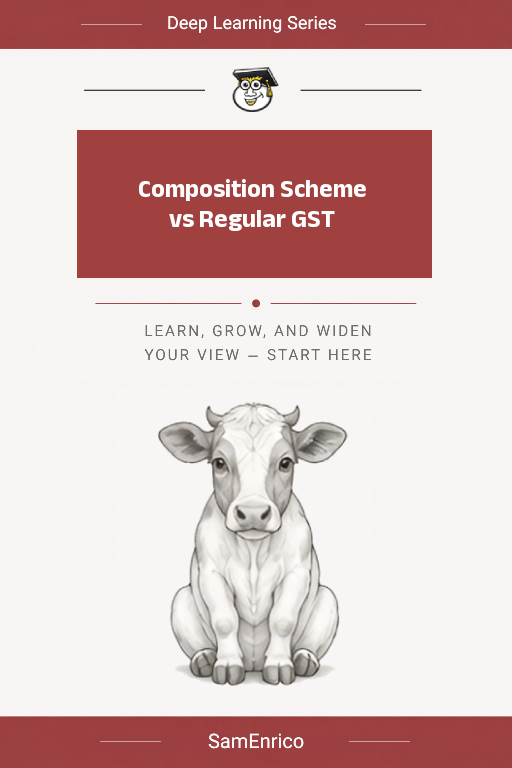
Non-FictionFirst 30 DaysSchemes
Composition Scheme vs Regular GST eBook
Choose between composition scheme (lower tax, no i
Choose between composition scheme (lower tax, no input credit) or regular GST for Indian businesses.
Formats
Free sample
Chapter 1: The ₹5 Lakh Lie--It was a Tuesday evening in May when Rajesh Khanna, a 42-year-old hardware trader in Delhi’s Chandni Chowk, received a notice that made his heart stop.The notice, from the GST department, was labeled “ASMT-10 — Notice for Mismatched Returns.” Rajesh didn’t understand most of the legal jargon, but one line stood out in bold: *“Based on your suppliers’ GSTR-1 filings, it appears your turnover for FY 2023-24 exceeded the Composition Scheme eligibility threshold. You are hereby directed to show cause why you should not be treated as a Regular taxpayer with retrospective effect, along with applicable interest and penalties.”*Rajesh had never heard of GSTR-1. He didn’t know what “retrospective effect” meant. But he understood the last word: penalties.He called his Chartered Accountant, a mild-mannered man named Suresh Mehta who had been handling Rajesh’s taxes for seven years. Suresh had been the one who, back in 2019, recommended that Rajesh opt for the Composition Scheme.
“It’s simpler,” Suresh had said. “Lower tax rate. Fewer filings. You don’t need all that Input Tax Credit headache.”Rajesh trusted Suresh. Why wouldn’t he?
Suresh was a CA. He wore crisp white shirts and had a framed degree on his wall. He charged ₹25,000 per year for tax compliance. In the world of small business owners, that made him an expert.But on that Tuesday evening, as Rajesh read the notice for the tenth time, he realized something terrible: his expert had been wrong. And that error was going to cost him ₹5 lakh.The Story of Rajesh — A Cautionary Tale for 7 Crore Businesses Rajesh’s business was straightforward.
He bought hardware tools — drills, hammers, saws, measuring tapes — from registered wholesale suppliers in Gujarat and Maharashtra. His purchase cost averaged ₹95 lakh per year. He sold these tools to local retailers and individual customers in Delhi, generating annual sales of approximately ₹1.2 crore. His profit margin was thin — about 8% before tax.Under the Composition Scheme, as Suresh had explained, Rajesh paid 1% tax on his total turnover. That meant ₹1.2 crore × 1% = ₹1,20,000 per year in GST.
Rajesh thought this was a great deal. After all, the Regular GST rate for hardware tools was 18%. Paying 1% instead of 18% felt like winning a lottery.But Rajesh never asked the most important question: “What am I giving up?”He never asked because Suresh never told him. And Suresh never told him because Suresh himself didn’t fully understand the mathematics of Input Tax Credit.Here is what Rajesh discovered after receiving the notice, after hiring a second CA to review his case, after spending three sleepless nights poring over GST rules he had never read before:Under the Composition Scheme, Rajesh paid ₹1,20,000 in tax. But under the Regular Scheme, here is what he would have paid:His purchase cost was ₹95 lakh.
On these purchases, his suppliers charged him 18% GST, which came to ₹17,10,000. Because Rajesh was under the Composition Scheme, he could not claim this amount back. It was a cost he simply absorbed.His sales were ₹1.2 crore. Under the Regular Scheme, he would have charged his customers 18% GST on these sales, which would have been ₹21,60,000. But — and this is the critical part — he would have deducted the ₹17,10,000 he had already paid to his suppliers as Input Tax Credit.The net GST he would have paid to the government under the Regular Scheme was: ₹21,60,000 (output tax) minus ₹17,10,000 (input credit) = ₹4,50,000.Wait.
That’s higher than ₹1,20,000. How is Regular worse?It’s not. Because the calculation above is incomplete. Rajesh forgot to account for the fact that under the Regular Scheme, he wouldn’t have just collected GST from his customers — he would have removed the GST component from his pricing strategy entirely.Let me explain.Under the Composition Scheme, Rajesh’s effective cost structure looked like this:Component Amount Purchase cost (including 18% GST)₹95,00,000Composition tax paid (1% of turnover)₹1,20,000Total cost to Rajesh₹96,20,000He sold his goods at a 25% markup on his purchase cost (excluding GST), which meant his selling price was approximately ₹1,18,75,000. But because he was under Composition, he could not separately show GST on his invoice.
His customers saw a single price. Some of those customers were registered dealers themselves — and they hated buying from Rajesh because they couldn’t claim Input Tax Credit on his bills.Under the Regular Scheme, Rajesh would have restructured his pricing. He would have told his suppliers to issue tax invoices showing GST separately. He would have issued tax invoices to his customers showing GST separately. His purchase cost excluding GST would have been ₹95,00,000 ÷ 1.18 = ₹80,50,847.
His sales excluding GST would have been ₹1.2 crore ÷ 1.18 = ₹1,01,69,492. His margin would have been roughly the same. But his cash flow would have been transformed.Here is the corrected comparison:Rajesh under Composition Scheme (actual):Paid ₹17,10,000 GST to suppliers (non-recoverable)Paid ₹1,20,000 Composition tax to government Total tax outflow: ₹18,30,000Effective tax rate on turnover: 15.25%Rajesh under Regular Scheme (if he had chosen it):Paid ₹17,10,000 GST to suppliers (recoverable as ITC)Collected ₹21,60,000 GST from customers Net paid to government: ₹4,50,000Total tax outflow: ₹4,50,000 (the GST paid to suppliers is recovered, not a cost)Effective tax rate on turnover: 3.75%Rajesh overpaid by ₹13,80,000 — not ₹5 lakh. The notice he received was for a different violation (crossing the turnover threshold), but the underlying damage was far worse. For three years, he had been paying 15% of his turnover in taxes when he could have been paying less than 4%.When Rajesh finally understood this, he fired Suresh Mehta.
Then he hired a litigation lawyer to contest the notice. Then he spent the next six months in tax litigation, missing work, losing sleep, and watching his blood pressure climb.All because of a lie. Not a malicious lie — Suresh wasn’t trying to cheat him. But a lie nonetheless: the lie that a lower tax rate always means lower taxes.The Lie That CAs Tell (Without Knowing They’re Lying)If you are a small business owner in India, you have probably heard some version of this conversation:You: “Should I register under the Composition Scheme or Regular GST?”Your CA: “What’s your turnover?”You: “About ₹80 lakh.”Your CA: “Then Composition. Lower rate.
Fewer filings. You don’t want the headache of Regular GST.”And just like that, a decision worth lakhs of rupees is made in 30 seconds.The problem is not that CAs are incompetent. Most CAs genuinely believe they are giving good advice. They remember the early days of GST (2017-2018) when the law was unclear, when returns were buggy, when claiming ITC was a nightmare. They remember clients who were penalized for mismatched invoices.
They remember the panic.But the world has changed. The GST portal works. Invoice matching is automated. Input Tax Credit, when claimed correctly, is no longer a “headache” — it is the single most powerful tax-saving mechanism in Indian indirect tax law.The lie persists because of three cognitive biases:Bias #1: The “Lower Rate” Heuristic Human beings are wired to compare percentages. 1% looks smaller than 18%.
It is smaller. But taxes are not paid on rates — they are paid on bases. The Composition Scheme applies its low rate to your entire turnover. The Regular Scheme applies its high rate only to your margin (value addition). If your margin is thin…
This is the end of the free sample. Get the eBook to keep going. Buy now
About this book
Details
- Author
- Mangum Zenaida
- Publisher
- SamEnrico
- Language
- English
- Genre
- Non-Fiction, First 30 Days, Schemes
- Released
- 2026-05-30
- Pages (approx.)
- 138
- Available as
- eBook, Audiobook

Read better in the ZLOADR app
Your eBooks on your phone or tablet. Sign in with your SamEnrico account and start reading.
More by Mangum Zenaida
 The Ghana Government Grant GuideMangum Zenaida$11.99
 Check The Facts DBT WorkbookMangum Zenaida$11.99
 Self Esteem for SurvivorsMangum Zenaida$11.99
 Breakup Grief RecoveryMangum Zenaida$11.99
 Cord and Tape SourcesMangum Zenaida$11.99
 Vaccine Confidence Parent WorkbookMangum Zenaida$11.99
 Newborn Never MetMangum Zenaida$11.99
 Annual Hearing Test GuideMangum Zenaida$11.99
 She Was the Voice: The Unsung Pioneers of Radio's Golden AgeMangum Zenaida$11.99
 Whispers in the Forest: The Baba Yaga’s Last LessonMangum Zenaida$11.99
 How to Start a Cotton Yarn Business (Beginners Guide)Mangum Zenaida$11.99
 How to Setup and Launch a Press ConferenceMangum Zenaida$11.99
You may also like
 Hong Kong Handover 1997Dunn Johnnie$11.99
 Zumba For Postnatal Recovery CourseNeal Christian$11.99
 Zumba for BeginnersLadner Nikia$11.99
 YouTube Comment Mining GuideHumes Pandora$12.99
 Worry Box MeditationCarlin Rudy$11.99
 Workplace Stress MeditationNguyen Lynn$11.99
 Workplace Stress and Sleep RepairHawley Ivory$11.99
 Workplace Perfectionism CureDelaney Jeffry$11.99
 Workplace Injustice Anger GuideWallen Isabelle$11.99
 Work Addiction and Burnout LinkGreenwood Ester$11.99
 Women in Yoga and WellnessBeattie Galina$11.99
 Women in Stand Up ComedyChun Evangeline$11.99