
Non-FictionSelf-HelpCompliments
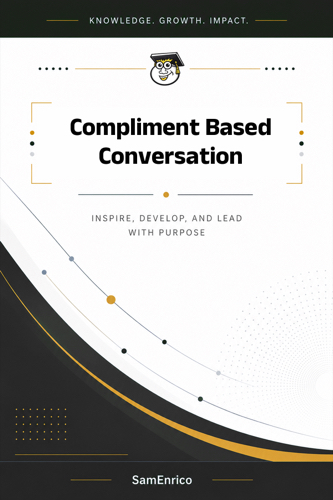
Compliment Based Conversation eBook
Start chats with genuine praise that invites recip
by Moyer Bertie
Start chats with genuine praise that invites reciprocal sharing.
Formats
Free sample
Chapter 1: The Appetite Within--The deepest principle in human nature is the craving to be appreciated. William James, the father of American psychology, wrote those words in 1890, and more than a century later, neuroscience has proven him exactly right. When you receive a specific, genuine compliment, your brain releases serotonin and dopamine—the same neurochemicals associated with warmth, safety, and reward. A well-delivered compliment is not merely polite. It is a biological event.
It lowers defenses, opens neural pathways associated with trust, and creates what researchers call a "micro-bond" in under three seconds. That is faster than it takes to say "How are you?" and hear "Fine."Yet most of us walk through entire days without receiving a single specific compliment. We receive automated "likes" on social media. We receive generic "good jobs" from managers who are not paying attention. We receive "thanks" from cashiers who are trained to say it.
But a genuine, specific, behavior-focused compliment? One that makes you feel truly seen? Many people go weeks without that experience. And that scarcity is not accidental. It is the result of three cultural forces that this book will help you overcome.The first force is what psychologists call the negativity bias.
Your brain is wired to scan for threats, problems, and errors because those kept your ancestors alive. A saber-toothed tiger in the tall grass mattered more than a beautiful sunset. That same wiring now means you will naturally notice what your spouse did wrong before you notice what they did right. You will spot the typo in an email before you appreciate the thoughtful argument. You will remember the one critical comment in a performance review and forget the nine pieces of praise.
This bias is not your fault, but it is your responsibility to manage.The second force is the fear of insincerity. You have hesitated to compliment someone because you worried it would sound fake, manipulative, or creepy. That fear is rational. People possess remarkably sensitive "insincerity detectors"—the brain processes potential flattery as a threat in milliseconds, activating the same regions involved in detecting lies. One study found that participants could distinguish between genuine and ulterior-motivated compliments with 78 percent accuracy based on tone alone.
You are right to be cautious. The solution is not to stop complimenting. The solution is to learn the structure of compliments that cannot be faked.The third force is simple habit erosion. Most people were never taught how to compliment well. They were told "be nice" or "say something positive," but those instructions are useless without a framework.
You cannot execute what you have not practiced. This book exists because "be nice" is not a strategy.This chapter introduces the foundational concept that will appear in every subsequent chapter: the shift from the negativity bias to the appreciation mindset. It also introduces the first major distinction of the book—the difference between Drive-By Compliments and Conversational Compliments—and provides your first self-assessment tool, which will be completed in full in Chapter 12. Finally, it previews the Criticism-to-Compliment Translation Table, a tool you will use throughout the remaining eleven chapters.By the end of this chapter, you will understand why a single specific compliment opens more conversational doors than ten generic questions. You will know the difference between a compliment that ends a conversation and one that starts it.
And you will have taken the first step toward rewiring your brain to see what is right before you see what is wrong.The Appreciation Hunger: What William James Got Right William James did not have access to f MRI machines. He could not measure serotonin or dopamine. Yet his 1890 observation that "the deepest principle in human nature is the craving to be appreciated" has been validated by every subsequent wave of psychological research. The desire for genuine recognition is not vanity. It is not weakness.
It is a fundamental human need, as basic as hunger or thirst.Consider what happens when you receive a compliment that feels true and specific. Not "nice job" but "the way you handled that customer's confusion—you repeated back their concern before offering a solution. I have never seen anyone do that. Where did you learn that?" In that moment, your brain releases a cascade of neurochemicals. Serotonin stabilizes your mood and creates a feeling of well-being.
Dopamine signals that something rewarding has occurred and motivates you to seek more of it. Oxytocin, sometimes called the bonding hormone, increases your sense of trust and safety with the person who spoke.These are not metaphors. These are measurable biological events. A 2015 study from the National Institute for Physiological Sciences in Japan used neuroimaging to show that receiving a sincere compliment activates the same reward circuitry in the brain as receiving cash. The compliment is neurologically equivalent to a small financial reward.
That is why a well-delivered compliment feels so good—not because you are vain, but because your brain is designed to treat genuine appreciation as a survival resource.The evolutionary logic is straightforward. Human beings survived not because we were the strongest or fastest but because we formed cooperative groups. Groups require trust. Trust requires positive feedback. A brain that released rewarding chemicals when it received genuine appreciation was more likely to seek out cooperative relationships, and those relationships increased survival odds.
Over hundreds of thousands of years, that wiring became universal.This is the biological foundation of everything that follows in this book. When you deliver a genuine, specific compliment, you are not being "nice." You are triggering a hardwired reward response that makes the other person want to continue interacting with you. You are lowering their defenses and opening a door. The question is not whether compliments work. They do, reliably, across cultures, ages, and contexts.
The question is how to deliver them so they land as genuine—and how to use them to start conversations that invite reciprocal sharing.The Negativity Bias: Why You Miss What Is Right If genuine appreciation is so powerful, why is it so rare? The answer lies in the architecture of your attention. The negativity bias is the tendency for negative events, emotions, and information to have a more powerful impact on your psychological state than positive ones. Psychologists Roy Baumeister and John Tierney summarized decades of research with a stark conclusion: "Bad is stronger than good."Consider the evidence. One negative comment in a performance review will be remembered longer than nine positive ones.
A single argument with your spouse will overshadow a week of pleasant interactions. One rude customer service experience will make you abandon a company you have used for years. This asymmetry is not a design flaw. It is a feature that kept your ancestors alive. The caveman who failed to notice the rustling grass that might contain a predator did not pass on his genes.
The caveman who ignored a delicious berry bush missed only a meal.The problem is that the world that wired your brain no longer exists. You are not scanning for tigers. You are scanning for typos, for slights, for things your partner did wrong, for the one critical sentence in an otherwise kind email. The negativity bias has become a liability.…
This is the end of the free sample. Get the eBook to keep going. Buy now
About this book
Details
- Author
- Moyer Bertie
- Publisher
- SamEnrico
- Language
- English
- Genre
- Non-Fiction, Self-Help, Compliments
- Released
- 2026-06-08
- Pages (approx.)
- 147
- Available as
- eBook, Audiobook

Read better in the ZLOADR app
Your eBooks on your phone or tablet. Sign in with your SamEnrico account and start reading.
More by Moyer Bertie
 Refund Rate DemographicsMoyer Bertie$11.99
 The Customer Rage De escalationMoyer Bertie$11.99
 Cigarette Butt Environmental ToxinMoyer Bertie$11.99
 MMORPG Addiction Help GuideMoyer Bertie$11.99
 The Alchemist of Light: Humphry Davy and the Birth of Modern ChemistryMoyer Bertie$11.99
 How to Start a Cherry Growing Business (Beginners Guide)Moyer Bertie$11.99
 Understanding Pulmonary Hypoplasia Familial PrimaryMoyer Bertie$17.99
 Podcast Marketing One Page PlanMoyer Bertie$12.99
 Notion GuideMoyer Bertie$12.99
 Financial Planning AssociateMoyer Bertie$11.99
You may also like
 Hong Kong Handover 1997Dunn Johnnie$11.99
 Zumba For Postnatal Recovery CourseNeal Christian$11.99
 Zumba for BeginnersLadner Nikia$11.99
 YouTube Comment Mining GuideHumes Pandora$12.99
 Worry Box MeditationCarlin Rudy$11.99
 Workplace Stress MeditationNguyen Lynn$11.99
 Workplace Stress and Sleep RepairHawley Ivory$11.99
 Workplace Perfectionism CureDelaney Jeffry$11.99
 Workplace Injustice Anger GuideWallen Isabelle$11.99
 Work Addiction and Burnout LinkGreenwood Ester$11.99
 Women in Yoga and WellnessBeattie Galina$11.99
 Women in Stand Up ComedyChun Evangeline$11.99