
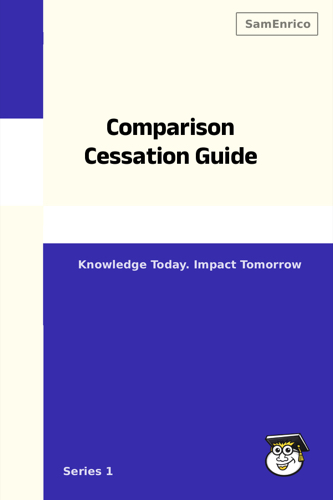
Non-FictionSelf-HelpSocial Comparison
Comparison Cessation Guide eBook
Stop measuring your success against peers to reduc
by Gage Annett
Stop measuring your success against peers to reduce pressure and prevent burnout.
Formats
Free sample
Chapter 1: The Comparison Loop--–- You are standing in a crowded room, but you are not looking at the people around you. You are looking at their reflections in a funhouse mirror—distorted, stretched, and impossibly flattering. That mirror is your brain on comparison.The moment you wake up, before your feet touch the floor, your brain has already begun a calculation you never asked for. It scans your recent memory: a colleague’s promotion announcement on Linked In, a friend’s vacation photo in a location you cannot afford, a peer’s gym selfie showcasing a body that seems sculpted from a different genetic code. You have not yet brushed your teeth, and already you are losing a race you did not sign up to run.This chapter is about why that happens, how it became automatic, and why it is not your fault—but is your responsibility to change.
By the time you finish reading, you will understand the neuroscience of social comparison, the evolutionary trap that makes upward comparison feel like survival, and the cognitive distortion that keeps you focused on what you lack rather than what you have. More importantly, you will complete your first concrete exercise: tracking your comparison triggers for one week. This baseline awareness is the foundation upon which the entire Comparison Cessation Guide is built. Without it, every subsequent chapter is just theory. With it, you become a scientist of your own mind.The Silent Algorithm You Never Installed Social comparison is not a character flaw.
It is not a sign of weakness, insecurity, or low self-esteem—though those things can worsen it. Social comparison is a feature of the human brain, installed by millions of years of evolution, and it runs automatically in the background like an operating system you cannot uninstall. The question is not whether you compare; it is how often, with whom, and what you do next.In the 1950s, social psychologist Leon Festinger formalized what humans have always known: we determine our own social and personal worth by comparing ourselves to others. Festinger’s social comparison theory proposed that in the absence of objective measures, we turn to other people to answer the question, “How am I doing?” If you want to know whether you are a good parent, you look at other parents. If you want to know whether your salary is fair, you look at colleagues.
If you want to know whether your body is healthy, you look at bodies around you.This system worked beautifully for most of human history. In small tribal groups of fifty to one hundred fifty people—what anthropologists call Dunbar’s number, the cognitive limit of stable social relationships—comparison was a survival tool. Knowing where you stood relative to others helped you allocate resources, form alliances, and avoid predators. If you were the third-best hunter in a tribe of thirty hunters, that information was useful. It told you who to learn from, who to compete with for status, and who might share food with you in a famine.But you no longer live in a tribe of one hundred fifty.
You live in a world where, in a single minute of scrolling, you can compare yourself to more people than your ancestors met in a lifetime. And each of those people is presented to you not as a whole human being with setbacks, fears, and boring Thursdays, but as a highlight reel of their best moments. Your brain, still wired for the tribal campfire, treats each of those highlights as a real, present, and relevant competitor for resources, status, and safety. This is the mismatch that causes the pain.Upward, Downward, and the One That Hurts Not all comparison is created equal. Researchers distinguish between two directions of social comparison: upward and downward.Upward comparison occurs when you compare yourself to someone you perceive as better off than you.
That person might have more money, a better relationship, a more impressive job, a fitter body, a happier family, or more Instagram followers. Upward comparison can sometimes inspire you. When you see a mentor who achieved what you want, you might think, “If they can do it, so can I.” This is called upward contrast—you see the gap, but you also see a path.However, upward comparison far more often triggers upward identification, where you see the gap and feel shame, inadequacy, or hopelessness. The difference depends on whether you believe the gap is bridgeable. If the person is a peer of similar age and background who seems to have sprinted ahead, your brain interprets that as a threat.
If they are a decade older or in a different field, the threat response is muted. We will return to this distinction in Chapter 6, when we build your personal decision tree for which peers to keep, which to transform into inspiration, and which to eliminate entirely.Downward comparison is the opposite: you compare yourself to someone you perceive as worse off. This can boost your mood temporarily—“At least I’m not that person.” But downward comparison is a drug with a short half-life and a nasty withdrawal. It builds a sense of self-worth on the shaky foundation of others’ misfortune, and it does nothing to address your own unmet needs. Moreover, chronic downward comparison makes you less compassionate and more fearful, because your brain becomes wired to seek out threats in the form of people who might fall below you.The comparison that drives burnout, however, is almost exclusively upward comparison to similar peers.
Your brain does not care that a billionaire flies a private jet. That person is too far outside your reference group to trigger a threat response. But your coworker who got the corner office? Your cousin who just bought a second home? Your former classmate whose startup just raised a funding round?
Those comparisons activate the pain centers of your brain as if you were being physically threatened.The Neuroscience of Envy: Your Anterior Cingulate Cortex on Fire Let us get specific about what happens inside your skull when you compare upward. Neuroimaging studies have shown that social comparison activates several brain regions, but the most important for our purposes is the anterior cingulate cortex (ACC) . The ACC is involved in detecting conflict, monitoring errors, and processing physical pain. When you experience social exclusion, rejection, or the sense that you are falling behind, your ACC lights up as if you had been punched.In one landmark study, participants played a virtual ball-tossing game while undergoing f MRI scans. When they were excluded from the game—when the other “players” (actually computers) stopped tossing them the ball—their ACC activated in the same pattern as physical pain.
Social comparison triggers this same response. When you see a peer achieving something you want, your brain does not calmly process the information. It registers a threat, a loss, and an error in your social standing.This is why envy feels so viscerally awful. It is not a moral failing to feel envy; it is a neurological event. The problem is what happens next.
In the moments after ACC activation, your brain seeks an explanation for the pain. It finds one quickly: “I am…
This is the end of the free sample. Get the eBook to keep going. Buy now
About this book
Details
- Author
- Gage Annett
- Publisher
- SamEnrico
- Language
- English
- Genre
- Non-Fiction, Self-Help, Social Comparison
- Released
- 2026-06-11
- Pages (approx.)
- 144
- Available as
- eBook, Audiobook

Read better in the ZLOADR app
Your eBooks on your phone or tablet. Sign in with your SamEnrico account and start reading.
More by Gage Annett
 Job Loss Sleep Recovery GuideGage Annett$11.99
 Citation Rules for Maps and CartographyGage Annett$11.99
 Rafale Pilot MemoirGage Annett$11.99
 Mindfulness Study ConcentrationGage Annett$11.99
 MDD Symptom Recognition GuideGage Annett$11.99
 Uber Driver Car Cleaning GuideGage Annett$11.99
 Rockefeller FoundationGage Annett$11.99
 Indian GST Registration for Franchise Operators CourseGage Annett$11.99
 The Mysterious Deaths of the Andes: Unraveling the High-Altitude EnigmaGage Annett$11.99
 The Alpine Watchmakers: Timekeeping Through Fire and IceGage Annett$11.99
 Echoes of the Forgotten: The Lost Apollo 20 MissionGage Annett$11.99
 Paystack Acquisition By Stripe Exit GuideGage Annett$12.99
You may also like
 Hong Kong Handover 1997Dunn Johnnie$11.99
 Zumba For Postnatal Recovery CourseNeal Christian$11.99
 Zumba for BeginnersLadner Nikia$11.99
 YouTube Comment Mining GuideHumes Pandora$12.99
 Worry Box MeditationCarlin Rudy$11.99
 Workplace Stress MeditationNguyen Lynn$11.99
 Workplace Stress and Sleep RepairHawley Ivory$11.99
 Workplace Perfectionism CureDelaney Jeffry$11.99
 Workplace Injustice Anger GuideWallen Isabelle$11.99
 Work Addiction and Burnout LinkGreenwood Ester$11.99
 Women in Yoga and WellnessBeattie Galina$11.99
 Women in Stand Up ComedyChun Evangeline$11.99