
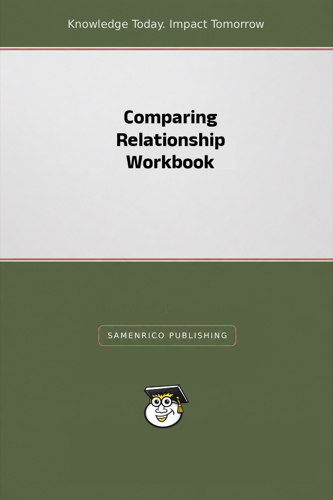
Non-FictionSelf-HelpSocial Comparison
Comparing Relationship Workbook eBook
Stop measuring your love against social media and
by Demers Sal
Stop measuring your love against social media and friends partnerships.
Formats
Free sample
Chapter 1: The Phantom Mirror--–- You are scrolling through your phone on a Tuesday evening, nothing special, just killing time before sleep. A friend from college has posted a photo of her partner surprising her with breakfast in bed. The lighting is warm. The coffee looks perfect. She has captioned it: “He knows the way to my heart.” You feel something shift in your chest.
It is not quite sadness and not quite anger. It is something smaller and sharper, like a splinter you cannot see but can definitely feel. You keep scrolling. Another friend has posted a video of their partner dancing with them in the kitchen while a song plays that you and your own partner used to love. Three thousand likes.
Forty-two comments saying “goals.” You lock your phone, set it face-down on the nightstand, and stare at the ceiling. Your partner is asleep next to you, breathing evenly, completely unaware that, in the past ninety seconds, you have just measured your entire relationship against two carefully curated photographs and found it wanting.This is not a failure of character. It is not a sign that your relationship is broken or that you are too jealous or too needy or too insecure. It is, instead, the predictable result of living inside a digital ecosystem that has been optimized for one thing above all else: making you feel like what you have is never quite enough. The platforms you use every day are not neutral windows into other people’s lives.
They are funhouse mirrors designed to magnify the highlights and erase the shadows, and you have been standing in front of them for years, wondering why your own reflection looks so dim by comparison.This chapter is called The Phantom Mirror because that is exactly what social media has become: a reflective surface that shows you a version of love that does not actually exist, but that feels real enough to hurt. You will learn why your brain cannot tell the difference between a genuine moment of connection and a sponsored post. You will name the specific posts that have triggered you recently. And you will take the first concrete step toward breaking the spell by completing an exercise that reveals, in black and white, just how much of your comparison habit is based on incomplete information.By the end of this chapter, you will understand something that most people never figure out on their own: the relationships you envy online are not better than yours. They are just better at hiding.The Curated Life Hypothesis Let us begin with a simple question: When was the last time you posted a photograph of your partner at their worst?
Not their playful worst, not a silly face made intentionally for the camera, but the actual worst—the exhausted slump after a sixteen-hour workday, the silent treatment after a stupid argument, the crying fit in the car over something neither of you fully understood. When was the last time you uploaded a video of the fight you had about whose family to visit for the holidays, or the fifteen-minute debate about whose turn it was to unload the dishwasher, or the quiet, grinding boredom of a Thursday night when neither of you had anything left to say?You have not posted those things because no one does. And that is the entire problem in a single sentence.The Curated Life Hypothesis is a simple but powerful idea: every person who posts about their relationship online is acting as an editor, not a documentarian. An editor watches hours of raw footage and selects the three seconds that tell the most flattering story. An editor cuts the boring parts, the ugly parts, the confusing parts, and the parts that might make anyone wonder whether this relationship is actually all that great.
The raw footage of any long-term partnership contains moments of profound love, yes, but it also contains moments of irritation, disappointment, misunderstanding, and plain old fatigue. The edited version contains only the love.Here is what makes this so dangerous for you: your brain did not evolve to distinguish between edited footage and raw footage. When you see a photograph of breakfast in bed, your limbic system—the ancient, fast-acting part of your brain that handles emotion and threat detection—does not stop to ask, “Is this an accurate representation of their daily reality?” It simply registers the image, compares it to your own morning (which probably involved an alarm clock, some grumbling, and a quick cup of coffee drunk while checking email), and concludes that you are falling short. This happens in milliseconds. It happens before your slower, more rational prefrontal cortex can step in and say, “Wait a minute.
They did not post the part where he burned the toast or the part where she snapped at him for using the last of the milk.”The result is something psychologists call upward social comparison—measuring yourself against someone you perceive as better off than you. And because social media has made it possible to see hundreds of upward comparisons per day, you are now subjecting your relationship to a level of scrutiny that would have been unimaginable twenty years ago.The First Exercise: Your Three-Second Scroll Test Before we go any further, you need data. You need to see, written down in your own handwriting, exactly what happens inside you when you scroll past certain kinds of posts. This is not about judging yourself. It is about collecting evidence.Exercise 1.1: The Three-Second Scroll Test You will need your phone, a notebook or journal, and a pen.
Set a timer for five minutes. Open whatever social media app you use most often. Scroll normally, but every time you see a post that features someone else’s romantic relationship—a photo of a couple, a caption about a partner, a video of a date, an anniversary post, even a meme about how great someone’s relationship is—you will stop for exactly three seconds. In those three seconds, you will notice your physical and emotional state. Then you will write down the following:What did the post show?
(One sentence.)What did you feel in your body? (For example: tight chest, shallow breath, hollow stomach, heat in face.)What thought immediately went through your mind? (For example: “We never do that” or “Why doesn’t he look at me like that?” or “I wish she still surprised me.”)On a scale of 1 to 10, how much did this post make you want to change something about your own relationship?Continue this for five minutes or until you have logged at least five posts. Do not overthink the answers. The goal is speed and honesty.After you finish, read back through what you wrote.
You will almost certainly notice a pattern. The same kinds of posts will trigger the same kinds of feelings. The same kinds of content will produce the same kinds of thoughts about your own partner. This pattern is your comparison fingerprint, and understanding it is the first step toward changing it.Why Your Brain Falls for This Every Single Time You might be thinking: “I know these posts are…
This is the end of the free sample. Get the eBook to keep going. Buy now
About this book
Details
- Author
- Demers Sal
- Publisher
- SamEnrico
- Language
- English
- Genre
- Non-Fiction, Self-Help, Social Comparison
- Released
- 2026-06-08
- Pages (approx.)
- 145
- Available as
- eBook, Audiobook

Read better in the ZLOADR app
Your eBooks on your phone or tablet. Sign in with your SamEnrico account and start reading.
More by Demers Sal
 Gates Partnering MethodDemers Sal$11.99
 Signal Corps Radio OperatorDemers Sal$11.99
 TikTok Personal Brand GuideDemers Sal$11.99
 Professional Liability PrimerDemers Sal$11.99
 The Asynchronous Remote Work GuideDemers Sal$11.99
 Visual Working Memory DrillsDemers Sal$11.99
 EQ for Workplace SuccessDemers Sal$11.99
 The Lady of the South China Sea: The Deadly Deception of Chen Man-LiDemers Sal$11.99
 The Kings of the North: How the Vikings Built a Seafaring EmpireDemers Sal$11.99
 How to Produce Finger PaintDemers Sal$11.99
 Last 30 Days JEE Revision GuideDemers Sal$12.99
 Cooperative Succession Planning WorkbookDemers Sal$12.99
You may also like
 Hong Kong Handover 1997Dunn Johnnie$11.99
 Zumba For Postnatal Recovery CourseNeal Christian$11.99
 Zumba for BeginnersLadner Nikia$11.99
 YouTube Comment Mining GuideHumes Pandora$12.99
 Worry Box MeditationCarlin Rudy$11.99
 Workplace Stress MeditationNguyen Lynn$11.99
 Workplace Stress and Sleep RepairHawley Ivory$11.99
 Workplace Perfectionism CureDelaney Jeffry$11.99
 Workplace Injustice Anger GuideWallen Isabelle$11.99
 Work Addiction and Burnout LinkGreenwood Ester$11.99
 Women in Yoga and WellnessBeattie Galina$11.99
 Women in Stand Up ComedyChun Evangeline$11.99