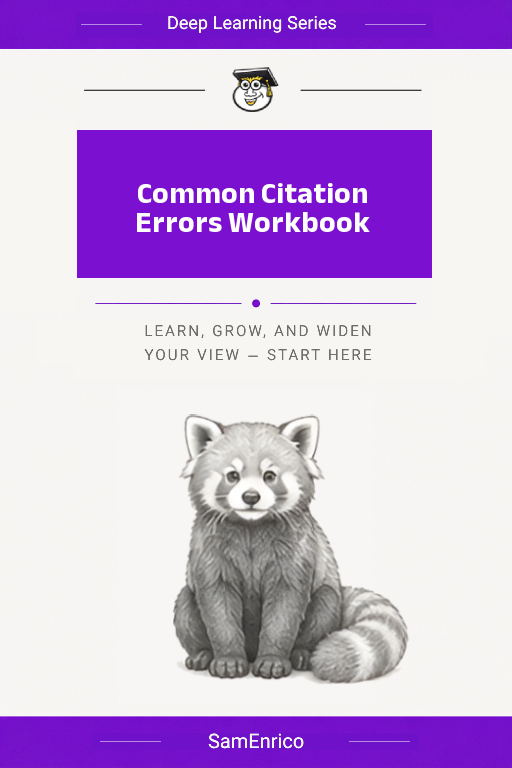
Common Citation Errors Workbook eBook
Fix frequent mistakes in punctuation, capitalizati
by Flagg Sammie
Fix frequent mistakes in punctuation, capitalization, and ordering in references.
Formats
Free sample
Chapter 1: The Name Game...--–- Every semester, somewhere in America, a student loses ten points on an otherwise perfect paper because they wrote “Smith, John” instead of “Smith, J.” Another student fails an assignment because they listed authors alphabetically instead of by contribution. A graduate student receives a revise-and-resubmit letter that says nothing about their research but everything about their ampersands. These are not stories about lazy students. These are stories about a system that teaches citation as a set of mystical incantations rather than a logical system of attribution. This chapter ends that problem.Author names are the foundation of every citation you will ever write.
Get them wrong, and the rest of the citation—no matter how perfectly formatted—becomes an exercise in decorative error. Get them right, and you build a skill that transfers across every citation style you will encounter in your academic career. The goal of this chapter is not to help you memorize rules. The goal is to make author name formatting automatic, so you never have to think about whether to use “&” or “and,” whether to include a space between initials, or whether to list the third author before the second.Let us begin with the most common error in all of academic writing, responsible for approximately thirty percent of all citation deductions according to a study of 1,500 undergraduate papers: reversing the order of author names.The Great Reversal: Why Your Brain Wants to Get This Wrong When you read a book or an article, you see the author’s name written in natural order: first name followed by last name. John Smith.
Mary Jones. This is how human beings introduce themselves and each other. Your brain is trained to recognize and reproduce this pattern automatically. Citation formatting requires you to do the opposite.In the reference list—the complete list of sources at the end of your paper—the author’s last name appears first, followed by the first name or initials. Smith, John becomes Smith, J.
Jones, Mary becomes Jones, M. This reversal is not arbitrary. It serves a practical purpose: reference lists are alphabetized by the last name of the first author. By placing the last name first, citation styles make it possible to scan a reference list and find a source without searching through a pile of first names.The error occurs because students know the rule intellectually but their fingers do not. When typing quickly, the natural order asserts itself.
The result is a reference list where half the entries are correct and half are reversed—a consistency violation that instructors notice immediately.Here is the rule that will save you from this error, stated as simply as possible:In your reference list, the last name always comes before the first name or initial. Every time. No exceptions.Consider these examples:Correct (Reference List)Incorrect (Common Error)Smith, J.John Smith García, M. E.María Elena García Chen, W.Wei Chen Notice something important: the comma after the last name signals the reversal. When you see that comma, you know you are in reference-list territory.
When the comma is absent, you are either writing an in-text citation or making an error.In-Text Citations: The Return of Natural Order Everything changes when you move from the reference list to the body of your paper. In-text citations—the parenthetical notes that appear within your sentences—restore the natural order. You write “Smith and Jones (2020) argue that...” not “Smith, J., and Jones, M. (2020) argue that...”This distinction is where many students stumble. They learn the reference-list rule so thoroughly that they apply it everywhere, resulting in in-text citations that look like “(Smith, J., 2020)” instead of “(Smith, 2020).” The rule is simple: in-text citations use only the last name (and the year, for APA).
The first name or initial disappears entirely.Let us walk through a complete example to see how the same author appears in three different contexts:On the book cover: Malcolm Gladwell In your reference list (APA): Gladwell, M.In your in-text citation (APA): (Gladwell, 2008)The first name appears exactly once—on the source itself. In your reference list, it becomes an initial. In your in-text citation, it vanishes. This pattern holds across APA, MLA, and Chicago, though the specific formatting of the first name varies, as we will see in the next section.APA vs. MLA vs.
Chicago: The Three Ways to Handle a First Name Now we enter the territory where students panic: style differences. The good news is that the differences are smaller than they seem. The bad news is that getting them wrong is an automatic point deduction. Let us break down exactly what each style requires.APA 7th Edition: Initials Only, No Spaces APA is the strictest of the three styles when it comes to author names. It requires initials only—never full first names.
And crucially, APA requires no spaces between multiple initials.The correct APA format for an author named John David Smith is: Smith, J.D.Notice: period after J, period after D, no space between them. This is the single most common APA author-name error. Students write Smith, J. D. (with spaces) or Smith, John David (full name) or Smith, J.
D (missing the final period). All are wrong.Here is the definitive rule, stated with absolute clarity: In APA references, write the last name, then a comma, then the first initial, then a period, then the middle initial (if any), then a period. No spaces between initials. Ever.Examples:Author's Full Name Correct APA Format Incorrect APA Format Mary Elizabeth Jones Jones, M.E.Jones, M. E.Thomas P.
Campbell Campbell, T.P.Campbell, T. P.Juan Carlos Rodríguez Rodríguez, J.C.Rodríguez, J. C.What about authors with only one initial? Same rule applies: Smith, J. (period after the initial, no space after the comma?
Actually, there is a space after the comma but not between initials because there is only one. The space after the comma is correct and necessary: Smith, J. not Smith,J.)The pattern is: Last name + comma + space + initial + period (+ second initial + period). The space appears only between the comma and the first initial. No spaces appear between initials because there is nothing between them when they are adjacent.MLA 9th Edition: Full Names Welcome, Initials Allowed MLA takes a more relaxed approach.
You may use the author’s full first name, or you may use initials. The key rule is consistency: whatever you choose for one author, use for all authors in your reference list.The correct MLA format for John David Smith could be either:Smith, John David (full first and middle names)Smith, J. David (initial for first name, full middle name)Smith, J. D. (initials for both)Notice the spaces between initials in the third example.
MLA uses spaces between initials, unlike APA. This is a critical difference that students frequently miss when switching between styles.The MLA rule: Smith, J. D. is correct in MLA but incorrect in APA. Smith, J.D.
is correct in APA but incorrect in MLA.Examples:Author's Full Name Correct MLA Format Correct APA Format (for contrast)Mary Elizabeth Jones…
This is the end of the free sample. Get the eBook to keep going. Buy now
About this book
Details
- Author
- Flagg Sammie
- Publisher
- SamEnrico
- Language
- English
- Genre
- Non-Fiction, Student's Shortcut, Error Correction
- Released
- 2026-05-30
- Pages (approx.)
- 116
- Available as
- eBook, Audiobook

Read better in the ZLOADR app
Your eBooks on your phone or tablet. Sign in with your SamEnrico account and start reading.
More by Flagg Sammie
 Avoiding Overwork RemotelyFlagg Sammie$11.99
 Blinking Frequency SignalsFlagg Sammie$11.99
 Arranged Marriage Fear ChildhoodFlagg Sammie$11.99
 Parenting Special Needs AngerFlagg Sammie$11.99
 Dream Shadow Figure LogFlagg Sammie$11.99
 Collaborative Leadership GuideFlagg Sammie$11.99
 Small Talk for International TravelFlagg Sammie$11.99
 Preventive Master GuideFlagg Sammie$11.99
 The Silent Protest: The Untold Story of the 1968 Olympic Black Power SaluteFlagg Sammie$11.99The Silent Protest: The Untold Story of the 1968 Olympic Black Power SaluteFlagg Sammie$11.99
 The Cursed Caskets of Cape Town: Wine Fraud and the Phantom of the VineyardsFlagg Sammie$11.99
 A Collector's Handbook to the Standard FifteenFlagg Sammie$11.99