
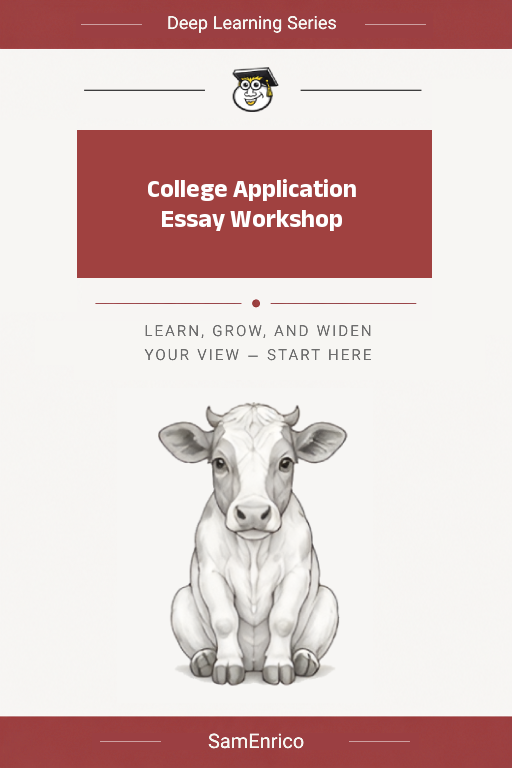
essaysAdmissions StrategyWriting Guide
College Application Essay Workshop eBook
Write authentic personal statements that admission
Write authentic personal statements that admissions officers remember. Includes brainstorming prompts, outline templates, and before-after examples.
Formats
Free sample
Chapter 1: The 650-Word Trap--The first thing you need to know about the college application essay is that nobody—not your English teacher, not your private counselor, not the stranger on Reddit who claims to have read ten thousand essays—nobody has told you the truth. Here it is: admissions officers do not read your essay the way you think they do. They do not curl up with a cup of coffee, muttering “bravo” after every graceful metaphor. They do not linger over your carefully chosen thesaurus words. They do not weep at your vulnerability and then stamp “ACCEPT” with a golden seal.They skim.
They hunt. They survive.Let me prove it to you.In 2023, the National Association for College Admission Counseling released a survey of admissions directors at over four hundred colleges. The result? The average time spent reading a personal statement is between three and five minutes. At highly selective schools receiving fifty thousand or more applications, that number drops to under three minutes.
At one Ivy League university, admissions officers reported spending an average of ninety seconds on the essay before making a decision about the entire file.Ninety seconds.Now add a second brutal truth: your essay has a hard limit of 650 words. That is not a suggestion. That is not a “we recommend.” That is a technical constraint built into the Common App text box. If you paste 651 words, the system rejects the entry. You could have written the next great American memoir in 651 words, and the Common App would delete the final word without sending you a condolence card.This chapter is not about teaching you how to write.
It is about teaching you how to win a game you did not know you were playing. The game has three rules, and once you understand them, the entire essay-writing process transforms from a vague, terrifying mystery into a predictable, manageable system.The Three Rules of the Essay Game Rule One: The Reader Is Exhausted Let me tell you about the person who will read your essay. Her name is Jenna (not her real name, but the composite of every admissions officer I have interviewed). It is January 15th. She has been reading applications since 8:00 AM.
It is now 7:00 PM. She has read fifty-seven personal statements today. She has a stack of sixty-three more to finish before she goes home. Her lower back hurts. She has not had caffeine since 2:00 PM because the line at the campus coffee shop was too long.
She has already read eight essays about winning the big game, twelve about mission trips, and five about grandparents who taught the applicant the meaning of hard work.She is not looking for the perfect essay. She is looking for the essay that makes her feel something other than tired.This is not cynicism. This is empathy. Admissions work is brutal. At universities that receive forty thousand applications, a single reader may be responsible for four hundred essays per week during peak season.
That means they are reading faster than you speak. They are pattern-matching, scanning for reasons to keep reading or reasons to stop.Here is what Jenna actually thinks when she opens your essay: “Please don’t be boring. Please don’t be the same as the last fifty. Please show me a human being.”The students who get into competitive colleges are not necessarily the best writers. They are the students who understood that Jenna is a human being with limited time, limited patience, and a deep desire to be surprised.Rule Two: The Essay Is Not a Resume This is the single most common mistake in the history of college admissions.
A student looks at the blank page, panics, and thinks: “I need to prove I am impressive.” So they write an essay that lists accomplishments. “I captained the debate team. I volunteered at the hospital. I won the science fair. I play three instruments.”The problem is that your resume already exists.
The Common App has a dedicated section for activities, awards, and test scores. When you repeat those accomplishments in your essay, you are not adding information. You are wasting the one opportunity you have to show something the numbers cannot capture.I call this the “Resume Repeat.” It is the fastest way to make Jenna put your essay down and move to the next file.Let me give you a concrete example. A student named Marcus applied to Northwestern University with a 4.3 GPA, a 1540 SAT, and a resume full of debate trophies. His first draft of the personal statement began: “As captain of my high school’s debate team, I learned that winning arguments requires listening as much as speaking.” That sentence cost him his chance.
Not because it was badly written—it was fine. It was fine in the worst possible way. It was fine in a stack of fifty other fine essays about leadership and lessons learned.Marcus was an interesting person. He collected vintage typewriters. He had repaired a 1967 Olivetti by watching You Tube videos at 2:00 AM.
He had a scar on his thumb from a stuck carriage return. None of that was in his essay because he assumed admissions officers wanted to hear about debate.They wanted to hear about the typewriter. They wanted to know why a sixteen-year-old would spend sixty dollars on a broken machine from a flea market. They wanted to know what it felt like to fix something that had been silent for thirty years.But Marcus wrote a Resume Repeat instead. And Marcus did not get in.Rule Three: Values Revelation Beats Achievement Listing If the Resume Repeat is the mistake, the Values Revelation is the solution.
A Values Revelation is an essay that answers one question: what do you care about, and how do you show that care in the world?Notice what this question does not ask. It does not ask for your grades. It does not ask for your awards. It does not ask for a list of everything you have done. It asks for evidence of your internal operating system—the principles, curiosities, and obsessions that drive you when no one is watching.Here is the difference in practice:Resume Repeat: “I have volunteered at the local food bank for three years, distributing groceries to families in need.”Values Revelation: “There is a woman named Delia who comes to the food bank every Tuesday.
She always asks for the same three things: rice, black beans, and the expired yogurt that nobody else wants. Last winter, she showed me a photo of her grandson’s fifth birthday party. She had not seen him in two years because his mother moved three states away. I do not remember how many cans I have stacked. I remember Delia’s hands—the way she holds a plastic bag like it might break.”Do you see the difference?
The first sentence tells me you are a good person. The second sentence shows me a specific moment of humanity, and in that showing, I learn that you are observant, empathetic, capable of noticing the unnoticed, and willing to remember someone’s name. Those are values. Those are revelations.The second sentence…
This is the end of the free sample. Get the eBook to keep going. Buy now
About this book
Details
- Author
- Lively Lakenya
- Publisher
- SamEnrico
- Language
- English
- Genre
- essays, Admissions Strategy, Writing Guide
- Released
- 2026-06-01
- Pages (approx.)
- 134
- Available as
- eBook, Audiobook

Read better in the ZLOADR app
Your eBooks on your phone or tablet. Sign in with your SamEnrico account and start reading.
More by Lively Lakenya
 Attempt Survivor Police StoryLively Lakenya$11.99
 School Project Parent Helper Time SaverLively Lakenya$11.99
 Canceled VoiceLively Lakenya$11.99
 High Carb Low Fat Vegan GuideLively Lakenya$11.99
 Forgiving After DivorceLively Lakenya$11.99
 The Ice Queen of Mexico: How a Housewife Built a Meth EmpireLively Lakenya$11.99
 How to Start a Cake Board Business (Beginners Guide)Lively Lakenya$11.99
 Small Business AI Tax Loss HarvestingLively Lakenya$12.99
 Understanding Neutropenia Monocytopenia DeafnessLively Lakenya$17.99
 Peoplesoft AdministratorLively Lakenya$11.99
You may also like
 YouTube Video Essay DepthLeon Lala$11.99
 TOEFL Independent Essay GuideMintz Alex$11.99
 Music Theory Essay GuideWilkinson Maisha$11.99
 Expository Essay AI PromptsApplegate Dalia$11.99
 Exam Essay MemorizationMcgovern Johna$11.99
 Compare Contrast Essay PromptsOntiveros Marx$11.99
 College Application Essay GuideSisson Aimee$11.99College Application Essay GuideSisson Aimee$11.99
 The 100 Word Essay ChallengeAli Luciana$11.99
 Journalism Essay PromptsThatcher Williemae$11.99
 Finance Essay PromptsShrader Lamont$11.99
 Cause Effect Essay GPT GuideBland Jacelyn$11.99