
Non-FictionHealth & WellnessCognitive
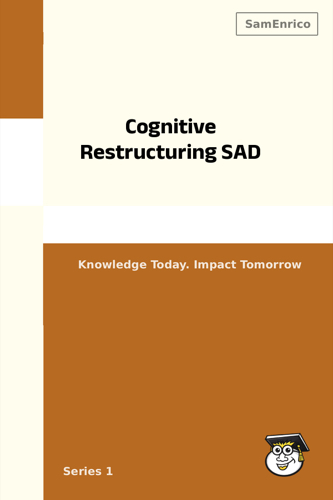
Cognitive Restructuring SAD eBook
Teaches challenging negative beliefs about social
Teaches challenging negative beliefs about social evaluation.
Formats
Free sample
Chapter 1: The Spotlight Illusion--–- You walk into the room. It could be anything—a birthday party, a team meeting, a coffee shop where you’re meeting someone new, or simply the office kitchen at 10 a.m. For a split second, everything feels normal. You reach for the door handle. You step inside.
And then it happens.The air changes. Or rather, your perception of the air changes. Suddenly, you feel as though every pair of eyes has swiveled toward you. You feel their gaze like a physical weight on your shoulders. Your heartbeat quickens.
You become acutely aware of your hands—what are you supposed to do with your hands? You scan for an empty seat, an exit, a bathroom, anything. You adjust your clothing even though it was fine three seconds ago. You feel exposed, as if you’re standing on a stage under a single blinding spotlight while the audience stares in silence.If you have social anxiety, you know this feeling intimately. It arrives without warning, often in the most ordinary situations.
And it brings with it a powerful, almost unshakable belief: Everyone is watching. Everyone is judging. And they are judging me negatively.Here is the first truth this book will ask you to consider, not as a platitude but as a testable hypothesis: That feeling is an illusion. Not a metaphor. Not a poetic exaggeration.
A literal, documented, scientific illusion.It is called the Spotlight Effect, and understanding it is the first step toward dismantling the cognitive machinery of Social Anxiety Disorder (SAD).The Science of Feeling Watched In the late 1990s, psychologists Thomas Gilovich and Kenneth Savitsky conducted a series of ingenious experiments at Cornell University. They asked college students to wear a potentially embarrassing T-shirt featuring a large image of the singer Barry Manilow—who, at the time, was considered distinctly uncool among the student population. The student wearing the shirt then entered a room full of other students.Afterward, the shirt-wearing student was asked: What percentage of the people in the room do you think noticed your shirt?The students estimated that around 50 percent of the people had noticed.In reality, only 23 percent had noticed.Let that sink in. The anxious students were wrong by more than double. They believed they were standing in a blazing spotlight when, in fact, most people were too distracted by their own thoughts, their own phones, their own mild hunger, their own fleeting worries about their own lives to care about a Barry Manilow T-shirt.This is the Spotlight Effect: our systematic tendency to grossly overestimate how much others notice and remember about us.
It is not a character flaw. It is not a sign of weakness. It is a cognitive bias—a predictable, measurable error in the way the human brain processes social information. And it is the foundation upon which social anxiety is built.The author of this book wants you to understand something crucial: You are not broken. You have a brain that evolved to detect social threats because, for your ancestors, being rejected by the tribe could mean death.
That ancient alarm system is still running, but it is now firing at false positives. It mistakes a neutral glance for a sneer, a yawn for a condemnation, a moment of silence for a catastrophe. Your job is not to eliminate the alarm. Your job is to learn to read the difference between a real fire and a flickering shadow.Actual Risk vs. Perceived Risk: The Crucial Distinction One of the most important distinctions this book will teach you is the difference between actual social risk and perceived social risk.Actual social risk is real, observable, and relatively rare.
Spilling a full glass of red wine onto a colleague’s white silk blouse at a company dinner? That is actual social risk. Accidentally insulting your partner’s parent at a family gathering? That is actual risk. Saying something so offensive that people actively avoid you afterward?
That is actual risk, and it requires a genuine repair attempt.Perceived social risk, on the other hand, is the creation of your anxious mind. It is the belief that pausing for two seconds before answering a question means everyone thinks you are stupid. It is the conviction that a slight tremor in your voice means everyone has labeled you weak. It is the certainty that walking across a quiet room means every eye is cataloging your flaws.Here is the liberating truth that emerges from the research on social anxiety: Most of the suffering in SAD comes from perceived risk, not actual risk. In study after study, when people with social anxiety are asked to record their feared predictions before a social event and then compare them to what actually happened, the vast majority of their predictions simply do not come true.
People do not laugh at them. People do not ostracize them. People do not even notice the vast majority of the "mistakes" the anxious person spent days worrying about.This chapter introduces the first of many tools you will use to test this for yourself. It is called the Prediction Log, and it is the most basic but most essential piece of data-collection equipment in your cognitive restructuring toolkit.Core Technique: The Prediction Log The Prediction Log is deceptively simple. Before any social event that triggers your anxiety, you will write down three things:The event (be specific: "Lunch with two coworkers" rather than "socializing")Your specific fear-based predictions (not "something bad will happen" but concrete, testable predictions like "I will run out of things to say within two minutes" or "Someone will comment on how quiet I am")Your anxiety level (on a scale of 0 to 100, just to have a baseline)Then, after the event, you will return to the log and write down:What actually happened (be honest and specific)Your revised anxiety level That is it.
No complicated scoring system. No jargon. Just a simple before-and-after comparison.Here is a completed example from a real person who struggled with social anxiety at work:Event: Team meeting, 10 a.m., conference room BPredictions made beforehand:"I will be asked a question I can't answer, and everyone will see how incompetent I am.""My voice will shake when I speak, and people will notice.""I will say something stupid and spend the rest of the day replaying it."Anxiety level beforehand: 85/100What actually happened:I was asked exactly one question. I knew the answer. I answered it.My voice was a little quieter than I wanted, but no one commented.I said one thing that was a bit rambling, but the meeting moved on immediately.Anxiety level afterward: 40/100Notice what happened here.
The anxious brain predicted catastrophe. Reality delivered something between neutral and fine. The gap between prediction and outcome is where recovery lives. Every time you collect this kind of data, you are giving your brain evidence that contradicts its threat predictions. And over time, the brain begins to update its models.
It learns, slowly and grudgingly, that the world is safer than the alarm system believes.Anticipatory Processing: The Week of Dread The Prediction Log is powerful, but it addresses only one…
This is the end of the free sample. Get the eBook to keep going. Buy now
About this book
Details
- Author
- Cambell Tyesha
- Publisher
- SamEnrico
- Language
- English
- Genre
- Non-Fiction, Health & Wellness, Cognitive
- Released
- 2026-06-05
- Pages (approx.)
- 141
- Available as
- eBook, Audiobook

Read better in the ZLOADR app
Your eBooks on your phone or tablet. Sign in with your SamEnrico account and start reading.
More by Cambell Tyesha
 Workaholic Support GroupsCambell Tyesha$11.99
 Small Talk for Meeting Partners ParentsCambell Tyesha$11.99
 GAD And Health EmergenciesCambell Tyesha$11.99
 Caregiver Burnout Recovery MemoirCambell Tyesha$11.99
 The Relationship Anger GuideCambell Tyesha$11.99
 The Abstinence Commitment GuideCambell Tyesha$11.99
 Harassment Reporting ScriptCambell Tyesha$11.99
 The Last Whale Hunters: A Vanishing Tradition in the ArcticCambell Tyesha$11.99
 Scharnhorst: The Iron Architect of PrussiaCambell Tyesha$11.99
 How to Produce Hobbies and Creative Arts ProductsCambell Tyesha$11.99
 Accountability Partner Advisor RoleCambell Tyesha$12.99
 Bulgaria Low Cost Master'sCambell Tyesha$12.99
You may also like
 Hong Kong Handover 1997Dunn Johnnie$11.99
 Zumba For Postnatal Recovery CourseNeal Christian$11.99
 Zumba for BeginnersLadner Nikia$11.99
 YouTube Comment Mining GuideHumes Pandora$12.99
 Worry Box MeditationCarlin Rudy$11.99
 Workplace Stress MeditationNguyen Lynn$11.99
 Workplace Stress and Sleep RepairHawley Ivory$11.99
 Workplace Perfectionism CureDelaney Jeffry$11.99
 Workplace Injustice Anger GuideWallen Isabelle$11.99
 Work Addiction and Burnout LinkGreenwood Ester$11.99
 Women in Yoga and WellnessBeattie Galina$11.99
 Women in Stand Up ComedyChun Evangeline$11.99